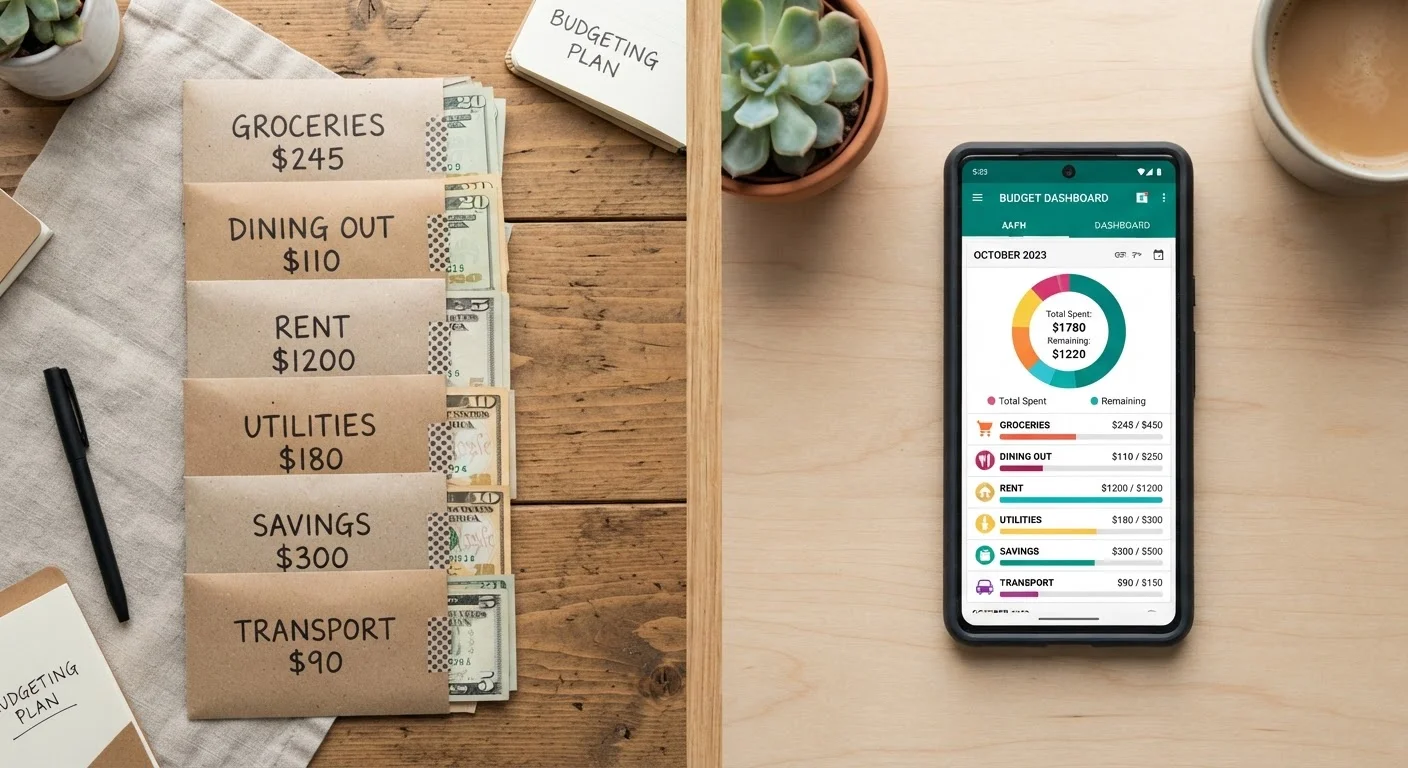
How Each Method Actually Works
Envelope budgeting is straightforward: at the start of each pay period, you withdraw cash and divide it into labeled envelopes - groceries, gas, dining out, entertainment, and so on. When an envelope is empty, spending in that category stops until the next cycle. No apps, no syncing, no dashboards. The limit is literal.
Digital spending trackers take the opposite approach. Rather than constraining spending in advance with cash, they record what you've already spent. Most apps connect to your bank accounts and credit cards, categorize transactions automatically, and display your totals against any budget limits you've set. You can see in real time whether you're on track - but the money remains in your account, accessible.
Understanding your personal spending patterns before choosing a method matters. Someone with a subscription-heavy, card-dependent lifestyle will find envelope budgeting genuinely inconvenient. Someone who blows through a grocery budget without noticing may need the hard ceiling that only cash provides.
| Criterion | Envelope Budgeting | Digital Spending Trackers |
|---|---|---|
| Spending medium | Cash only | Cards, bank accounts, any |
| Setup effort | Withdraw and divide cash | Link accounts, set categories |
| Real-time limit enforcement | Hard - empty envelope = stop | Soft - alerts only, money still accessible |
| Impulse spending friction | High - physical cash constraint | Low - no barrier at point of purchase |
| Reporting & trend data | None - manual tracking only | Rich charts and history |
| Works for online purchases | No | Yes |
| Security risk | Lost cash unrecoverable | Data privacy considerations |
| Best habit-building stage | Early - builds awareness fast | Ongoing - sustains long-term insight |
The Psychology Behind Each Approach
Research in behavioral economics consistently finds that paying with cash feels more painful than swiping a card - a phenomenon sometimes called the "pain of paying." When money is physical and finite, people tend to spend more deliberately. Envelope budgeting weaponizes this effect on purpose. The act of handing over cash - and watching an envelope thin out - creates a feedback loop that digital transactions don't replicate.
Digital trackers work on a different psychological lever: awareness. Many people genuinely don't know where their money goes until they see it categorized in a report. An app that shows you spent $340 on dining last month when you thought it was closer to $150 can be a motivating revelation. That awareness can shift behavior - but only if you act on it.
This is the core tension. Envelope budgeting changes behavior at the point of purchase. Digital tracking changes behavior at the point of review - which may be days or weeks later. If you're prone to emotional or impulse spending, in-the-moment friction tends to be more effective than after-the-fact data.
~33%
Americans with no monthly budget
Federal Reserve surveys consistently find a substantial share of U.S. adults have no formal spending plan, underscoring why choosing any system matters.
12-18%
Typical subscription spend underestimation
Consumer research suggests people routinely underestimate their recurring subscription costs by a meaningful margin - a gap digital trackers help expose.
Higher
Pain of paying with cash vs. cards
Behavioral economics studies indicate that cash transactions activate stronger loss-aversion responses than equivalent card payments, supporting the envelope method's effectiveness.
Practical Trade-Offs Worth Knowing
Envelope budgeting has real limitations. Carrying cash is inconvenient for online purchases, automatic bill payments, and subscriptions. It also creates a security concern - lost or stolen cash isn't recoverable. For households with complex finances, managing a dozen physical envelopes becomes cumbersome.
Digital trackers have their own friction points. Automatic categorization is imperfect; apps frequently miscategorize transactions, and fixing errors requires time and attention. More importantly, having a perfectly labeled budget in an app doesn't prevent you from spending - the money is still there. For people who struggle with impulse control, the app becomes a scoreboard for losses rather than a guard rail.
A hybrid approach can address both weaknesses. Use a digital tracker for your full financial picture - fixed expenses, savings transfers, overall cash flow - while applying the envelope method only to your two or three highest-risk spending categories. This keeps the convenience of digital tracking while preserving the behavioral constraint where it matters most. Consider pairing either method with a monthly budget audit to catch drift before it compounds.
For guidance on building habits that hold regardless of which system you choose, see budgeting habits that actually stick.
This article is for general informational purposes only and does not constitute personalized financial advice. Consult a qualified financial professional for guidance specific to your situation.