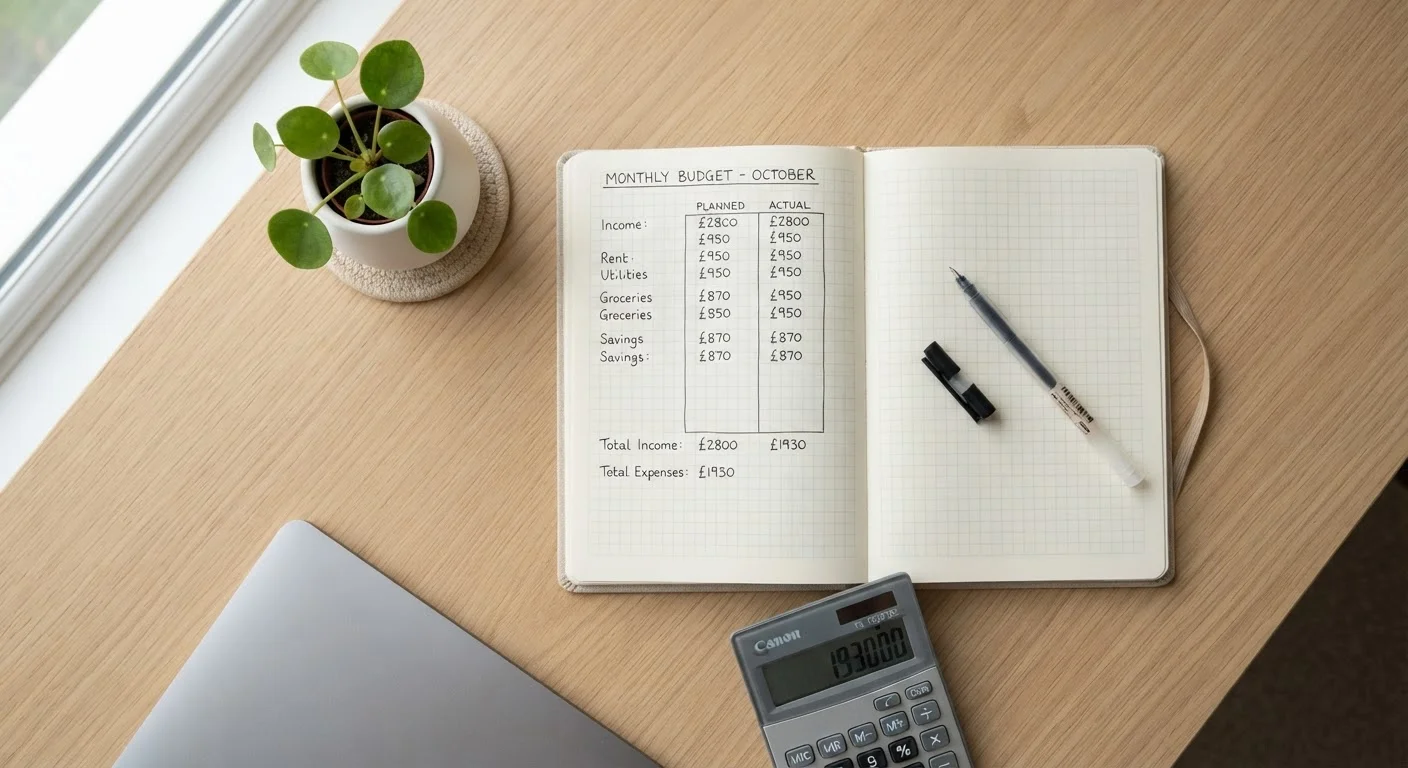
Why Budgeting Is the Starting Point
Most people treat budgeting as a restriction - a list of things they can't spend money on. In practice, a budget is the opposite: it's a plan that tells your money where to go before it disappears. Without one, saving happens by accident, debt compounds quietly, and long-term goals remain abstract wishes.
The foundational role of a budget is visibility. When you know exactly what comes in and what goes out each month, you can make deliberate decisions rather than reactive ones. That clarity is where financial progress begins - regardless of income level.
If you're just getting started, the introductory guide to saving and debt walks through the core concepts without jargon. The Saving & Debt hub also provides a structured path from fundamentals to more advanced planning.
~32%
Americans with a written monthly budget
Surveys consistently find that fewer than one in three U.S. adults maintains a formal written budget, despite widespread acknowledgment that one is useful.
$5,700+
Average U.S. household credit card balance
Federal Reserve data indicates the average revolving credit card balance carried by American households exceeds $5,700, underscoring the scale of consumer debt.
3-6 months
Recommended emergency fund coverage
Financial planners broadly recommend maintaining three to six months of essential living expenses in an accessible savings account.
Core Budgeting Methods Explained
There is no single correct way to budget. The method that works is the one you'll actually maintain. Here are three practical frameworks:
The 50/30/20 Rule
Allocate 50% of after-tax income to needs (housing, groceries, utilities), 30% to wants (dining out, subscriptions, entertainment), and 20% to savings and debt repayment. It's a flexible starting point, especially for beginners who want broad guidance without tracking every dollar.
Zero-Based Budgeting
Every dollar of income is assigned a job - expenses, savings, or debt payments - until the balance reaches zero. This method demands more attention but produces the clearest picture of where money actually goes. It's particularly effective if you've noticed unexplained month-end shortfalls.
Envelope Budgeting
Spending categories get a fixed cash allocation each month. Once an envelope is empty, spending in that category stops. Originally a physical system, digital versions now exist in several apps. It works well for categories like groceries or dining where overspending tends to be habitual.
When choosing a budgeting method, start with the one that requires the least setup - you can always add complexity later. A simple percentage framework practiced consistently outperforms a detailed system abandoned after two weeks.
Behavioral research on habit formation consistently shows that simplicity at the outset improves long-term adherence to new financial routines.
Automate your savings transfer on payday, before any discretionary spending occurs. Treating savings like a non-negotiable bill removes the decision - and the temptation - entirely.
Automating savings contributions removes reliance on willpower, which is a finite resource. Pay-yourself-first systems produce stronger savings outcomes over time compared to saving whatever remains at month's end.
How Your Budget Feeds Your Emergency Fund
An emergency fund - typically three to six months of essential expenses - is the buffer that prevents a car repair or medical bill from becoming new debt. But it doesn't build itself. It requires a dedicated line item in your budget, treated with the same non-negotiable status as rent.
Start smaller if the full target feels unreachable. A $500 to $1,000 starter fund covers most common financial surprises and meaningfully reduces the risk of turning to credit cards in a crisis. Once that baseline is in place, you can grow it gradually while simultaneously addressing debt.
For a detailed look at balancing both at once, see paying off debt while saving at the same time.
This article is for general informational purposes only and does not constitute personalized financial advice. Consult a qualified financial professional for guidance specific to your situation.
Connecting Your Budget to Debt Payoff
Debt repayment belongs in your budget as a specific, sized commitment - not whatever's left over at the end of the month. Two well-known payoff strategies can help structure that commitment:
- Avalanche method: Pay minimums on all debts, then direct extra funds to the highest-interest balance first. Mathematically, this minimizes total interest paid over time.
- Snowball method: Pay minimums on all debts, then focus extra payments on the smallest balance first. The psychological wins from eliminating accounts quickly can sustain motivation.
Neither method works without a budget that identifies how much extra can realistically be directed toward debt each month. Even an additional $50 per month accelerates payoff meaningfully on most consumer debt balances.
High-interest debt - typically credit cards carrying balances at rates above 15% - generally warrants prioritization because the compounding cost erodes other financial progress. The complete picture of saving and debt covers how to sequence these priorities over time.
Budgeting for Long-Term Goals
Retirement contributions, a home down payment, a child's education fund - these goals feel distant until they don't. The only reliable way to fund them is to make them recurring line items in a current budget rather than intentions addressed someday.
Start by naming the goal and estimating its cost and timeline. A $20,000 down payment needed in four years requires setting aside roughly $420 per month. That number either fits the budget or prompts a trade-off decision - which is exactly the right conversation to have now rather than later.
For workplace retirement accounts, contributing at least enough to capture any employer match is often considered a baseline worth prioritizing early, since the match represents an immediate return on the contribution. Note that tax treatment of contributions varies by account type; a tax professional can clarify what applies to your situation.
The Money Mindset hub explores the habits and attitudes that support sticking to long-term financial plans when short-term pressures arise.
Keeping the System Working Month to Month
A budget written once and never revisited stops reflecting reality quickly. Life changes - income shifts, expenses appear, goals evolve. A brief monthly review, typically 15 to 30 minutes, is enough to catch drift before it compounds.
During a review, check three things: Did spending match the plan? Are savings and debt payments on track? Does the budget need to change for the coming month? The monthly budget reset checklist provides a structured walkthrough for this process.
Irregular income adds complexity but doesn't make budgeting impossible. One approach: budget from your lowest expected monthly income and treat anything above that as a deliberate allocation - extra debt payment, savings boost, or a short-term goal. This prevents lifestyle expansion from absorbing income increases before they can do meaningful work.
The goal isn't a perfect budget - it's a consistent practice that keeps your spending, saving, and debt repayment connected to what you actually want your financial life to look like.