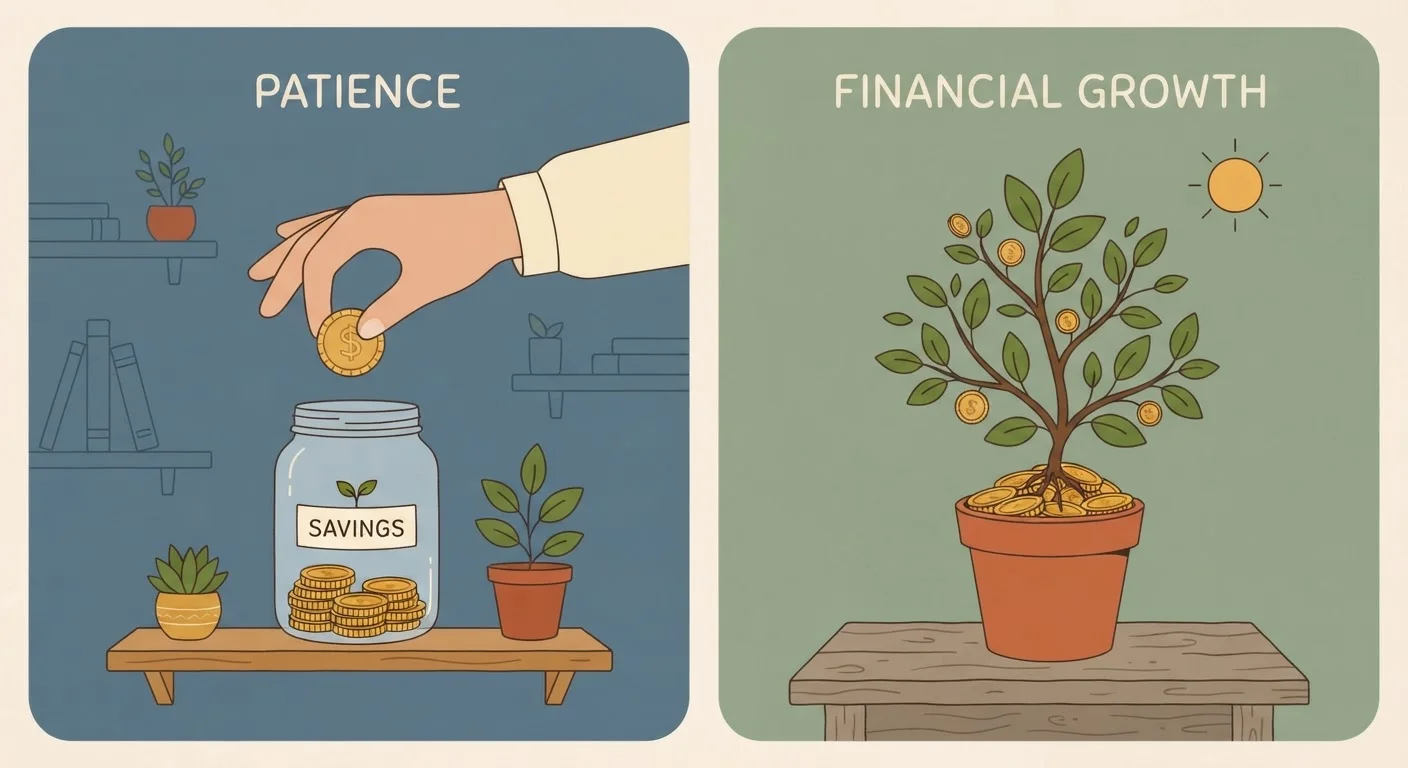
Why Patience Predicts More Than Willpower
Decades of research in behavioral psychology and economics have produced a consistent finding: the ability to delay immediate rewards is one of the strongest behavioral predictors of long-term financial health. It outperforms income level as a predictor of savings accumulation in several longitudinal studies - a finding that continues to reshape how financial educators think about money habits.
The most widely cited early work involves experiments where children were offered a small reward immediately or a larger one if they waited. Follow-up studies tracked those same participants into adulthood, finding that those who waited longer tended to have better outcomes across a range of measures, including financial stability. The research has been refined and debated since, with later studies adding important nuance: environment, trust, and economic security all shape a person's ability to wait. But the core behavioral link remains credible and well-documented.
For everyday financial decisions, the implication is practical. Whether you're weighing a purchase against a savings goal, or considering whether to pay down debt or spend a tax refund, you're making an intertemporal trade-off - a choice between now and later. Your habitual response to those moments, repeated across years, largely determines your financial trajectory.
~70%
Americans with less than 3 months emergency savings
Federal Reserve surveys on household economic well-being have consistently found that a significant majority of U.S. adults would struggle to cover a major unexpected expense - a gap closely linked to low savings rates.
2-3x
Wealth differential linked to savings behavior vs. income
Research in household finance, including studies drawing on Survey of Consumer Finances data, suggests that consistent savings behavior explains wealth gaps between households at similar income levels by a factor of two or more.
24-48 hrs
Cooling-off period that reduces impulse purchases
Consumer behavior research suggests that introducing a short waiting period before non-essential purchases significantly reduces the likelihood of completing those purchases.
The Brain's Role: How Immediate Rewards Win by Default
Human brains are wired to respond more strongly to immediate, concrete rewards than to abstract future ones. This is sometimes called 'present bias' - a tendency to overvalue what's available now compared to what's available later, even when the later reward is objectively larger. It's not irrationality in a simple sense; it's a deeply ingrained cognitive pattern shaped by evolutionary history.
This is why knowing that saving is important doesn't automatically translate into saving. The emotional pull of a present reward - a purchase, a meal out, a subscription upgrade - often overpowers the abstract satisfaction of a growing bank balance. Understanding this gap between intention and behavior is the starting point for addressing it.
Financial stress amplifies the problem. Research in behavioral economics, including work associated with scholars like Sendhil Mullainathan and Eldar Shafir, suggests that scarcity - of money, time, or security - consumes cognitive bandwidth in ways that make long-term thinking harder. This is not a moral failing; it's a documented psychological mechanism. It also means that structural supports matter more than motivation, especially for people navigating tight financial circumstances. For a deeper look at how identity and behavior interact, see the behavioral science behind lasting financial habits.
Practical Strategies That Work With Your Psychology
The most effective approaches to building financial patience don't ask you to overpower your instincts - they work around them.
- Automate first. Setting up automatic transfers to savings or retirement accounts before you have access to the money removes the decision entirely. You never experience the trade-off in real time.
- Introduce a pause rule. A 24- or 48-hour waiting period before non-essential purchases gives the initial impulse time to fade. Many purchases that seem urgent become less compelling after a short delay.
- Make future goals concrete. Vague goals like 'save more' are easy to defer. Specific ones - 'save $3,000 for an emergency fund by next spring' - activate more deliberate decision-making because the future reward becomes easier to visualize.
- Celebrate small wins. Behavioral research consistently shows that visible progress reinforces continued effort. Tracking milestones, even modest ones, builds the momentum that sustains long-term habits.
These strategies align with what researchers call 'commitment devices' - structures you put in place in advance that make the desired behavior easier and the undesired behavior harder. They're the financial equivalent of not keeping junk food in the house.
Start With Structure, Not Motivation
Motivation fades; systems persist. Rather than relying on willpower to make the patient choice each time, build structures that make saving the default - automatic transfers, separate savings accounts for specific goals, and a simple pause rule for discretionary spending. These tools work even on days when financial discipline feels hardest. For help building those systems from the ground up, see budgeting habits that actually stick.
Connecting Patience to Broader Financial Outcomes
The financial benefits of sustained delayed gratification compound over time in ways that are difficult to fully appreciate in the moment. A person who consistently saves even a modest portion of their income, avoids high-interest debt, and resists lifestyle inflation as earnings grow can build meaningful financial resilience - regardless of a high starting salary.
This doesn't mean that income and systemic factors don't matter - they do, significantly. But within a given set of circumstances, behavioral patterns consistently explain a substantial portion of variation in financial outcomes. Research on savings behavior across income levels regularly finds that the habit of saving - even small amounts - predicts wealth accumulation more reliably than income alone. For more on this, the habits that help people build savings on a modest income article is a useful companion read.
It's also worth noting the role of values and upbringing. The money attitudes formed in childhood - often absorbed from family behavior and cultural context - shape how easily delayed gratification comes to us as adults. If you'd like to understand those roots, how financial values form across generations offers useful context. And if you're looking for a concrete starting point, developing a consistent savings habit addresses the behavioral side of starting from scratch.
This article is for general informational and educational purposes only and does not constitute personalized financial advice. For guidance specific to your situation, consult a licensed financial professional.