The Problem With Calories as a Lone Metric
Counting calories became the dominant framework for thinking about food over the latter half of the twentieth century. It's a tidy number - easy to track, easy to compare. But a calorie count answers only one question: how much energy does this food provide? It says nothing about whether that energy comes packaged with nutrients your body actually needs to function.
Consider two foods with 200 calories each. A handful of mixed nuts delivers that energy alongside healthy fats, magnesium, vitamin E, fiber, and protein. Two hundred calories of a heavily processed snack cake delivers roughly the same energy alongside a short list of refined ingredients. Calorie-for-calorie, these are not equivalent foods - yet calorie counting treats them as if they were.
This gap is exactly what the concept of nutrient density is designed to address. As our article on calories versus nutrients explains, energy and nutrition are not the same conversation.
~57%
Of US calories from ultra-processed foods
Research published in the journal BMJ Open estimated that ultra-processed foods account for a majority of daily caloric intake in the average American diet, often displacing more nutrient-dense options.
4 in 10
Americans fall short on dietary fiber
According to USDA dietary data, dietary fiber is among the most consistently under-consumed nutrients in the US, despite being widely available in fruits, vegetables, legumes, and whole grains.
90%+
Of Americans under-eat vegetables
The Dietary Guidelines for Americans report that the vast majority of American adults do not meet recommended vegetable intake - one of the food groups most strongly associated with high nutrient density.
How Nutrient Density Actually Works
Nutrient density is essentially a ratio: beneficial nutritional content divided by caloric content. A food rates high when it provides substantial amounts of essential nutrients - vitamins, minerals, dietary fiber, quality protein, beneficial fats - relative to its calorie load. It rates low when its calories are largely unaccompanied by those essentials.
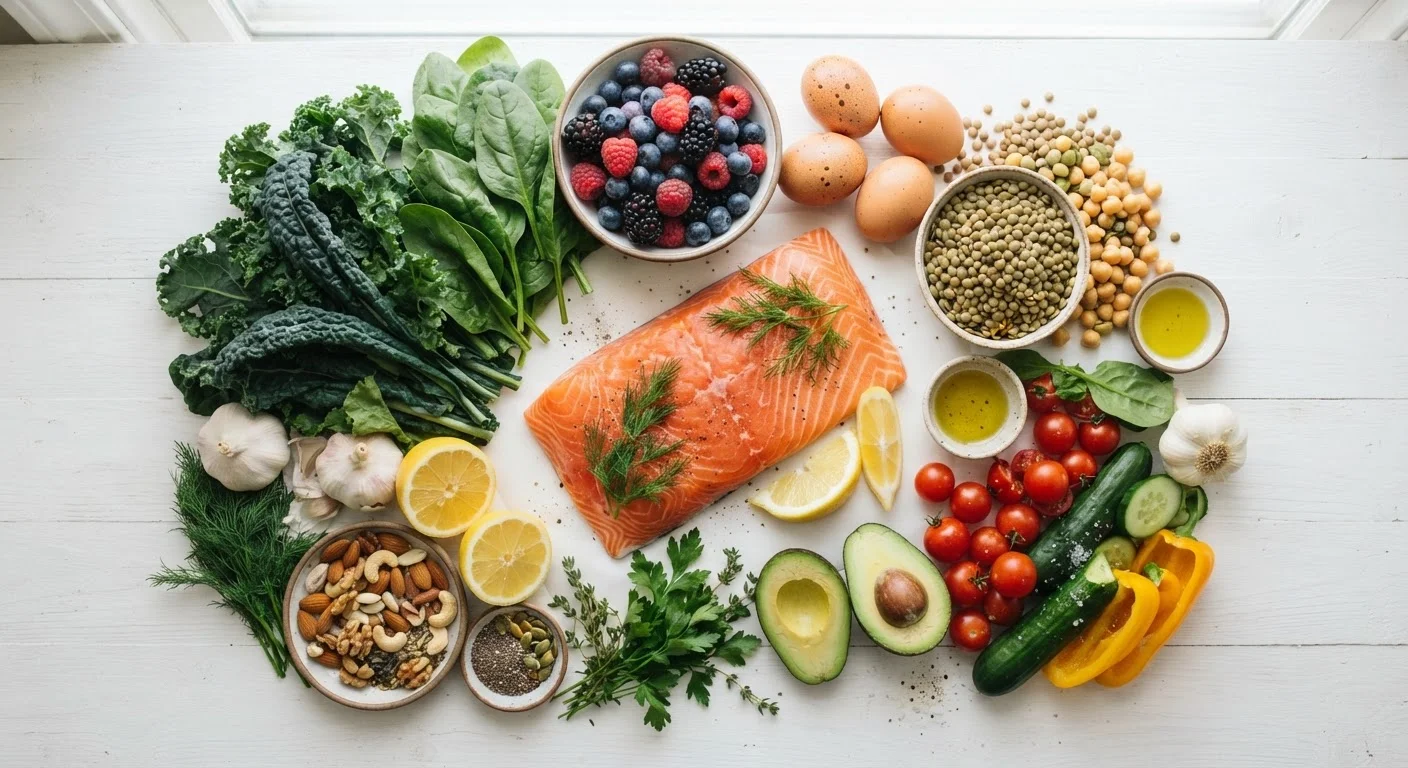
Leafy greens are a classic high-density example. A large serving of spinach or kale delivers significant amounts of vitamin K, folate, iron, calcium, and antioxidants for very few calories. On the opposite end, many ultra-processed foods supply a large share of their calories from refined carbohydrates and added fats with minimal micronutrient return.
Importantly, nutrient density doesn't mean a food has to be low in calories overall. Salmon is relatively calorie-dense but also extraordinarily nutrient-rich, providing high-quality protein, omega-3 fatty acids, B vitamins, and selenium. The goal is not to minimize calories but to maximize what each calorie brings with it.
A Simple Way to Apply Nutrient Density Daily
When choosing between two similar foods, ask: which one delivers more vitamins, minerals, fiber, or protein for roughly the same calories? You don't need to calculate a score - just ask whether the food brings something meaningful with it. Over time, this habit builds a more nourishing diet without the mental overhead of tracking numbers. Learning to read a Nutrition Facts label can support this process when buying packaged foods.
Why This Lens Makes Practical Eating Easier
Shifting focus from calorie arithmetic to nutritional value tends to make day-to-day food decisions more intuitive. Rather than calculating a number for every meal, the guiding question becomes simpler: does this food do something useful for my body?
This reframe also tends to steer eating patterns toward whole foods naturally - vegetables, legumes, whole grains, eggs, fish, nuts, and seeds - because those foods consistently score well on nutritional return. It moves the conversation away from restriction and toward abundance of quality.
Population-level nutrition data consistently shows that many American diets fall short on a cluster of key nutrients despite adequate or even excessive calorie intake. Common gaps include fiber, potassium, magnesium, and vitamins D and E. Our article on nutrient gaps that creep into reasonable diets covers which shortfalls appear most frequently - even among otherwise well-intentioned eaters.
Understanding which foods deliver the most nutrition per calorie gives you a durable framework that doesn't require apps, obsessive logging, or rigid rules. It's a mindset that supports long-term dietary health over any single metric.
This article is for general informational and educational purposes only and is not a substitute for professional medical or nutritional advice. Consult a qualified healthcare provider or registered dietitian for guidance tailored to your individual health needs.