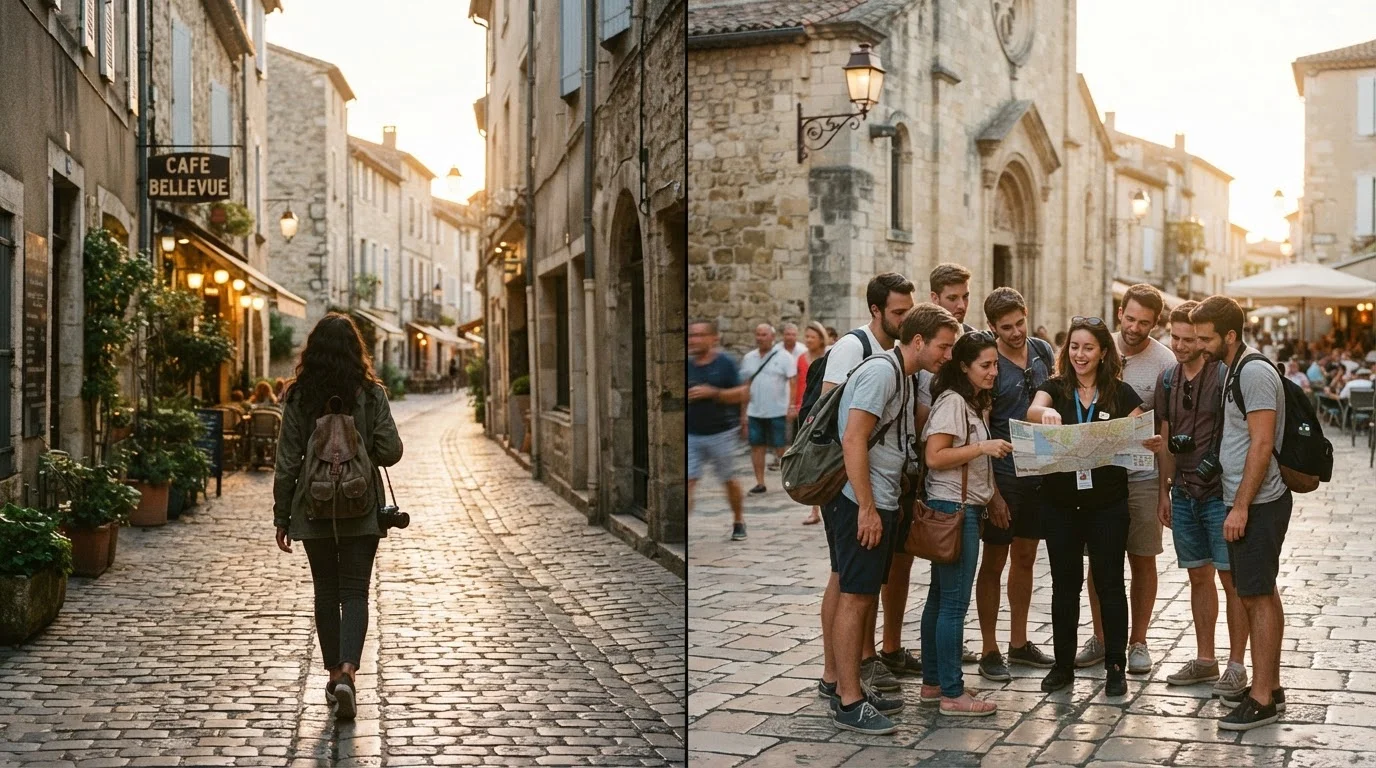
The Core Trade-Off: Freedom vs. Structure
Choosing between solo travel and a group tour is fundamentally a question of what you're optimizing for. Solo travelers trade support and social ease for autonomy. Group tour participants trade flexibility for convenience and guided access.
Neither approach is universally better. The right fit depends on your comfort with uncertainty, how much planning energy you're willing to invest, and what you actually want out of the trip. As our guide to flexible vs. fixed itineraries explores, your travel style preferences often reveal which model suits you before you even pick a destination.
Understanding the concrete differences - in cost, safety, social dynamics, and planning burden - is the best place to start.
| Criterion | Solo Travel | Group Tours |
|---|---|---|
| Itinerary flexibility | Complete control | Fixed schedule |
| Planning burden | High - all on you | Low - handled by operator |
| Social connection | Self-initiated | Built in |
| Safety support | Limited, self-managed | Group and guide present |
| Cost predictability | Variable, customizable | Bundled, upfront |
| Pace of travel | Set by you | Set by group |
| Cultural depth | Depends on your research | Guided interpretation included |
| Best for newcomers | Moderate to experienced travelers | All experience levels |
Planning and Logistics: Who Does the Work?
Solo travel puts every decision in your hands. You research destinations, book accommodations, navigate transportation, and troubleshoot when plans change. This can be deeply satisfying - but it's also time-consuming and can feel overwhelming, especially in countries with language barriers or complex transit systems.
Group tours offload most of that work. A tour operator handles transportation between sites, hotel arrangements, and often meals. That convenience has real value, particularly for travelers who have limited vacation time and want to spend it exploring rather than coordinating. The trade-off is that the itinerary is set - you go where the group goes, at the group's pace.
First-time international travelers, in particular, often find that a group tour provides a useful orientation before attempting a destination independently. For a grounded introduction to going it alone, see our guide to solo travel in the US.
~25%
Solo travelers who are first-timers
Industry research from the Adventure Travel Trade Association suggests roughly one in four solo travelers is embarking on their first independent trip.
72%
Group tour travelers citing logistics as primary reason
Surveys of organized tour participants consistently cite simplified logistics and safety as the top reasons for choosing guided travel over independent arrangements.
3-5 days
Average planning time saved with a group tour
Travel industry estimates suggest organized tours can reduce pre-trip research and booking time by several days compared to fully independent itinerary planning.
Safety, Cost, and Social Dynamics
Safety: Solo travelers - particularly those unfamiliar with a destination - take on more risk by default. There's no built-in support system if something goes wrong, and navigating medical issues, theft, or route changes alone is more demanding. That said, many solo travelers manage this well through careful preparation, staying in well-reviewed accommodations, and staying alert. Be aware that safety conditions vary widely by destination, and official government travel advisories should always be consulted before departure.
Cost: Group tours often include substantial amenities in a single price, which can simplify budgeting. However, solo travelers can frequently find more flexible pricing, avoid single-supplement fees by staying in hostels or shared accommodations, and skip paid activities that don't interest them. There's no blanket answer on which costs more - it depends heavily on the destination, travel style, and tour tier.
Social experience: Traveling alone doesn't mean being lonely, but it does require more initiative to connect with others. Group tours, by contrast, create an immediate social environment. Some travelers find this energizing; others find a fixed group dynamic limiting. It's worth honestly assessing which scenario you'd find more comfortable.
For a broader look at assumptions many travelers carry into their trip planning, our piece on common travel myths is worth reading before you commit to either approach.
How to Decide: Matching the Approach to the Trip
Many seasoned travelers don't choose one model permanently - they use both strategically. A traveler might join a structured tour for a dense, complex destination like a country with significant language barriers or logistical challenges, then travel solo through somewhere more navigable on the same trip.
Ask yourself these questions before deciding:
- How much does spontaneity matter to me on this specific trip?
- Am I comfortable handling unexpected disruptions alone?
- Do I want deep social engagement built into the trip, or do I prefer solitude with occasional connection?
- How familiar am I with the destination's language, culture, and infrastructure?
Your answers will likely point clearly in one direction. The Trip Planning hub has additional frameworks to help you think through destination-specific decisions, from transport mode to packing strategy.
This article provides general travel information for educational purposes. Entry requirements, safety conditions, and travel advisories change frequently - always verify current details with official government sources and your travel provider before departing.