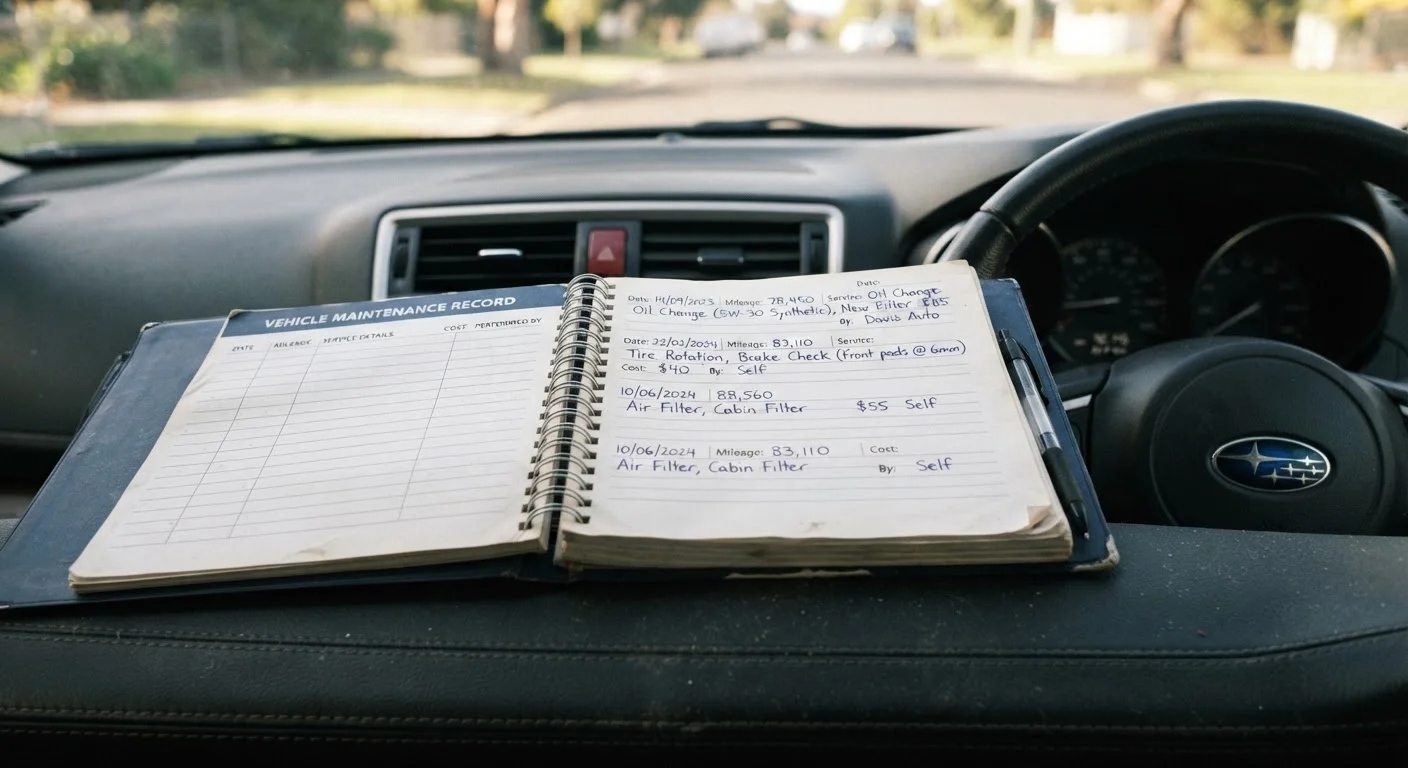
What a Maintenance Log Actually Does for You
A vehicle maintenance log is a running record of every service, repair, and inspection your car has received - oil changes, tire rotations, brake jobs, fluid top-offs, and anything in between. At its most basic, it's a dated list with mileage readings. At its most useful, it's a timeline that tells you exactly where your vehicle stands.
Without a log, you're relying on memory or scattered receipts stuffed in a glove box. Memory fades, and receipts disappear. A log consolidates that history into one place, making it easy to know when your next service is due and what was done at your last visit. For drivers who use independent shops, switch mechanics, or do some of their own work, this continuity is especially valuable - no single shop has the full picture unless you do.
Think of it as a medical record for your car. When something goes wrong, a complete service history helps a mechanic diagnose the problem faster. When nothing is wrong, it gives you confidence you're staying ahead of wear. See our primer on how key vehicle systems work if you want context on what's actually happening under the hood.
Best Practices for Keeping Your Log
How you keep the log matters less than keeping it at all. Here are the practices that make a maintenance log genuinely useful rather than just a box-checking exercise.
Record every service at the time it happens, not weeks later.
Details go stale quickly - mileage readings, part numbers, and fluid types are easy to misremember. Logging immediately means the record is accurate and complete. Delayed entries often get skipped entirely.
Include mileage alongside the date for every entry.
Most service intervals are mileage-based, not calendar-based. Without odometer readings, you can't reliably calculate when your next oil change, tire rotation, or transmission service is due.
Log repairs and parts, not just routine maintenance.
Knowing that a specific component was replaced - and with what - is critical for warranty claims, pattern recognition, and resale documentation. Routine-only logs leave gaps that matter.
Keep receipts and attach them to your log or store them in a labeled envelope.
A log entry is your summary; receipts are the supporting evidence. If a part fails within a warranty window or a buyer asks for proof, receipts close the loop that memory and notes alone cannot.
Note any symptoms, warning lights, or odd behavior, even if no repair was done.
Intermittent problems are notoriously hard to diagnose. A timestamped note that a particular warning light appeared twice in cold weather gives a mechanic meaningful diagnostic context later.
The Long-Term Payoff: Resale Value and Pattern Recognition
~$1,200
Average annual vehicle maintenance and repair cost per U.S. driver
According to AAA's annual driving cost studies, unexpected repairs represent a significant share of that total - costs a log can help anticipate.
Up to 15%
Potential increase in private resale price with documented service history
Consumer research consistently shows that buyers assign measurable value to verifiable maintenance records when evaluating used vehicles.
One of the most overlooked benefits of a maintenance log is what it reveals over time. When you can look back at two years of entries, patterns emerge. If you've replaced the same belt twice in 18 months, that's a signal - possibly a misaligned pulley or a systemic issue. Without a log, that pattern stays invisible until a more expensive failure forces the issue.
The resale benefit is equally real. Buyers, whether private or dealers, are taking on unknown risk when they purchase a used vehicle. A thorough, legible maintenance log reduces that uncertainty. It signals that the car was cared for by someone organized and proactive - and that perception carries weight in negotiation. Even if you can't prove every service was done, the ones you can document tell a story of ownership discipline. This connects directly to the habits that quietly shorten a vehicle's lifespan - a log makes those habits visible and correctable before damage accumulates.
If you're planning a longer drive, a current log also helps you confirm that your vehicle is actually ready. Cross-reference it against the pre-trip checklist for long road trips to make sure nothing has been missed before you leave.