Why Intersection Rules Trip Up Even Experienced Drivers
Intersection errors are among the most common causes of traffic crashes in the United States. The problem isn't that drivers don't know a rule exists - it's that they misremember it, misapply it, or freeze when the situation doesn't match their mental picture. Roundabouts confuse drivers used to four-way stops. Yield signs get treated like optional suggestions. Two cars arrive at a stop at the same moment and neither moves - or both do.
This reference covers the three situations that generate the most real-world confusion: roundabouts, four-way stops, and yield signs. Knowing exactly how each works takes the guesswork out of your next approach.
Four-Way Stops: The Order That Ends the Standoff
A four-way stop (also called an all-way stop) requires every driver to stop completely before proceeding. The order of movement follows a clear hierarchy:
- First to stop, first to go. Whoever arrived and stopped first has the right of way.
- Tie in arrival? Yield to the right. If two vehicles stop simultaneously, the driver on the left yields to the driver on the right.
- Facing traffic goes before turning traffic. If you're going straight and an opposing driver is turning left, you go first.
- Right turns before left turns when other factors are equal.
The most important detail people overlook: you must come to a complete stop, not a rolling slow-down. A full stop is both legally required and necessary to accurately judge who arrived first.
Right of way
The legal entitlement of a vehicle or pedestrian to proceed through a space before others. It is granted by traffic law, not taken unilaterally.
All-way stop
An intersection where every approach has a stop sign, requiring each driver to stop fully before proceeding in order of arrival.
Roundabout
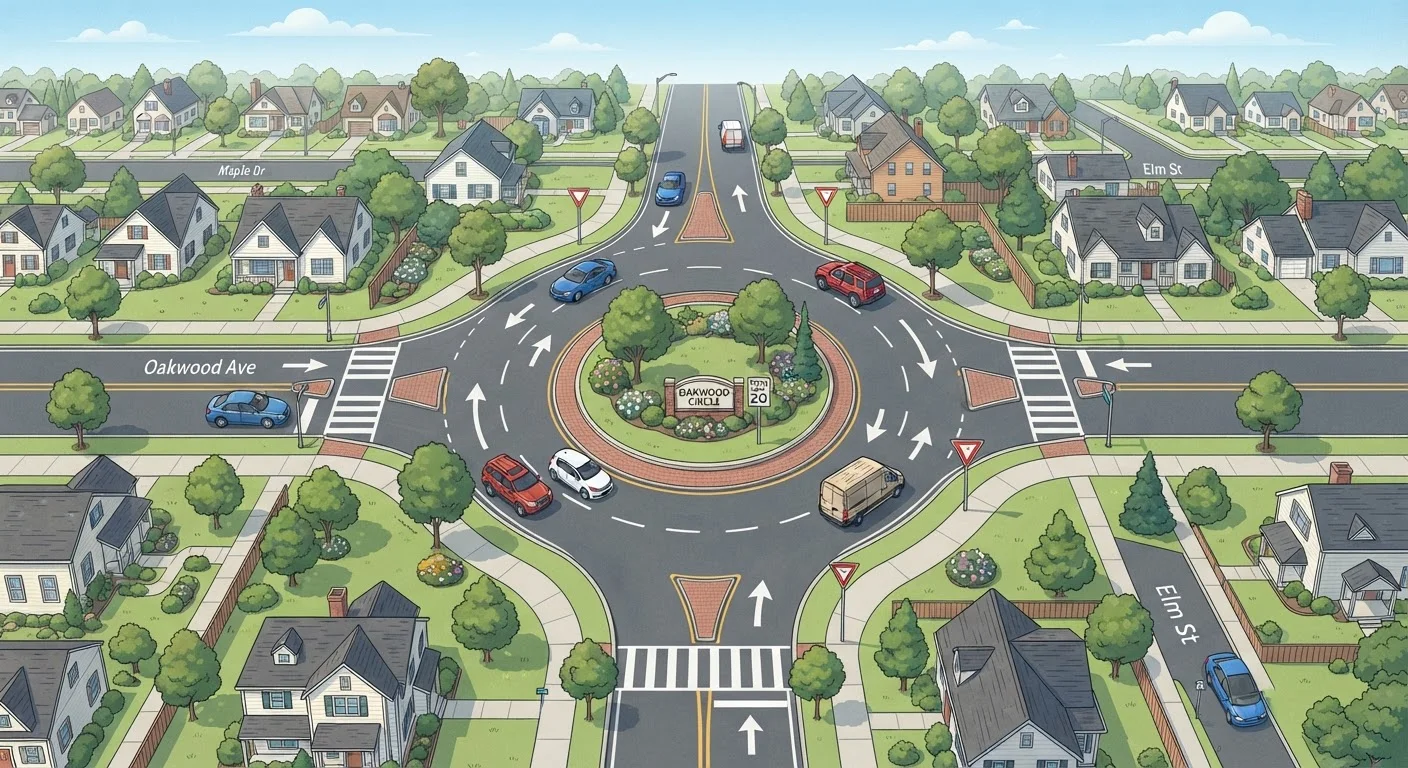
A circular intersection where traffic flows counterclockwise around a central island. Entering drivers yield to vehicles already circulating inside.
Yield
To slow or stop and allow other traffic or pedestrians to proceed before you. A yield sign does not always require a full stop - only if conditions demand it.
Circulating traffic
Vehicles already moving within a roundabout. They hold the right of way over vehicles waiting to enter.
Roundabouts: Yield Before You Enter, Not Inside
Roundabouts are designed to keep traffic moving at low speeds without traffic signals. The fundamental rule is simple: traffic already in the roundabout has the right of way. You yield at the entry point - the dashed yield line - not once you're circulating.
Practical steps at a roundabout:
- Slow down on approach and look left - that's where circulating traffic comes from.
- Stop or yield at the entry until there is a safe gap in circulating traffic.
- Once you enter, do not stop inside the roundabout unless emergency vehicles require it.
- Signal your exit before you leave the roundabout.
- Multi-lane roundabouts: choose your lane before entering. Right lane for right turns or going straight; left lane for left turns or going all the way around.
Roundabouts are statistically safer than signalized intersections for severe crashes because speeds are low and T-bone collisions are nearly impossible by design. If roundabouts are new to your area, the adjustment period is short once the entry-yield rule clicks.
Yield Signs: What They Actually Mean
A yield sign means slow down, be prepared to stop, and give right of way to traffic or pedestrians in the intersection or crosswalk. It does not mean stop automatically - but it also doesn't mean proceed freely.
Where you typically encounter yield signs:
- Roundabout entries - as described above.
- Freeway on-ramps merging into traffic - though this situation has its own dynamics. See our guide to highway merging for details on speed matching and gap selection.
- T-intersections - where a minor road ends at a major road.
- Pedestrian crosswalks at mid-block locations.
The legal obligation at a yield sign: you must not proceed if doing so would force another driver or pedestrian to brake or change course to avoid you. If traffic is clear, you may proceed without stopping. If it isn't, you must stop until it is safe.
State Laws Can Add Detail
Right-of-way rules are established at the state level in the U.S., and while the core principles are consistent nationwide, specific language and penalties vary by state. Always consult your state's driver handbook or DMV for the exact rules that apply where you drive. When traveling across state lines, be aware that traffic controls - especially roundabout density and signage conventions - can differ noticeably.
Quick Scenarios to Test Your Recall
Use these situations to confirm the rules are solid before your next drive:
- Scenario A: You and another driver arrive at a four-way stop at the exact same moment. You're on the other driver's right.
- You go first. The driver to your left yields to you.
- Scenario B: You approach a roundabout. There are two cars circulating inside. The entry is clear right now but a third car is approaching.
- Wait for circulating cars to pass, then enter when there's a safe gap. Do not base your decision on what entering cars are doing.
- Scenario C: You see a yield sign at a T-intersection. No cross traffic is visible.
- Slow down, confirm it's clear, and proceed without a full stop - but be ready to stop if conditions change.
Building these rules into habit matters most in unfamiliar territory, in construction zones, and when road markings are worn. For more on navigating unusual road conditions, see our article on navigating construction zones. And if you're planning a long drive, the anatomy of a well-planned road trip covers the broader picture of staying safe on unfamiliar routes.