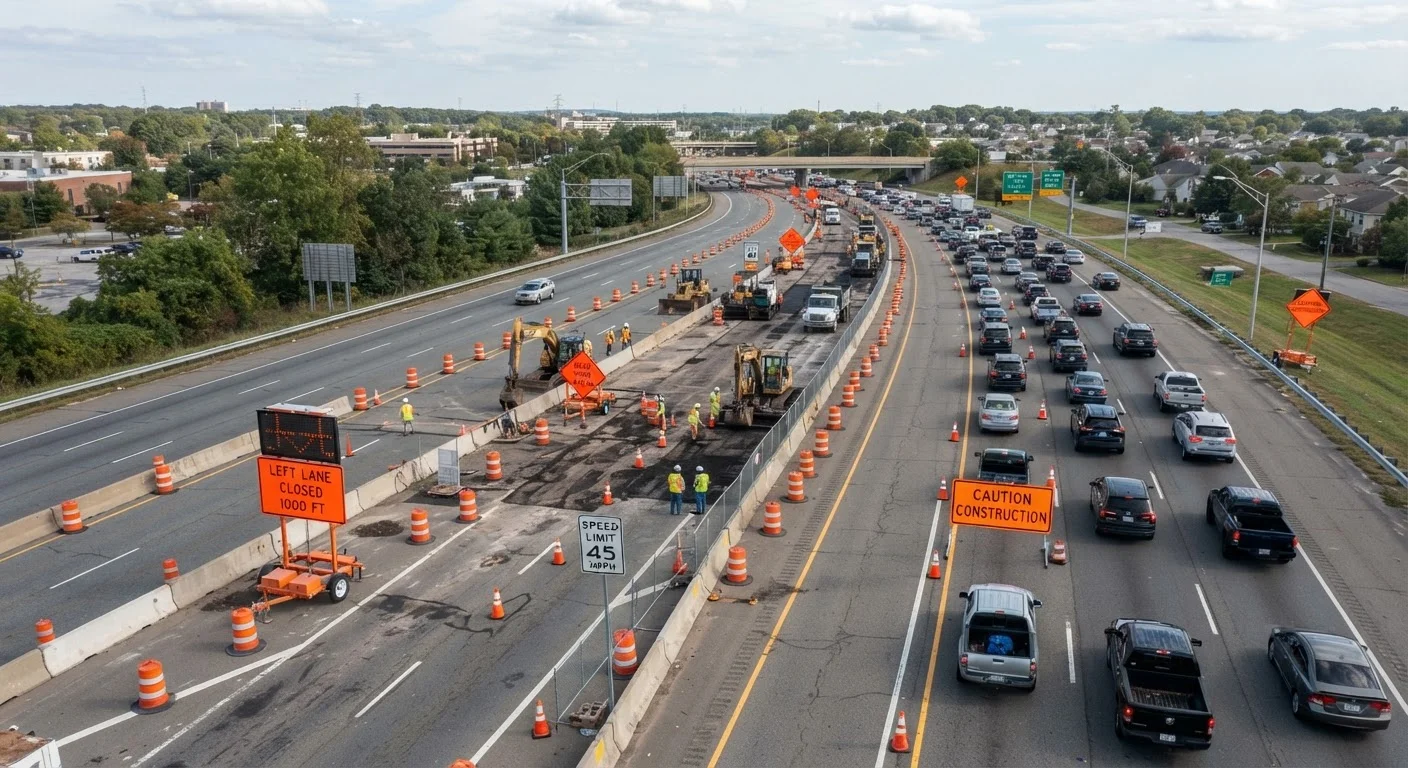
Why Construction Zones Demand a Different Mindset
Most drivers pass through work zones dozens of times a year without incident - but that familiarity can breed complacency. Construction zones are among the most dynamic and unpredictable environments on any road. Lane configurations shift. Surfaces change without warning. Workers, heavy equipment, and guide vehicles operate just feet from moving traffic.
According to the Federal Highway Administration, hundreds of fatalities occur in U.S. work zones every year, and a significant share of those involve the drivers passing through - not the workers. Speed is almost always a factor. The gap between a safe pass-through and a serious crash is often just a few miles per hour and a second of inattention.
The steps below walk through how to handle a work zone from the moment you see the first warning sign to when you're clear on the other side. If you also want to sharpen your overall pre-drive awareness, see our pre-drive safety walkthrough for habits that carry over directly.
What you will need
Step-by-Step: Moving Through a Work Zone Safely
Follow these steps each time you encounter a work zone, whether it's a short patch of repaving or a miles-long highway project.
React to the first warning sign, not the last one
Work zones are preceded by a sequence of advance warning signs - often beginning a quarter mile or more before any actual lane shift. When you see the first orange sign, that's your cue to begin reducing speed gradually and increasing your following distance. Waiting until you see cones or flaggers means you're already behind the curve.
Turn off cruise control immediately
Cruise control is designed for open, consistent highway conditions. Inside a work zone, speeds change quickly and stopping distances compress. Disengage it as soon as you see the first work zone sign so you have full manual control of your throttle from the start.
Obey the posted work zone speed limit
Work zone speed limits are set by traffic engineers based on lane width, sight lines, and worker proximity - not picked arbitrarily. In most U.S. states, fines for speeding in an active work zone (one with workers present) are doubled or tripled. Follow the posted limit from the moment you pass the speed limit sign, not from when the zone looks 'active' to you.
Increase your following distance
In normal conditions, a three-second following gap is a reasonable minimum. In a work zone, extend that to at least four seconds - more if the surface is rough, wet, or if there's heavy equipment nearby. Sudden stops happen with little warning when a flagger halts traffic ahead.
Put the phone down completely
Distraction is cited as a leading contributing factor in work zone crashes. Even a glance at a notification takes your eyes off a rapidly changing environment. Silence notifications and place the phone out of reach before entering the zone. If you need to check directions or take a call, wait until you're fully clear.
Follow flaggers and signage - they override everything else
Flaggers have legal authority to direct traffic, equivalent to a traffic signal. If a flagger signals you to stop, stop. If their signal conflicts with a traffic light or your GPS directions, the flagger takes precedence. Make eye contact if possible and move deliberately, not in a rush.
Exit the zone at the same controlled pace
Many drivers accelerate the moment they see the 'End Road Work' sign, sometimes before the zone is fully clear. Continue your controlled driving until the posted speed limit returns to normal and the road surface and lane width have stabilized. Accelerate gradually, not in a rush to make up time.
Active Work Zones Can Change Overnight
A route you drove yesterday may have an entirely different lane layout today. Overnight crews regularly shift barriers, change signage, and open or close lanes. Never rely on memory when entering a work zone - read every sign as if it's new information. If conditions look different from what you expect, slow down further rather than assuming your prior experience is accurate.
Once you're clear of the zone, it's also worth reconsidering whether cruise control is appropriate for the road ahead. Learn when cruise control works against you - work zones are one of the clearest examples of where it should stay off.
Common Mistakes Drivers Make (and How to Avoid Them)
Even cautious drivers fall into predictable traps in construction zones. Recognizing these patterns helps you sidestep them.
- Late merging into a closed lane. Darting over at the last second disrupts traffic flow and increases collision risk. When a lane-closure sign indicates your lane ends ahead, begin your merge as early as traffic allows - not at the cone line.
- Rubbernecking at equipment and crews. It's natural to glance at large machinery. But looking sideways while moving forward at 45 mph is how rear-end collisions happen. Eyes forward, attention on the vehicle ahead.
- Assuming the zone looks the same as yesterday. Overnight shifts routinely change lane patterns, add new detours, or shift the flagging operation. Never drive a work zone on autopilot.
- Following GPS blindly. Navigation apps don't always reflect real-time construction closures. If signage contradicts your GPS, follow the signs - flaggers and posted instructions always take legal precedence.
For a broader look at how right-of-way rules interact with unusual road setups, sorting out right-of-way rules covers intersections and scenarios that share the same logic of yielding and reading the road correctly.