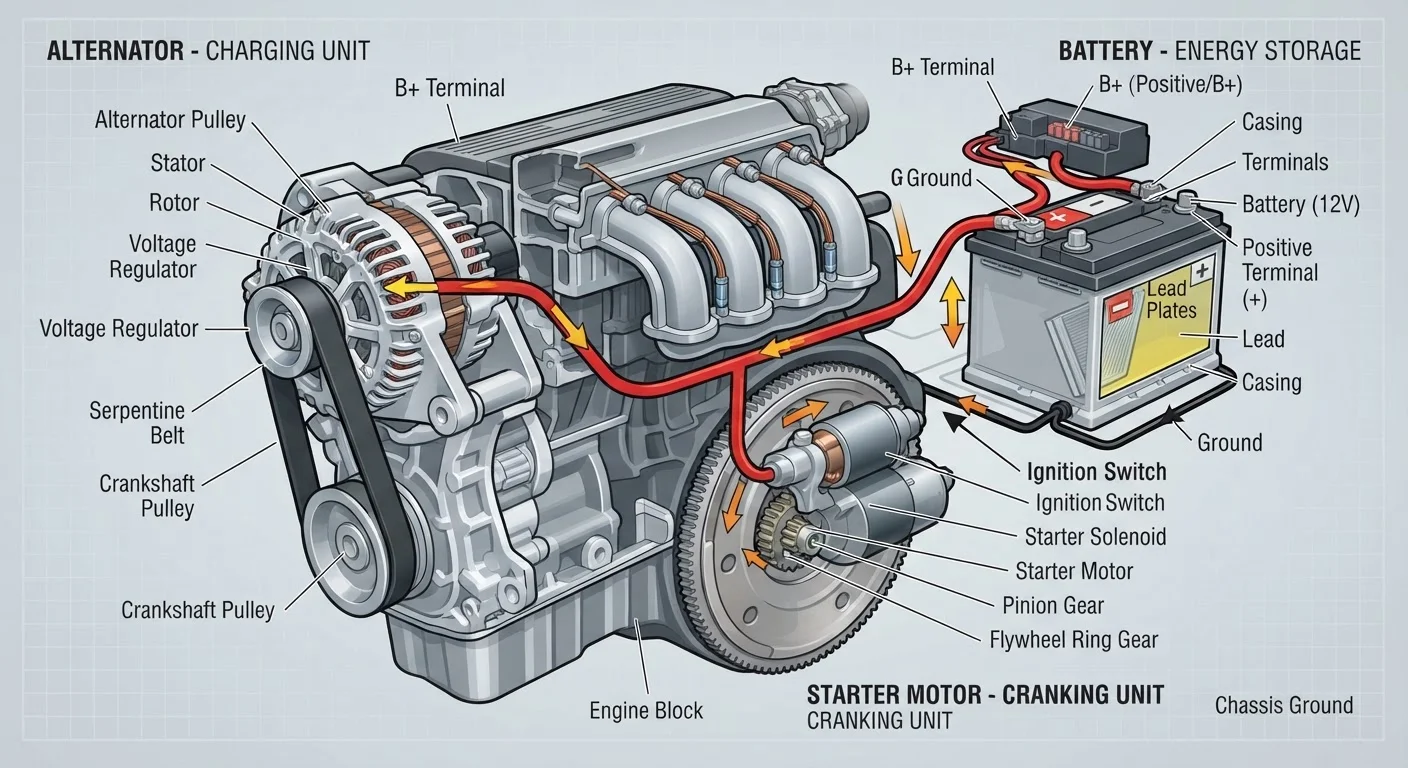
The Big Picture: A Continuous Electrical Loop
Your car's electrical system isn't a one-way street - it's a continuous loop where stored energy is spent, then replenished, then spent again. Three components drive this cycle: the battery, the starter motor, and the alternator. Each has a distinct job, but they're interdependent. When one fails, the others can't compensate for long.
Understanding how they work together doesn't require an engineering degree. It just requires knowing which component is responsible at each stage of a drive - from the moment you turn the key to the moment you park and shut off the engine.
Battery
A device that stores electrical energy chemically and releases it as direct current. In a car, it provides the high-current burst needed to start the engine.
Starter motor
A small electric motor that spins the engine fast enough to initiate combustion. It engages briefly at startup and then disengages automatically.
Alternator
A generator driven by the engine that produces electricity to power the car's systems and recharge the battery while the engine is running.
Solenoid
An electromagnetic switch in the starter circuit that engages the starter gear and completes the high-current circuit from the battery to the starter motor.
Parasitic drain
Electrical current drawn from the battery when the car is off - caused by a component that stays active and slowly depletes stored charge overnight.
Rectifier
A component inside the alternator that converts alternating current (AC) into the direct current (DC) that a car's electrical system requires.
The Battery: Your Car's Stored Energy Reserve
Think of the battery as a tank of stored electrical energy. It supplies the large burst of power needed to start the engine and also runs the car's electronics - lights, radio, sensors - whenever the engine is off. Most passenger vehicles use a 12-volt lead-acid battery, which stores energy through a chemical reaction between lead plates and sulfuric acid solution.
A common misconception is that the battery runs the car while you drive. It doesn't. Once the engine is running, the alternator takes over that job and simultaneously recharges the battery. The battery's primary role is ignition - that single high-demand moment when the starter needs a large jolt of current.
Check Battery Age Before It Fails
Most car batteries have a service life of three to five years under normal conditions. If yours is approaching that range, consider having it load-tested at a shop. A proactive replacement is far less disruptive than a no-start situation far from home.
The Starter: Cranking the Engine to Life
The starter is a small but powerful electric motor bolted near the bottom of the engine. When you turn the ignition key or press the start button, the battery delivers a surge of current to the starter solenoid - a relay switch that both engages a small gear (called the pinion gear) and completes the high-current circuit to the starter motor itself.
That pinion gear meshes with the engine's ring gear, spinning the engine fast enough for combustion to begin. Once the engine starts and runs on its own, the starter automatically disengages. The entire process takes less than a second under normal conditions. If the starter motor is worn or the solenoid is failing, you may hear a grinding noise or a single loud click instead of the engine turning over.
The Alternator: Keeping Everything Running
Once the engine is running, the alternator becomes the primary electrical source for the entire vehicle. Driven by a belt connected to the engine's crankshaft, the alternator converts mechanical energy into AC electricity, then uses an internal rectifier to convert that to the DC electricity car systems require.
The alternator does two things simultaneously: it powers all active electrical loads - the ignition system, fuel injectors, headlights, climate control, infotainment - and it recharges the battery for the next start. A healthy alternator typically outputs between 13.5 and 14.8 volts while the engine is running. If output drops below 13 volts, the battery starts to drain even with the engine on.
Just as your engine needs a cooling system to manage heat - as explained in our guide on how your car's cooling system works - the alternator also generates heat during operation, which is why proper airflow in the engine bay matters.
Voltage Testing Is Simple and Cheap
A basic digital multimeter - available at any hardware store - lets you check battery voltage (should read around 12.6V when fully charged and engine off) and alternator output (should read 13.5-14.8V with engine running). These two readings alone can quickly tell you which component is underperforming. If you're unsure how to interpret results, a mechanic can walk you through it.
When the System Fails: Reading the Warning Signs
Because these three components are linked, a failure in one can look like a failure in another. Here's how to read the symptoms:
- Slow or no-crank on startup: Usually points to a weak battery or a failing starter. Rapid clicking often means the battery lacks enough charge to fully engage the starter.
- Battery warning light while driving: Almost always indicates the alternator isn't generating sufficient voltage. The battery is being drained in real time.
- Electrical systems dimming while driving: Dashboard lights, headlights, or the radio fading mid-drive is a sign the alternator is losing output and the battery is picking up the slack - temporarily.
- Engine stalls shortly after starting: If the alternator fails immediately, the battery can't sustain ignition and fuel injection loads for long.
When any of these signs appear, have the charging system tested by a qualified mechanic. Most auto parts stores can also perform a free battery and alternator output test, which is a reasonable starting point for diagnosing the problem before committing to a repair.