Why This Matters for Everyday Drivers
You don't need to be a mechanic to benefit from understanding how your engine works. Knowing the basics helps you interpret what a technician tells you, recognize early warning signs, and make better decisions about maintenance - rather than just nodding along when someone mentions a misfiring cylinder or a clogged air intake.
The four-stroke engine cycle is the foundation of nearly every gasoline-powered car sold in the United States. Once you grasp it, a lot of other automotive concepts - from why oil gets dirty to how spark plugs wear out - start making intuitive sense.
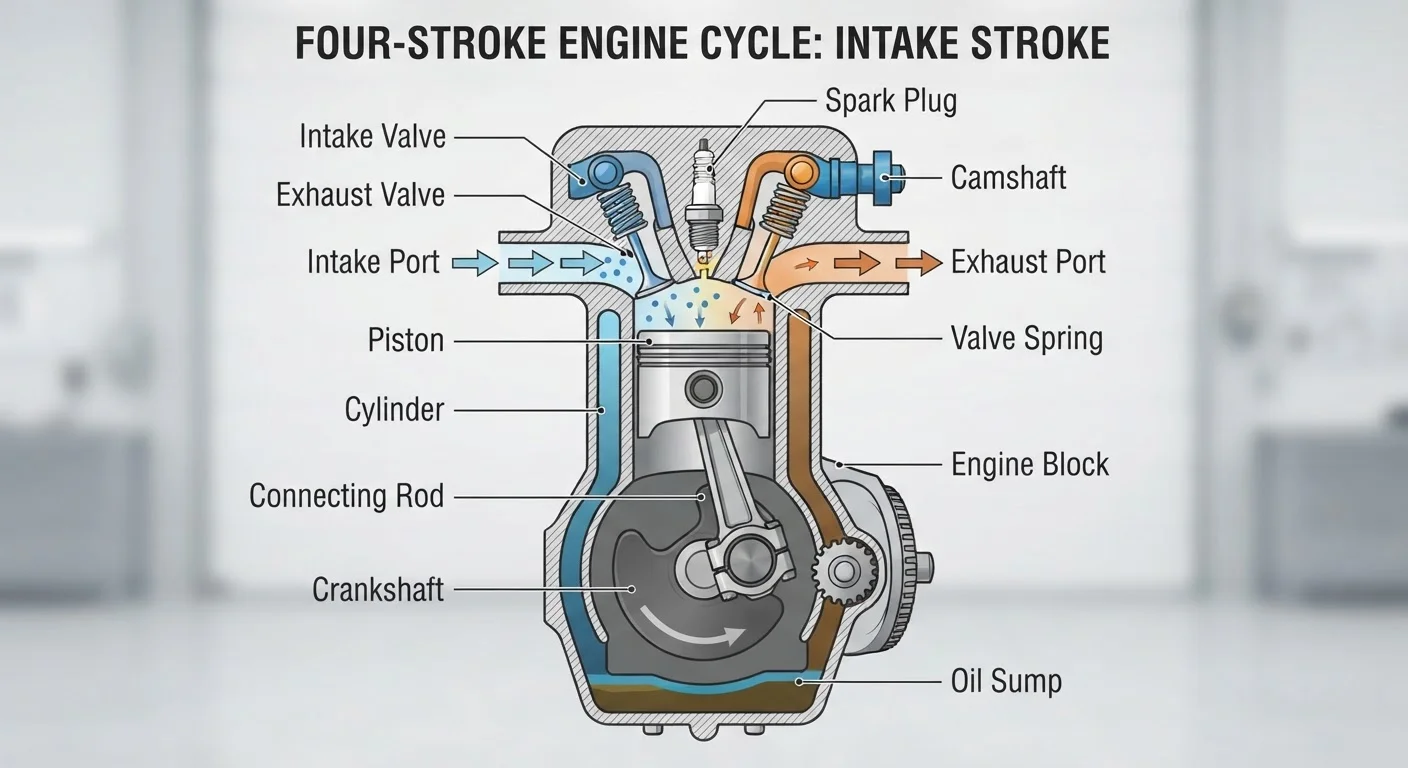
Piston
A cylindrical component that moves up and down inside an engine cylinder, transferring force from combustion to the crankshaft.
Crankshaft
A rotating shaft that converts the up-and-down movement of pistons into the rotational motion that ultimately drives the wheels.
Spark plug
A small electrical device that produces a spark to ignite the air-fuel mixture inside the cylinder at the right moment in the cycle.
Compression ratio
The ratio of the cylinder's volume when the piston is at the bottom versus the top of its stroke; a higher ratio generally means more power and efficiency.
RPM (Revolutions Per Minute)
A measure of how many times the crankshaft completes a full rotation each minute; it reflects how fast the engine is running.
Camshaft
A shaft with lobes that controls the opening and closing of intake and exhaust valves in sync with the piston's position.
The Four Strokes, One at a Time
Inside your engine are cylinders - sealed tubes where the real work happens. Inside each cylinder sits a piston that moves up and down. Each stroke is one full up or down movement.
1. Intake
The piston moves down, and the intake valve opens. This draws a mixture of air and fuel into the cylinder. Think of it like inhaling. The air-fuel ratio here matters: too much fuel or too little air affects efficiency and emissions.
2. Compression
Both valves close, and the piston moves up, squeezing the air-fuel mixture into a much smaller space. Compressing the mixture makes it more volatile and easier to ignite. This is why engine compression ratio - how much the mixture is squeezed - affects power output.
3. Combustion (Power)
At the top of the compression stroke, the spark plug fires. The compressed mixture ignites, expanding rapidly and forcing the piston down with significant force. This is the only stroke that generates power. The force travels through the connecting rod to the crankshaft, which converts the up-and-down motion into the rotational force that eventually turns your wheels.
4. Exhaust
The exhaust valve opens and the piston moves up again, pushing the burned gases out of the cylinder and into the exhaust system. This is the engine's equivalent of exhaling. A clogged catalytic converter or exhaust restriction can interfere with this step and hurt performance.
A Simple Mental Model That Sticks
Try remembering the four strokes as: Suck, Squeeze, Bang, Blow - a classic mnemonic used in automotive training. Intake draws the mixture in (suck), compression squeezes it, combustion fires it (bang), and exhaust pushes the spent gases out (blow). It's informal, but it works.
How the Cycle Repeats - Thousands of Times a Minute
One complete four-stroke cycle requires two full rotations of the crankshaft. At a typical highway cruising speed, your engine might be spinning at 2,500 RPM - meaning each cylinder completes 1,250 full cycles every minute.
Most passenger cars have four, six, or eight cylinders, and they don't all fire at the same time. The firing order is staggered so that power strokes from different cylinders overlap, keeping the engine running smoothly rather than in lurching bursts. A four-cylinder engine has power strokes spaced evenly, while a V8 can deliver a power stroke for nearly every rotation - which is one reason V8s feel so smooth at low speeds.
The crankshaft, camshaft, and timing system (whether it uses a timing belt or timing chain) coordinate this precise sequence. If that timing slips - which is why timing belt replacement is a scheduled service on many vehicles - the engine can run rough or stop running entirely.
Understanding the engine cycle also helps frame how the transmission picks up where the engine leaves off. Once rotational force (torque) leaves the crankshaft, it passes through the transmission before reaching the drive wheels. See our guide to transmission types to understand how that power gets managed.
What Can Go Wrong and Why It Connects to Maintenance
Each stroke has parts that wear out or fail. When a technician mentions a specific problem, it usually maps directly back to one stroke of the cycle:
- Intake issues: A dirty air filter restricts airflow into the cylinder during the intake stroke, reducing efficiency and power. Fuel injector problems affect how cleanly fuel mixes with incoming air.
- Compression issues: Worn piston rings or a damaged head gasket can allow the compressed mixture to leak, reducing pressure and causing a noticeable loss of power. A compression test measures how well each cylinder seals.
- Combustion issues: Worn or fouled spark plugs produce a weak or mistimed spark, leading to misfires - when the combustion stroke doesn't fire properly. A misfire wastes fuel, increases emissions, and can damage the catalytic converter over time.
- Exhaust issues: A clogged or damaged exhaust system creates back pressure that makes it harder to push burned gases out, which in turn makes the intake stroke less effective.
Engine oil doesn't belong to one stroke - it lubricates the entire cycle, reducing friction between the piston and cylinder walls on every stroke. Neglecting oil changes accelerates wear across all four strokes simultaneously, which is why it remains the single most impactful routine maintenance task for any engine.
When your check engine light comes on, the vehicle's onboard diagnostics system often identifies which cylinder misfired and during which part of the cycle the fault occurred. That's the four-stroke cycle, helping you and your mechanic pinpoint a problem rather than guessing.
Diesel Engines Work Differently
Diesel engines also use a four-stroke cycle, but there's no spark plug. Instead, air alone is compressed to such a high ratio that it becomes extremely hot, and fuel injected at that moment ignites spontaneously. This is called compression ignition, and it's why diesel engines tend to produce more torque at lower RPMs than comparable gasoline engines.