Why Your Transmission Matters More Than You Think
The transmission is the link between your engine and your wheels. The engine produces power at a limited range of speeds, and the transmission's job is to translate that power into usable motion across a wide range of driving conditions - whether you're crawling through traffic or merging onto a highway at 70 mph.
Every time your car accelerates, decelerates, or cruises, the transmission is actively managing the ratio between engine speed and wheel speed. Different transmission designs accomplish this in fundamentally different ways, which is why two cars with identical engines can feel completely different to drive. Understanding those differences helps you make sense of what you're experiencing - and what to expect from the vehicle you own or are considering.
This article covers the four transmission types you're most likely to encounter: automatic, manual, continuously variable (CVT), and dual-clutch (DCT). For a broader look at how power gets distributed once it leaves the transmission, see our guide on front-wheel drive vs. rear-wheel drive.
The Four Main Transmission Types Compared
Here's how each transmission type stacks up across the criteria that matter most to everyday drivers.
| Automatic | Manual | CVT | Dual-Clutch | |
|---|---|---|---|---|
| Driver effort | Minimal - shifts automatically | High - clutch and gear selection | Minimal - fully automatic | Low - fully automatic |
| Shift feel | Smooth, noticeable steps | Driver-controlled, direct | Seamless, no distinct steps | Very fast, precise steps |
| Fuel efficiency | Good, improving steadily | Good with skilled driver | Often excellent | Generally very good |
| Performance potential | Moderate to high | High with driver skill | Moderate | High - fast shifts |
| City/stop-go driving | Excellent | Demanding on clutch | Excellent | Can feel jerky at low speed |
| Maintenance complexity | Moderate | Clutch wear to monitor | Moderate, fluid critical | Higher, specialized service |
| U.S. market availability | Very common | Increasingly rare | Common in economy/hybrid | Common in performance models |
Keep in mind that real-world performance varies by vehicle, engine, and how the manufacturer has tuned the transmission. These are general characteristics, not guarantees for any specific car.
Automatic: The Default for a Reason
A traditional automatic transmission uses a torque converter and a set of planetary gear sets to shift through a fixed number of gears - typically six to ten in modern vehicles - without any input from the driver. A computer monitors throttle position, vehicle speed, and load, then selects the appropriate gear automatically.
The driving experience is smooth and low-effort. There's no clutch pedal, no stalling risk, and modern automatics have become genuinely efficient. Many offer a manual mode or paddle shifters that let you select gears yourself if you want more control in specific situations, such as engine braking on a long downhill grade.
Automatics do have more mechanical complexity than manuals, which can mean higher repair costs when something does go wrong. Keeping transmission fluid in good condition is especially important - check our article on vehicle fluids every driver should know about for what to watch.
Manual: Full Control, Full Responsibility
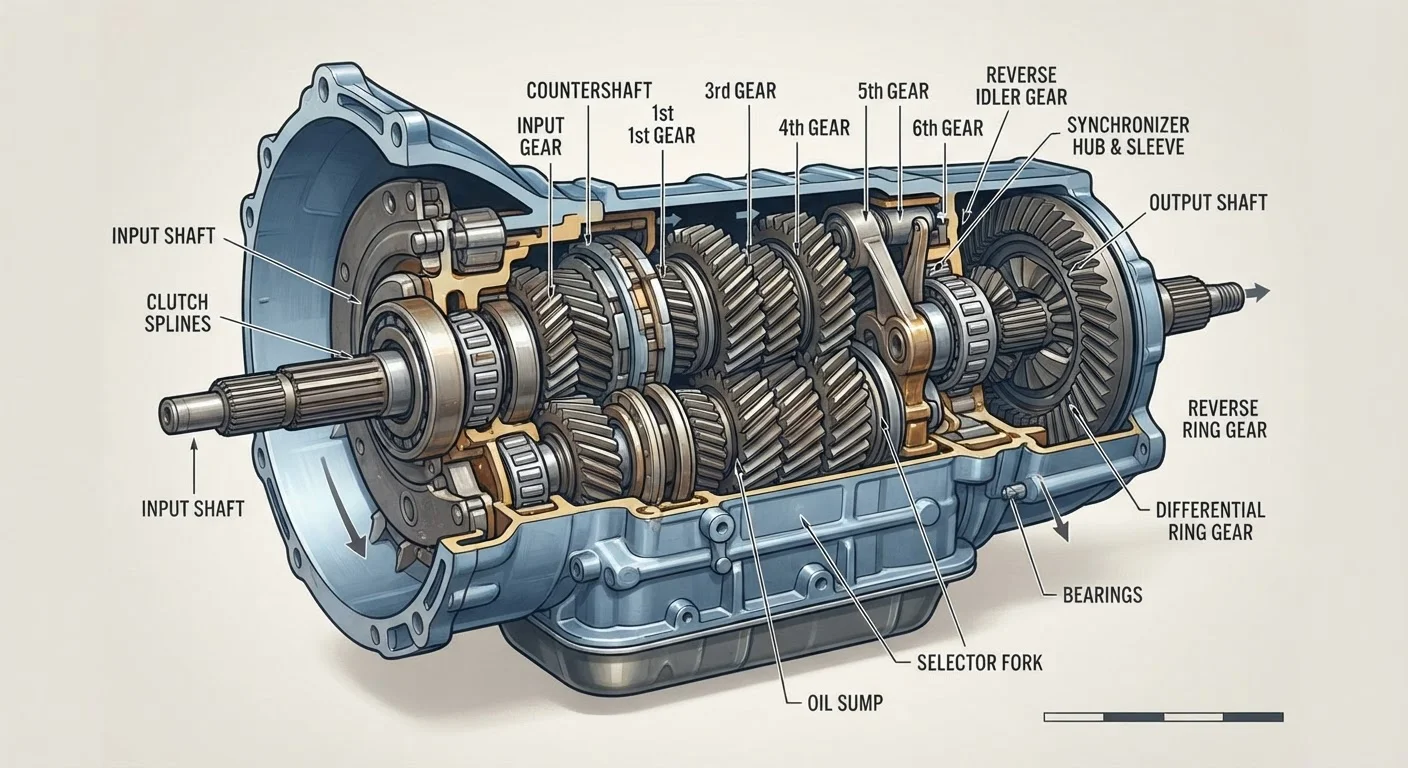
A manual transmission - also called a stick shift or standard - requires the driver to operate a clutch pedal and physically select gears using a gear lever. The clutch disengages the engine from the drivetrain momentarily so gears can be changed without grinding.
The appeal is direct engagement. You decide when the car shifts, which gives you precise control over power delivery - useful in performance driving, towing, or navigating slippery conditions where you want a specific gear locked in. Many drivers also find manuals more satisfying to operate.
The trade-offs are real: there's a learning curve, and city driving in heavy stop-and-go traffic becomes physically demanding. Clutch wear is a maintenance cost unique to this type. Manual transmissions have become increasingly rare in the U.S. market, though they remain common in some vehicle categories and in many other countries.
Learning Manual? Start on Flat Ground
If you're learning to drive a manual transmission, practice in a level, low-traffic area first. Hills add the challenge of preventing rollback while engaging the clutch - a skill that takes time to develop. Once you're comfortable with smooth starts on flat surfaces, hills become much more manageable.
CVT: Smooth Power, Unusual Feel
A continuously variable transmission (CVT) doesn't use fixed gears at all. Instead, it relies on a pair of variable-diameter pulleys connected by a steel belt or chain. By changing the diameter ratio between the two pulleys, a CVT can achieve any effective gear ratio within its range - essentially an infinite number of steps rather than discrete shifts.
The result is seamless acceleration without the sensation of gear changes. The engine can hold its most efficient speed regardless of vehicle speed, which is why CVTs often post strong fuel economy numbers. They're common in hybrids and fuel-focused sedans and crossovers.
Some drivers find the experience disorienting. Because the engine RPM doesn't rise and fall with acceleration the way it does in a geared transmission, CVTs can feel like the car is slipping or "droning" under hard acceleration. Manufacturers have added simulated step shifts to some CVTs specifically to address this feedback. CVTs also have historically had reliability concerns in certain applications, though designs have improved considerably.
Dual-Clutch: Efficiency Meets Speed
A dual-clutch transmission (DCT) is mechanically related to a manual - it uses actual gear sets and clutch packs - but it operates automatically. The key feature is two clutches: one handles odd-numbered gears, the other handles even-numbered gears. While you're in third gear, the transmission has already pre-selected fourth. When the shift happens, it's nearly instantaneous.
DCTs are found in performance-oriented vehicles because they shift faster than a human can manage with a traditional manual, and they're more mechanically efficient than a torque-converter automatic. Fuel economy tends to be strong for the same reason.
At low speeds and in stop-and-go traffic, some DCTs can feel jerky or hesitant - a known characteristic that varies by design and manufacturer tuning. They also tend to have higher servicing costs than traditional automatics. If you're comparing vehicles with different drivetrain configurations, our piece on all-wheel drive vs. four-wheel drive covers how power delivery works once it leaves the gearbox.