Why So Many People Never Start a Budget
Ask most Americans why they don't have a budget, and you'll hear a familiar set of reasons: they don't earn enough for it to matter, tracking every dollar sounds exhausting, or budgets are for people who are already in financial trouble. These beliefs feel intuitive, but most of them simply don't hold up.
The result is a real cost. Without any spending plan, it's easy to reach the end of the month wondering where the money went - and to stay stuck in that cycle. Understanding what's actually true about budgeting is often the first step toward changing that. Before reading further, it's worth clarifying what a monthly budget actually is, because the definition itself trips people up.
Myth
Budgeting is only necessary if you're in debt or struggling financially.
Fact
A budget is a planning tool useful at any income level - including when finances are already stable.
This is probably the most common reason people don't start. The thinking goes: if you're paying your bills and not overdrafting, why bother? But a budget isn't a rescue plan - it's a direction-setting tool. It helps you allocate money toward goals like saving, investing, or large purchases, rather than letting spending happen by default. People at all income levels use budgets precisely because they want to stay financially healthy, not because they've hit rock bottom.
Myth
You need to track every single purchase down to the cent for a budget to work.
Fact
Broad category-level tracking is enough for most people to see meaningful results.
The idea of logging every coffee and grocery item sounds exhausting - and for most people, it is. The good news is that obsessive granularity isn't what makes a budget effective. Grouping spending into five to ten categories (housing, food, transportation, etc.) and reviewing totals weekly gives you actionable information without the burden. Perfectionism in budgeting is often what kills it. A rough plan you actually follow beats a precise one you abandon.
Myth
Budgets mean you can't spend money on anything fun.
Fact
A sound budget deliberately includes money for discretionary spending and enjoyment.
Deprivation-based budgets don't last. If a spending plan has no room for dining out, hobbies, or entertainment, it creates an all-or-nothing dynamic that tends to collapse the moment any enjoyment is allowed. Sustainable budgets treat discretionary spending as a legitimate category, not a guilty exception. The point is to spend intentionally - not to stop spending. Knowing you've set aside $150 for restaurants this month is far more freeing than having no idea where your money is going.
Myth
Budgeting doesn't work if your income is irregular.
Fact
People with variable income can budget effectively using income-averaging and floor-based approaches.
Freelancers, gig workers, and seasonal earners often assume budgeting requires a predictable paycheck. It doesn't. One approach is to identify your lowest-earning month over the past year and build your baseline budget around that figure. Any income above that floor gets allocated to savings or irregular expenses. Another method involves averaging the past three to six months of income as an estimate. The mechanics are different from a salaried budget, but the principle is the same. For a deeper look, see budgeting on an irregular income.
Myth
You need special apps or software to budget properly.
Fact
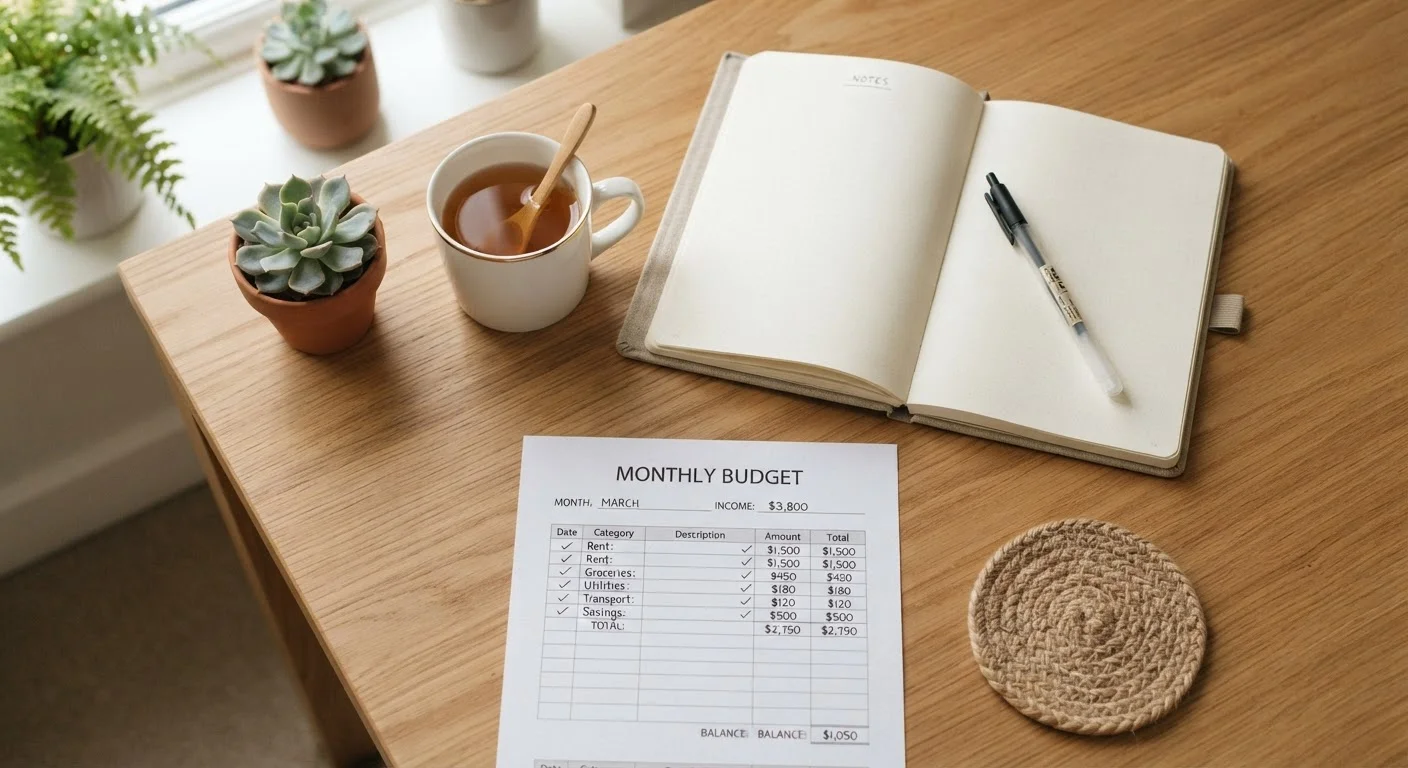
A pen and paper - or a basic spreadsheet - is sufficient for an effective budget.
Technology can make budgeting more convenient, but it isn't a prerequisite. The core act of budgeting is comparing what you earn to what you spend and making deliberate choices about the difference. That requires honesty and consistency, not a subscription app. If a particular tool helps you stay engaged, use it. But many people find that simpler formats - a notebook, a monthly worksheet, even a notes app - are easier to maintain because there's no learning curve or login friction.
What Getting Started Actually Looks Like
Once you set aside the myths, budgeting becomes far less intimidating. The most effective first step is simply tracking what you already spend for one full month - no changes required. This reveals your spending patterns worth knowing before you ever set a single limit.
From there, a basic budget assigns your income to categories: fixed costs like rent and utilities, variable needs like groceries and transportation, and discretionary spending like dining out or entertainment. If you want a more structured method, zero-based budgeting gives every dollar a specific purpose, which eliminates the ambiguity that causes most plans to unravel.
Avoid Setting an Unrealistic First Budget
A common early mistake is cutting spending targets so aggressively that the budget becomes impossible to follow within the first two weeks. If your first draft has no room for any flexibility, you're more likely to abandon the plan entirely after one slip. Start with realistic numbers based on your actual recent spending, then adjust gradually over time as habits shift.
The format genuinely doesn't matter as much as the consistency. A handwritten list reviewed weekly will outperform an elaborate spreadsheet that gets opened once. If you want to understand why most structured plans fall apart around week six, see our piece on why budgets fail in month two - the causes are usually structural, not personal.
For those building long-term habits rather than a one-time fix, budgeting habits that actually stick offers evidence-informed practices for staying consistent month after month.
This article is for general informational purposes only and does not constitute personalized financial advice. For guidance specific to your financial situation, consider consulting a qualified financial professional.