The Misunderstanding That Holds Most People Back
Ask someone why they don't budget and you'll often hear some version of the same answer: "I don't want to feel restricted" or "I already know I'm spending too much." Both responses point to the same core misunderstanding - that a budget is a financial punishment, a document designed to tell you no.
It isn't. A monthly budget is simply a spending plan: a deliberate decision, made in advance, about where your money goes. The difference between that and a spending restriction is enormous. One takes away agency; the other gives it back to you.
This framing shift matters because it changes how people engage with budgeting. When a budget feels like a cage, people abandon it the moment they go over in a single category. When it feels like a tool - something you control and adjust - it becomes far more durable and genuinely useful.
Budgets Aren't Only for People in Debt
One of the most persistent myths about budgeting is that it's a crisis tool - something you only need when finances are difficult. In reality, people at every income and net-worth level use spending plans to stay intentional. If you've wondered whether budgeting myths are holding you back, common budgeting misconceptions are worth examining directly.
What a Monthly Budget Actually Contains
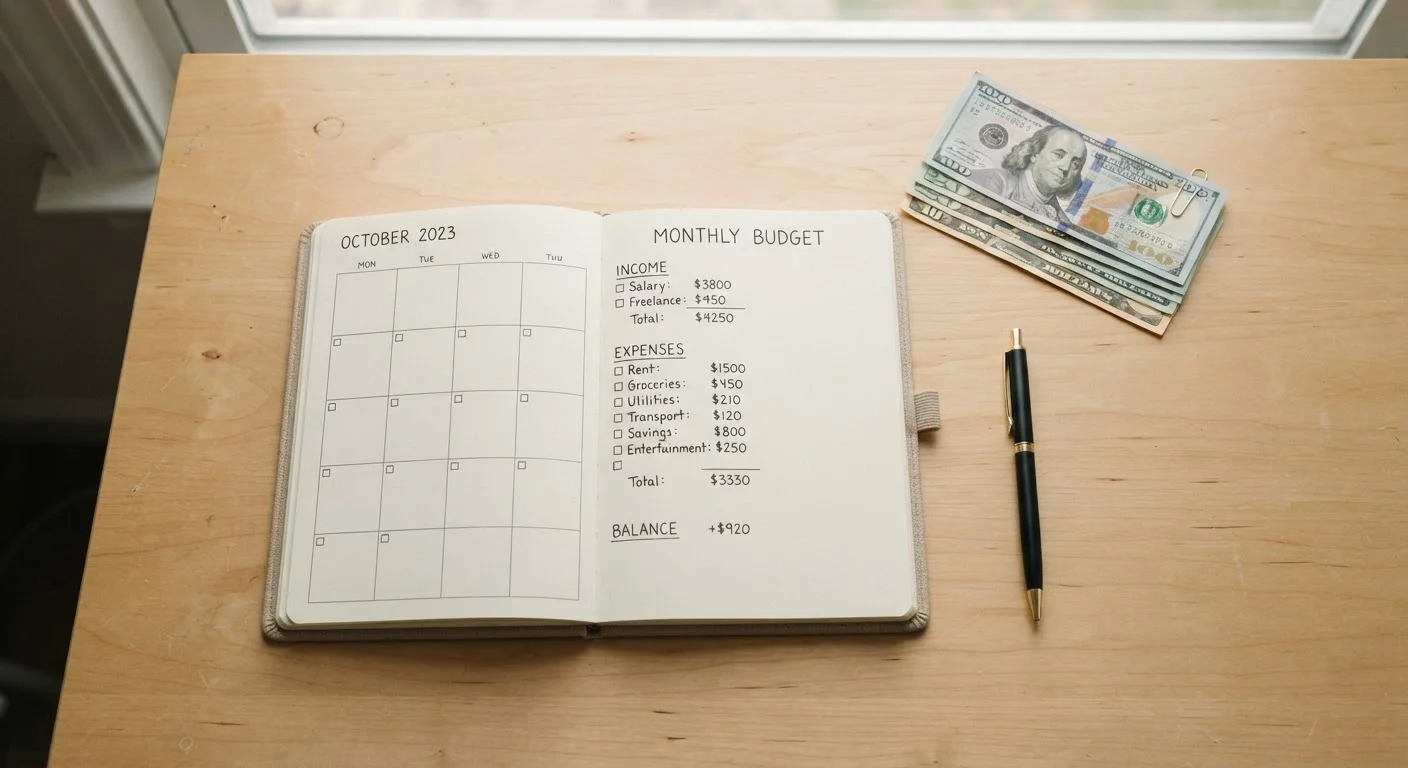
A functional monthly budget has three basic parts: income, fixed expenses, and variable expenses. Income is everything coming in - wages, freelance pay, side income. Fixed expenses are costs that stay consistent month to month, like rent or a car loan payment. Variable expenses shift - groceries, gas, dining out, entertainment.
Understanding which of your costs are fixed and which are variable is one of the most practical skills in personal finance. The difference between fixed and variable expenses shapes not just how you build a budget, but where you actually have room to make adjustments.
Beyond those categories, a solid budget also carves out a line for savings - ideally treated as a non-negotiable expense rather than whatever's left over. And it accounts for irregular but predictable costs: annual subscriptions, car registration, holiday spending. These are the expenses that most commonly blow up a first-time budget because they weren't included.
~33%
Americans who maintain a detailed monthly budget
Multiple consumer surveys, including research by the National Foundation for Credit Counseling, have consistently found that only roughly one-third of U.S. adults keep a detailed household budget.
$1,000+
Average monthly gap between perceived and actual spending
Research from financial literacy organizations suggests many households routinely underestimate their monthly spending by several hundred to over a thousand dollars, primarily due to irregular and discretionary expenses.
Why the Math Isn't the Hard Part
People often approach budgeting as though the obstacle is arithmetic. Add up income, subtract expenses, see what's left. But the math is genuinely simple - the difficulty is behavioral and organizational.
The common failure points are: underestimating how much certain categories actually cost (especially food and personal care), omitting irregular expenses, and treating the first draft of a budget as final. Most Americans also share predictable spending patterns and blind spots - subscription creep, underestimated dining costs - that derail early budgets before they get a chance to work.
A budget is a living document. The goal in month one isn't perfection; it's establishing baseline numbers you can refine. Expect to adjust. The monthly budget audit process - reviewing what you actually spent against what you planned - is how the system improves over time.
Where a Budget Fits in Your Larger Financial Picture
A monthly budget doesn't exist in isolation. It's the operational layer of a broader financial life - the mechanism that connects daily spending decisions to longer-term goals like building an emergency fund, paying down debt, or saving for a major purchase.
Without a spending plan, those goals tend to stay abstract. With one, they become line items: "$200 a month toward my emergency fund" is an actionable commitment, not a vague intention. That's why budgeting connects directly to saving, debt payoff, and financial stability.
It's also worth naming what a budget won't do on its own: it won't increase your income, eliminate debt overnight, or replace professional financial guidance for complex situations. It's one tool - a foundational one - in a larger set.
“A budget is telling your money where to go instead of wondering where it went.”
— John C. Maxwell, Author and leadership speaker, frequently cited in personal finance education
This article is for general informational and educational purposes only and does not constitute personalized financial or tax advice. Consult a qualified financial professional for guidance specific to your situation.