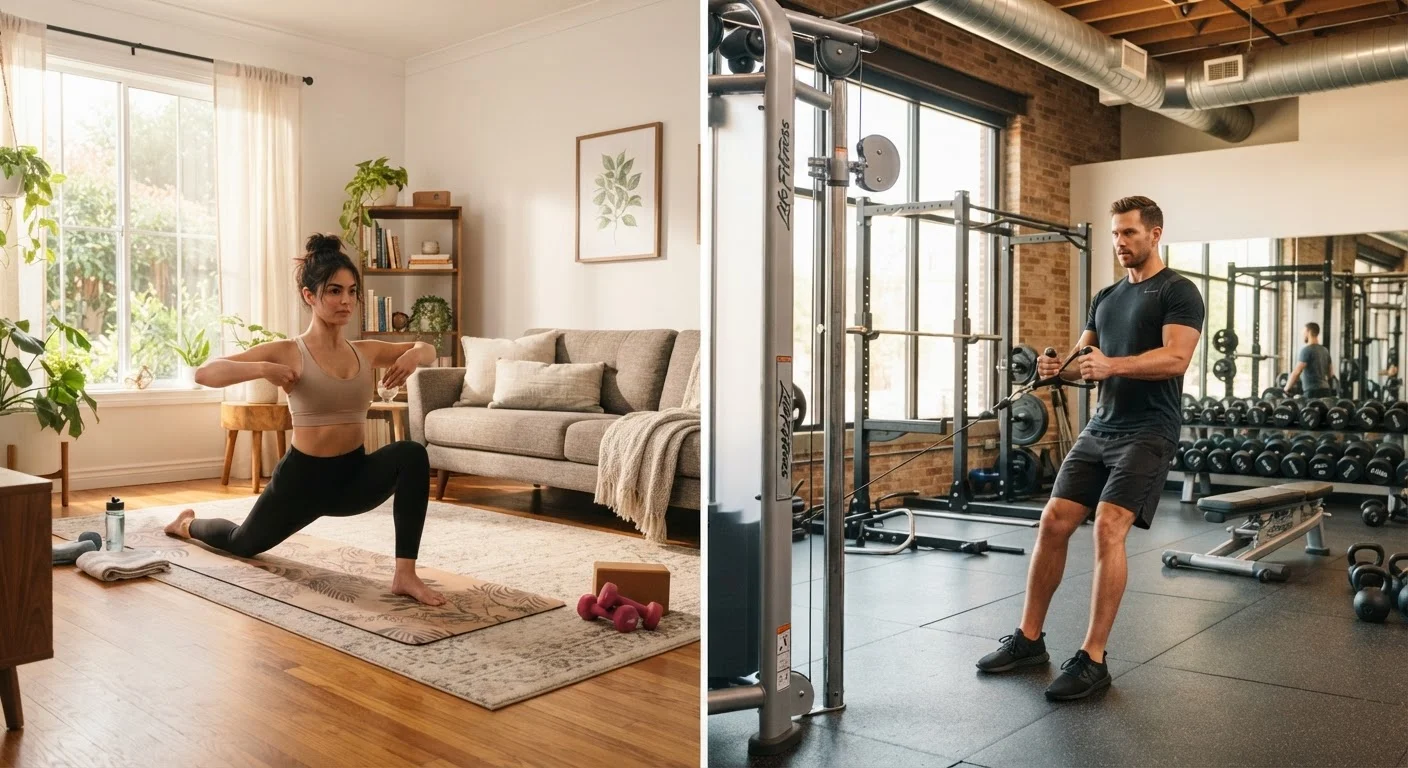
Why Environment Matters More Than You Might Think
Where you train shapes more than just the exercises you can do - it affects your motivation, your consistency, and how easily you progress over time. Research on exercise adherence consistently shows that reducing barriers to entry is one of the most reliable predictors of long-term participation. In that light, evaluating your training environment isn't a minor logistical detail; it's a meaningful fitness decision.
Both home workouts and gym sessions can produce real improvements in strength, cardiovascular fitness, and overall health. The question isn't which one is inherently better - it's which one fits your life well enough that you'll actually do it, week after week. For a practical framework on building sustainable movement habits without equipment, see our guide to building a weekly movement routine.
What Home Workouts Do Well
Training at home removes nearly every logistical obstacle. There's no commute, no membership fee, no waiting for equipment, and no fixed schedule. For people managing full work weeks, childcare, or irregular hours, that friction reduction is genuinely significant - a 20-minute session you actually complete beats a 60-minute session you keep postponing.
No commute - exercise begins immediately
Eliminating travel time removes one of the most common barriers to starting a session. Studies on exercise adherence suggest that proximity to a workout location is a significant predictor of consistency.
Lower long-term cost
A modest collection of home equipment - a mat, resistance bands, and a set of dumbbells - can be purchased once and used indefinitely, often costing less than a year of gym membership over time.
Complete scheduling flexibility
Home training works at 6 a.m., during a lunch break, or late at night - without gym hours or class schedules dictating when you can move.
Privacy and comfort reduce social anxiety
Training in a personal space removes self-consciousness, which research suggests can meaningfully increase the likelihood that beginners stick with exercise long-term.
Encourages functional, adaptable movement
Without relying on machines, home trainers often develop stronger body awareness and movement efficiency across a broad range of patterns.
Body-weight training, resistance bands, and a pair of adjustable dumbbells can support a wide range of fitness goals, from building foundational strength to improving cardiovascular capacity. The environment also tends to be lower-pressure, which can help people who feel self-conscious in public gym settings stay consistent and gradually build confidence.
One underrated advantage: home training encourages creativity and adaptability. When you can't rely on a cable machine or a squat rack, you learn to use movement patterns more intentionally - a skill that transfers well to overall physical literacy.
Where Home Training Has Limits
The primary constraint of home training is equipment. Progressive overload - the principle of gradually increasing training demands over time - is easier to implement when you have access to a full range of weights, cable systems, and machines. With limited equipment, home trainees often plateau in certain movement patterns, particularly heavy pulling and lower-body loading, unless they invest meaningfully in home gym setup.
Limited equipment constrains progressive overload
Without access to heavier loads and varied resistance, some movement patterns - especially heavy lower-body pulling and pressing - are difficult to progress beyond a certain point.
Higher risk of distraction and low motivation
Household tasks, family interruptions, and the absence of a structured environment make it harder for many people to initiate and maintain workout intensity at home.
Lack of instruction increases injury risk for beginners
Without a trainer or knowledgeable peers nearby, beginners may develop poor movement habits that go uncorrected and lead to injury over time.
Some training goals require specialized equipment
Sports-specific conditioning, Olympic lifting, and certain rehabilitation protocols depend on equipment that is impractical or cost-prohibitive to own at home.
Motivation and structure can also be harder to sustain at home. Without the social cues of a gym environment or a scheduled class, some people find it genuinely difficult to begin sessions or push through fatigue. Distractions - from household tasks, family members, or simply the comfort of familiar surroundings - are real obstacles that shouldn't be dismissed. Understanding the habits that quietly undermine exercise progress can help you identify and correct these patterns early.
What the Gym Brings to the Table
A well-equipped gym provides access to tools that are difficult or expensive to replicate at home: barbells with full plate sets, cable machines, pull-up rigs, specialty cardio equipment, and often the guidance of staff or trainers. This breadth of equipment makes it significantly easier to follow structured, periodized programs - particularly those focused on strength development or body composition change.
~80%
Adults who cite convenience as a top exercise barrier
Physical Activity Guidelines research consistently identifies time and access as the leading reasons Americans don't meet activity recommendations.
2-3×
Potential strength gains with progressive overload
Well-structured resistance training programs using progressive overload principles can produce two to three times the strength gains of unstructured training, according to exercise science literature.
~$500-$800
Average annual US gym membership cost
Industry data suggests average annual gym membership spending in the US falls in this range, not including commuting costs or personal training fees.
The social environment of a gym can be a powerful motivator for many people. Exercising alongside others, even strangers, has been associated with increased effort and longer session duration in some research contexts. Group fitness classes, common in most commercial gyms, add accountability and instruction simultaneously. If you're interested in how different training intensities compare, our piece on Zone 2 cardio vs. high-intensity intervals offers useful context.
The Gym's Genuine Downsides
Cost is the most obvious barrier. Monthly membership fees, travel costs, and time spent commuting add up - and if attendance becomes inconsistent, that cost-per-session rises sharply. Peak-hour crowding can make certain equipment unavailable, disrupt training flow, and add frustration that erodes motivation over time.
For some individuals, the gym environment itself creates anxiety. Feeling watched or judged - sometimes called "gym intimidation" - is a documented barrier to participation, particularly for beginners or those returning after a long break. This is a real issue worth acknowledging, not dismissing. Privacy and personal pacing are genuinely harder to control in a shared public space.
This article is for general informational purposes only and does not constitute medical or personal fitness advice. If you have health conditions or injuries, consult a qualified healthcare professional before beginning any new exercise program.