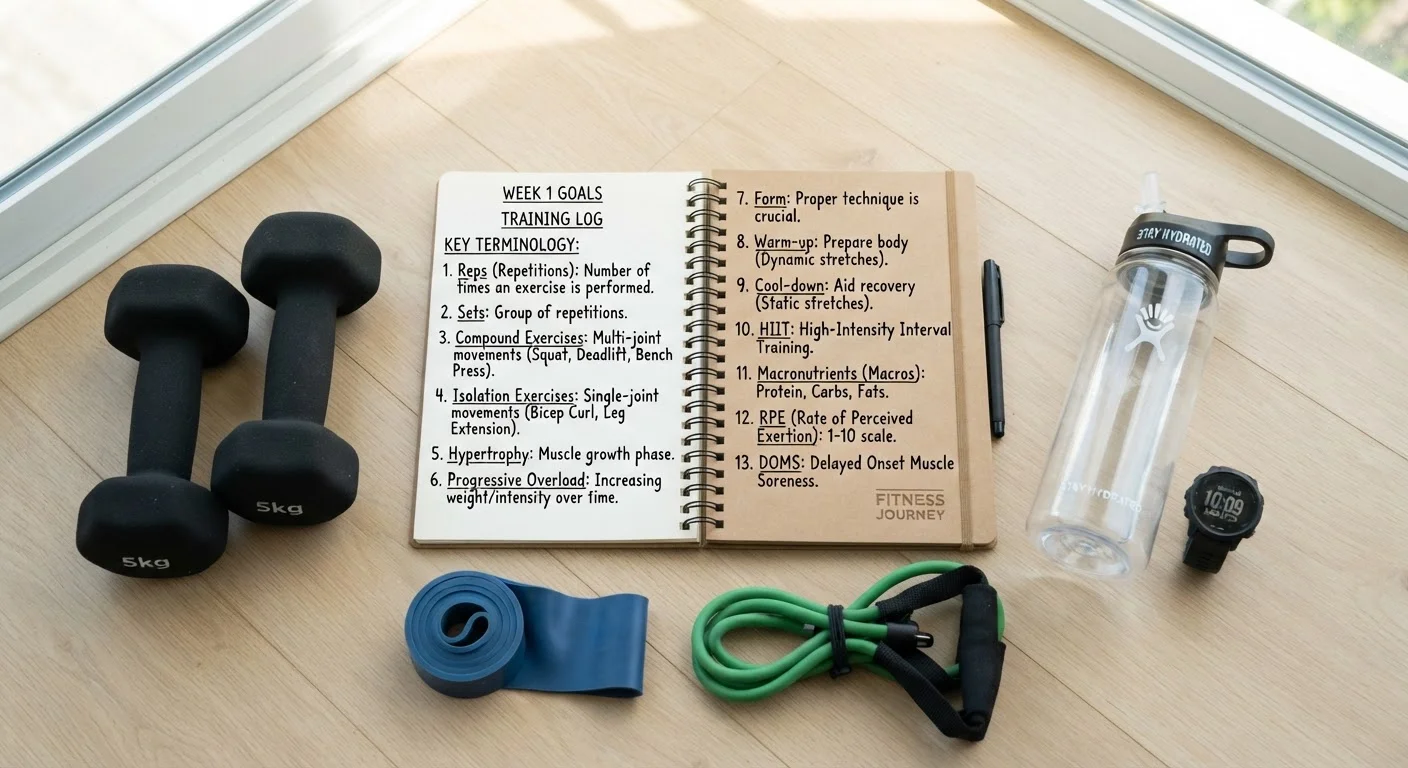
Why Fitness Jargon Matters
Walk into any gym, open a training app, or read a workout plan, and you'll encounter a wall of acronyms and shorthand - RPE, AMRAP, HIIT, VO2 max. For beginners and experienced exercisers alike, unfamiliar terms can make programming feel inaccessible. But this language exists for good reason: it gives coaches, athletes, and everyday exercisers a precise, shared vocabulary for describing effort, structure, and physiology.
This reference covers the terms you're most likely to encounter, explained in plain English. Whether you train at home or in a gym - see how each environment shapes your training - understanding the terminology helps you follow programming more accurately and progress more intentionally.
Set
A group of consecutive repetitions of an exercise performed before resting. Most programs prescribe multiple sets per exercise.
Rep (Repetition)
One full completion of an exercise movement, from start to finish and back again. Reps are counted within a set.
RPE (Rate of Perceived Exertion)
A subjective 1-10 scale used to rate how hard an effort feels during exercise. It helps calibrate intensity without relying solely on external measures like pace or weight.
1RM (One-Rep Max)
The maximum amount of weight a person can lift for a single repetition of a given exercise with correct form. Often used as a baseline for programming strength training loads.
VO2 Max
A measure of the maximum volume of oxygen the body can use per minute during intense exercise. It is a widely used indicator of aerobic fitness capacity.
Superset
Two exercises performed consecutively with little or no rest in between. Supersets are used to increase workout efficiency or training volume.
AMRAP
"As Many Rounds (or Reps) As Possible" - a timed workout format in which you complete as much work as you can within a set time window.
HIIT
High-Intensity Interval Training. A method alternating short, intense work periods with recovery intervals, designed to elevate cardiovascular demand in a shorter session.
Progressive Overload
The principle of gradually increasing training stress over time - through added weight, reps, or reduced rest - to continue driving physical adaptation.
Aerobic Exercise
Physical activity sustained by oxygen-based energy production. Activities like jogging, swimming, and cycling at moderate intensity are primarily aerobic.
Anaerobic Exercise
Short, intense activity where energy demand outpaces oxygen supply. Sprinting and heavy resistance training are examples of anaerobic effort.
EMOM
"Every Minute On the Minute" - a training format where a set number of reps begins at the start of each minute, with any remaining time used as rest.
Training Structure Terms
Most workout programs use a consistent structural vocabulary to describe how exercises are grouped and sequenced.
| Common set-rep scheme for strength | 3-5 sets of 3-6 reps (Widely cited in strength and conditioning literature) |
| Common set-rep scheme for hypertrophy | 3-4 sets of 8-12 reps (Supported by resistance training research consensus) |
| Typical HIIT work-to-rest ratio | 1:1 to 1:3 (Varies by protocol and fitness level) |
| VO2 max measurement unit | mL/kg/min (Standard physiological measurement) |
| RPE scale range | 1 (rest) to 10 (maximal effort) (Borg CR10 scale, widely used in exercise science) |
| Progressive overload frequency guideline | Increase load or volume every 1-4 weeks (General guidance from exercise science; varies by individual) |
- Set: A group of consecutive repetitions of an exercise before resting. "3 sets of 10" means you perform the movement 10 times, rest, then repeat twice more.
- Rep (Repetition): One complete execution of a movement - the lowering and raising of a dumbbell, for example.
- Superset: Two exercises performed back-to-back with little or no rest between them. Supersets can target opposing muscle groups (antagonist pairing) or the same muscle group for added intensity.
- Circuit: A sequence of several exercises performed in order with minimal rest between movements. One pass through all exercises equals one circuit.
- AMRAP: "As Many Rounds (or Reps) As Possible" within a set time window. A common format in functional and CrossFit-style training.
- EMOM: "Every Minute On the Minute." You perform a prescribed number of reps at the start of each minute; remaining time in that minute is your rest.
Understanding these structures allows you to read and execute a program as written, rather than guessing at the intent behind the design.
Effort, Intensity, and Physiological Terms
These terms describe how hard you're working and what's happening inside your body during exercise.
- RPE (Rate of Perceived Exertion): A self-reported scale - typically 1 to 10 - reflecting how hard an effort feels. An RPE of 6 feels moderately challenging; a 9 or 10 is near-maximal. RPE is a useful tool when heart rate monitors aren't available.
- 1RM (One-Rep Max): The maximum weight you can lift for a single, complete repetition of an exercise with proper form. Many strength programs prescribe loads as a percentage of your 1RM.
- VO2 Max: The maximum rate at which your body can consume oxygen during intense exercise, expressed in milliliters per kilogram of body weight per minute. It is one measure of cardiovascular fitness - higher values generally indicate a more efficient aerobic system.
- Aerobic vs. Anaerobic: Aerobic exercise relies primarily on oxygen to generate energy and is sustainable for longer durations (e.g., jogging, cycling). Anaerobic exercise - like sprinting or heavy lifting - demands energy faster than oxygen can supply it and is necessarily brief.
- HIIT (High-Intensity Interval Training): Alternating short bursts of near-maximal effort with recovery periods. HIIT sessions are typically shorter than steady-state cardio but place significant demand on the cardiovascular system.
- Progressive Overload: Gradually increasing the stress placed on the body over time - through heavier loads, more volume, or reduced rest - to drive continued adaptation. It is the foundational principle behind lasting fitness gains. See our complete guide to progressive overload for a deeper look at how to apply it safely.
This article provides general fitness education and is not a substitute for personalized guidance from a qualified fitness or healthcare professional. If you have any health conditions or are new to exercise, consult a professional before beginning a new training program.