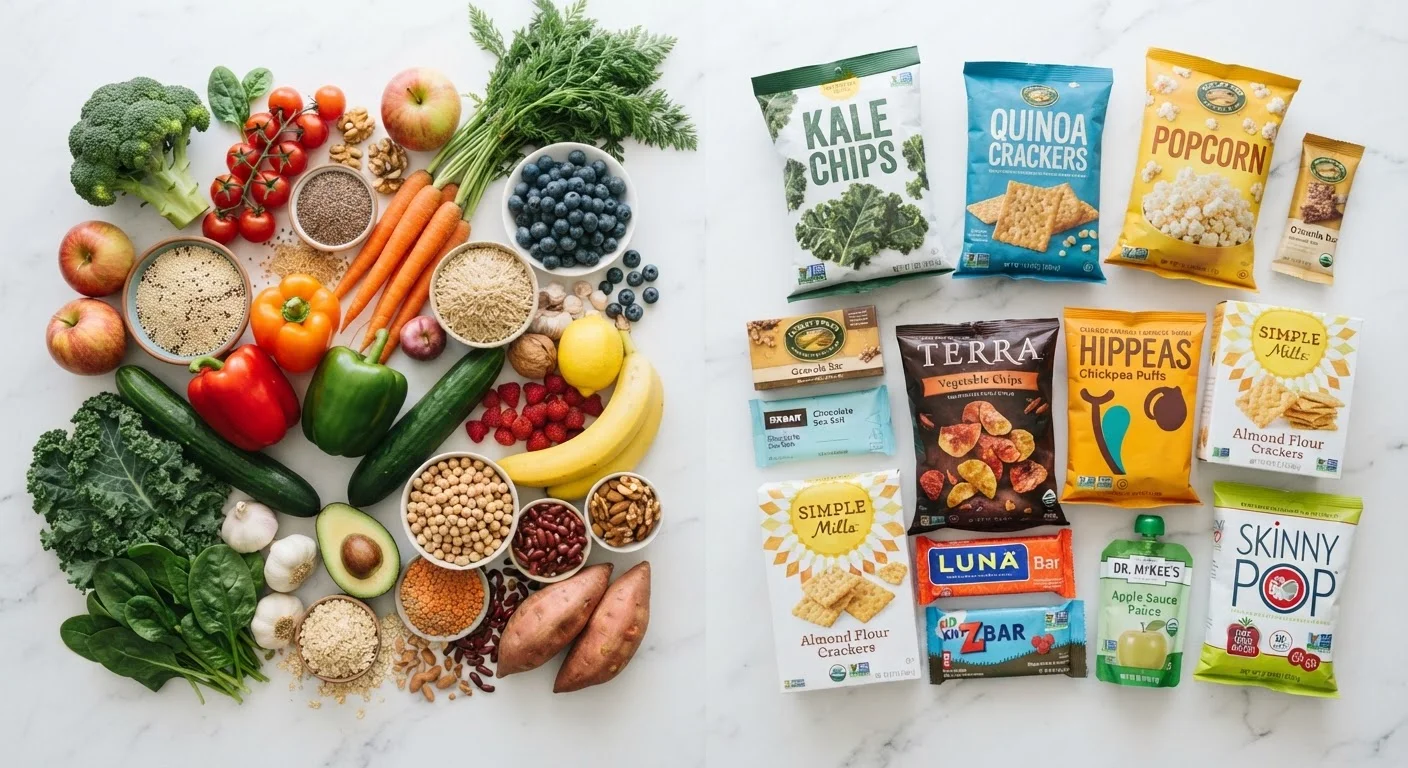
What Makes a Food 'Whole'?
A whole food is one that remains close to the form it came from - whether that's a plant, animal, or grain. An apple, a handful of almonds, a piece of salmon, a bowl of oats, or dried lentils all qualify. Minimal processing - washing, cutting, freezing, or cooking - doesn't disqualify a food from this category. What matters is that the item's original nutritional structure is largely intact.
Nutrition researchers often use the NOVA classification system, developed by researchers at the University of São Paulo, to sort foods by degree of processing rather than by individual nutrients. Under NOVA, Group 1 foods are unprocessed or minimally processed: fresh produce, plain meat, eggs, milk, and plain legumes. Group 2 covers culinary ingredients - oils, flour, salt - used to prepare food. These two groups form the backbone of what most people mean by a whole-food diet.
Importantly, a whole food isn't synonymous with "organic" or "expensive." Frozen peas, canned tomatoes without added sodium, and plain rolled oats are all minimally processed and nutritionally sound. The practical question is whether the item has been substantially altered from its original form - and whether additives serve industrial rather than culinary purposes. For more on how to assess what's actually in a packaged food, see our guide on reading a nutrition facts label.
Defining Ultra-Processed: More Than Just 'Junk Food'
Ultra-processed foods (NOVA Group 4) are not simply foods with added sugar or salt. They are industrially manufactured products that contain ingredients rarely or never used in home cooking - emulsifiers, artificial flavors, color additives, humectants, modified starches, and preservatives designed to extend shelf life or make a product more palatable. Think packaged snack cakes, most fast-food items, certain breakfast cereals, carbonated soft drinks, flavored chips, and many ready-to-eat meals.
The defining feature is industrial formulation. These products are typically assembled from refined ingredients and then rebuilt with additives to mimic the texture, flavor, and appearance of real food. The result is often calorie-dense, low in fiber, and stripped of micronutrients - though some are fortified to partially compensate.
| Criterion | Whole Foods | Ultra-Processed Foods |
|---|---|---|
| Definition | Minimally altered from natural form | Industrially formulated with multiple additives |
| Typical ingredients | One or few recognizable items | Long list including emulsifiers, flavors, colors |
| Nutrient density | Generally high; fiber, vitamins intact | Often low; may be partially fortified |
| Fiber content | Naturally present | Usually low or absent |
| Shelf life engineering | Minimal or none | Central to production process |
| Research association | Linked to better long-term health outcomes | Linked to higher chronic disease risk |
| Examples | Oats, eggs, lentils, fresh fruit | Packaged snack cakes, soft drinks, flavored chips |
This distinction matters because the harms associated with ultra-processed foods appear to go beyond their macronutrient profiles. A growing body of research - including large prospective cohort studies from Europe and North America - associates high ultra-processed food consumption with elevated risk of obesity, cardiovascular disease, type 2 diabetes, depression, and all-cause mortality. Whether those effects come from specific additives, the displacement of nutritious foods, or other factors is still being studied, but the pattern across populations is consistent. Understanding why calories and nutrients aren't the same conversation helps clarify why calorie counts alone don't capture this distinction.
Putting It Into Practice Without the Perfectionism
Framing this as an all-or-nothing choice is where many readers get stuck - and it's unnecessary. No credible nutrition framework requires complete avoidance of every processed food. The relevant question is what dominates your overall eating pattern, not what appears occasionally.
Minimally Processed ≠ Inferior
Frozen vegetables, canned beans, plain yogurt, and pasteurized milk are all processed to some degree - but they fall into NOVA Groups 1-3, not the ultra-processed category. Freezing preserves nutrients effectively, and canning makes legumes far more accessible. Processing method and intent matter enormously. Don't let the word "processed" automatically trigger avoidance.
A practical approach: anchor your meals around foods from NOVA Groups 1 and 2 - vegetables, fruit, legumes, plain grains, eggs, dairy, and minimally processed proteins. Use NOVA Group 3 (processed foods like cheese, cured meats, or tinned fish) as ingredients and accompaniments. Reserve Group 4 ultra-processed items for the margins of your diet rather than the center.
This doesn't require a pantry overhaul. Swapping a highly sweetened breakfast cereal for plain oats, choosing plain yogurt over a heavily flavored dessert-style variety, or cooking dried or canned beans instead of relying on packaged meal kits are incremental changes with meaningful cumulative impact. For evidence-backed patterns that apply this principle at the dietary level, see eating patterns that hold up to scientific scrutiny.
If you're looking at this from a sustainability angle - one where changes actually stick - sustainable eating habits that don't require overhauling your life offers grounded, realistic guidance without extremes.
This article provides general nutrition education and is not a substitute for personalized advice from a registered dietitian or qualified healthcare provider. Individual health needs vary; consult a professional before making significant dietary changes.