Why Shut-Off Knowledge Is a Safety Skill
A burst pipe, a gas odor, or a sparking outlet can escalate from minor problem to major disaster in minutes. The single biggest factor in how much damage results is often how quickly utilities can be stopped. Yet many homeowners - including long-term residents - have never actually located all of their shut-offs, let alone practiced using them.
This isn't about being handy. It's about basic household readiness, no different than knowing where your smoke detectors are. Understanding your home's shut-off systems is also one of the simplest preventive maintenance habits you can build. See our guide on DIY vs. professional repairs to understand when shut-off tasks are safe to handle yourself and when to call a pro.
Main shut-off valve
A single valve that controls all water entering a home from the municipal supply or well. Closing it stops water flow throughout the entire house.
Ball valve
A type of valve with a lever handle that opens or closes with a quarter-turn. Faster and more reliable to operate than older gate valves.
Gate valve
An older style of valve with a round wheel handle that requires several full turns to open or close. More prone to seizing when not used regularly.
Circuit breaker
A safety switch inside your electrical panel that automatically cuts power to a circuit if it detects overload or a fault. Can also be manually flipped off.
Gas meter shut-off
The valve located at the gas meter that stops all gas flowing into the home. Typically operated with a wrench and should only be closed in a serious emergency.
Main disconnect
The large breaker at the top of the electrical panel that cuts power to every circuit in the home at once without shutting off the utility line itself.
Finding and Understanding Your Water Shut-Offs
Your home has two types of water shut-offs: individual fixture valves and the main shut-off.
Individual fixture valves are located behind or beneath toilets, sinks, dishwashers, washing machines, and water heaters. They allow you to stop water to one fixture without cutting off the entire house. Turning these clockwise (for most designs) stops flow.
The main water shut-off controls all water entering the home. It's typically found where the supply line enters the house - a basement, utility room, or crawl space in colder climates; near the foundation exterior or in a curb box in warmer regions. Gate valves (round wheel handle) require several full turns to close; ball valves (lever handle) close with a quarter turn.
Once located, turn each valve slowly to confirm it still moves. A valve that's been untouched for years can seize - and a seized valve is useless in an emergency. If you find a stuck valve, contact a licensed plumber rather than forcing it. For added winter readiness, knowing your water shut-offs is a key part of winterizing your home.
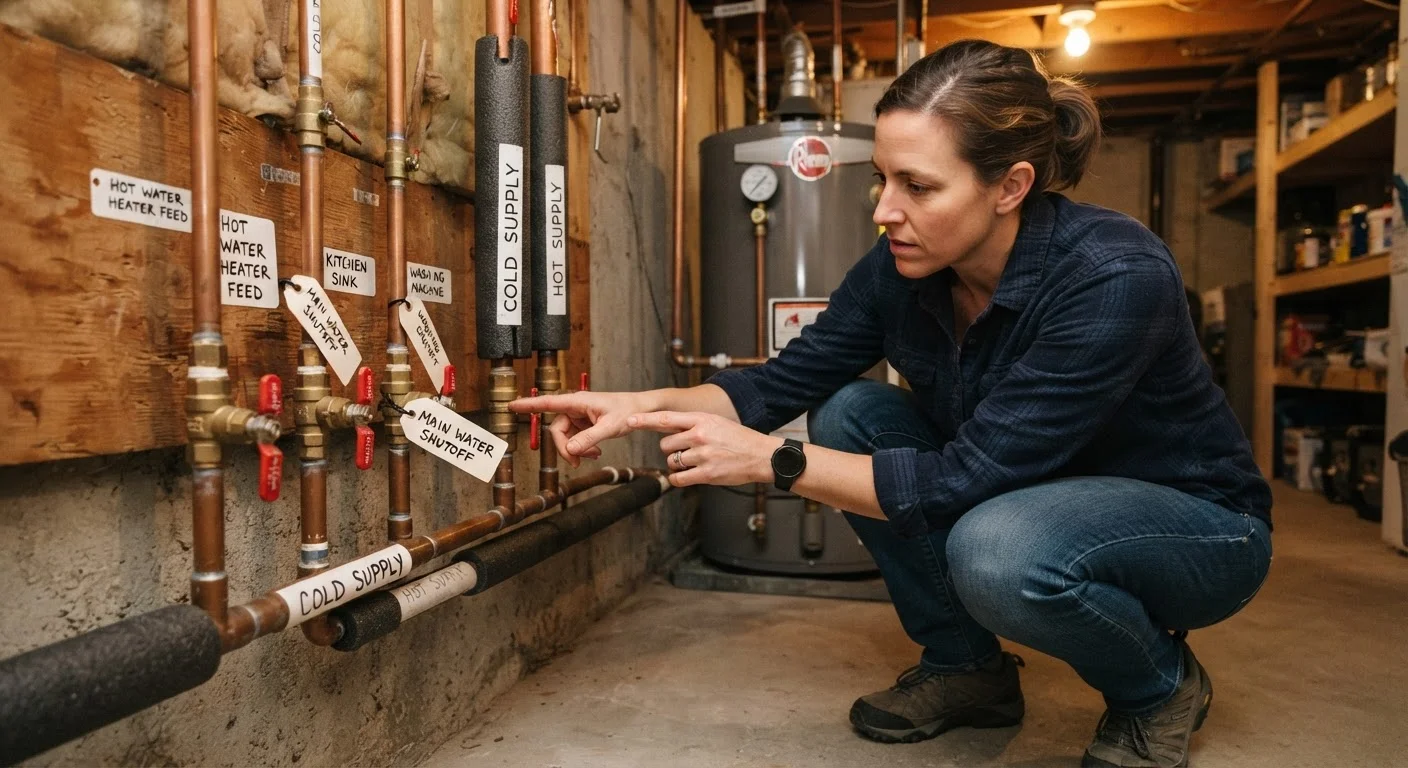
Label Valves Before You Forget
After locating your shut-offs, use a waterproof marker or adhesive label to tag each valve with its function - for example, 'Kitchen sink' or 'Main water supply.' This takes two minutes and is invaluable when someone else needs to act quickly or a plumber is working under time pressure.
Locating Your Gas Shut-Off Valves
Gas shut-offs fall into two categories: appliance-level and whole-home.
Appliance shut-offs sit on the gas supply line directly behind or beside each gas appliance - furnace, water heater, range, dryer. The handle position tells you the status: parallel to the pipe means open (gas flowing), perpendicular means closed.
The main gas shut-off is located at your gas meter, usually mounted on an exterior wall or in a ground-level box. Closing it requires a wrench; utilities typically ask homeowners not to do this routinely, because restoring gas service after a shutoff requires an inspection by the utility company.
Never Ignore a Gas Smell
If you detect the odor of natural gas (often described as a rotten egg or sulfur smell), do not operate any light switches, electrical devices, or open flames. Leave the home immediately, leaving doors open as you go, and call your gas utility's emergency line or 911 from outside. Do not re-enter until cleared by professionals.
Walk your home now and identify where each gas appliance's individual shut-off is. Sketch a rough floor plan if it helps. If you smell gas - don't touch any switches or valves, leave the home immediately, and call your gas utility or 911 from outside.
Your Electrical Panel: Breakers and the Main Disconnect
Your electrical panel (also called a breaker box or load center) is the control center for your home's circuits. It's most often found in a garage, utility room, basement, or hallway. Inside, individual circuit breakers protect different areas of the home; a main breaker at the top or bottom disconnects all power at once.
Individual breakers should be labeled to identify which room or appliance they control. If labels are missing or illegible, map them out: plug a lamp into an outlet, then flip breakers one at a time until the lamp goes off. Write the circuit description on the panel door using the existing label slots or a piece of tape.
The main disconnect is the large breaker at the top of the panel (or occasionally a separate exterior disconnect near the meter). Flipping it cuts power to all circuits in the home - useful during a flood or if an outlet sparks badly and you can't identify the circuit.
Never work inside a breaker panel yourself - the wiring behind the breakers remains live even when breakers are off. Electrical panel issues should always involve a licensed electrician. For broader home tech awareness, our overview of structural awareness for homeowners illustrates why understanding your home's systems - before problems arise - matters across the board.
Building a Simple Shut-Off Reference for Your Household
Knowing the locations yourself isn't enough - every adult in your household should be able to act independently in an emergency. A simple reference document goes a long way.
- Walk the home together. Show each person the main water shut-off, each fixture valve, appliance gas shut-offs, and the electrical panel.
- Create a one-page reference sheet. Sketch a rough floor plan with shut-off locations marked. Note which tool (if any) is needed - a wrench for the gas meter, for instance.
- Post it somewhere accessible. Inside a kitchen cabinet door, on the utility room wall, or photographed and stored in your phone are all practical options.
- Check annually. Confirm valves still turn, that panel labels are legible, and that nothing has shifted (finished basements and renovations can accidentally block valve access).
This kind of proactive preparation is the foundation of good preventive maintenance - the same principle that applies to smoke detectors, HVAC filters, and seasonal inspections. A few minutes spent today can save significant time, money, and stress when something goes wrong.