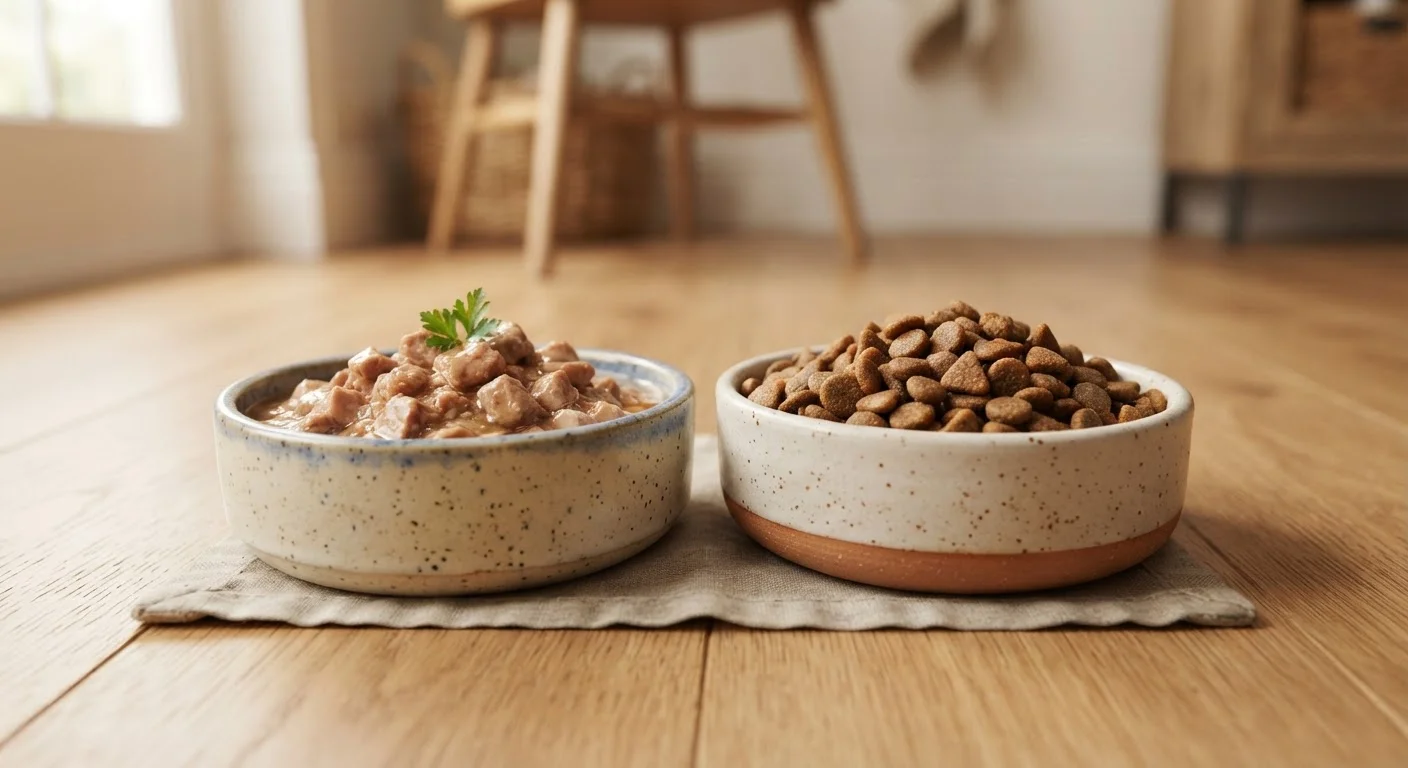
Why the Wet vs. Dry Debate Actually Matters
Cats are obligate carnivores with nutritional requirements shaped by millions of years of evolution as desert hunters. Their prey - small rodents and birds - provided not just protein and fat, but also a significant portion of their daily water intake. This evolutionary background is central to understanding why the wet-versus-dry question isn't just a matter of preference; it directly affects long-term health.
Most domestic cats have a weak thirst drive compared to dogs or humans. They don't instinctively compensate for a dry-food diet by drinking more water, which means the food itself becomes a critical hydration vehicle. As the full breakdown of feline dietary needs covers, getting the fundamentals right matters far more than chasing premium labels.
| Criterion | Wet Cat Food | Dry Cat Food |
|---|---|---|
| Moisture content | 70-80% | 8-10% |
| Calories per gram | Lower | Higher |
| Hydration support | Strong | Minimal |
| Urinary/kidney benefit | Generally favorable | Neutral to less favorable |
| Dental abrasion | Minimal | Minimal to slight |
| Shelf life once opened | 24-48 hours refrigerated | Weeks in sealed container |
| Convenience | Requires refrigeration | Room-temperature stable |
| Satiety per serving | Higher (more volume) | Lower (less volume) |
| Typical cost | Generally higher | Generally lower |
Hydration, Kidneys, and Urinary Health
Chronic low-grade dehydration is a genuine concern for cats fed exclusively dry food. Veterinary literature consistently links inadequate water intake to a higher incidence of feline lower urinary tract disease (FLUTD) and chronic kidney disease (CKD) - two of the most common and costly conditions in domestic cats.
Wet food, with its 70-80% moisture content, meaningfully increases daily fluid intake without requiring cats to drink more from a bowl. By contrast, dry kibble typically contains only 8-10% moisture. That's not an argument to eliminate dry food outright, but it is a real physiological consideration - particularly for male cats, who are anatomically more susceptible to urinary blockages.
70-80%
Moisture content in wet cat food
Compared to just 8-10% in dry kibble, this difference has meaningful implications for cats' daily fluid intake.
~60%
Estimated share of cats fed dry food exclusively
Industry surveys suggest the majority of U.S. cat owners rely primarily or entirely on dry kibble, despite veterinary guidance supporting mixed feeding for many cats.
Top 3
Ranking of kidney disease among cat health conditions
Chronic kidney disease is among the most common causes of illness and death in older domestic cats, with hydration widely recognized as a key modifiable factor.
Cats already managing kidney disease or recurrent urinary issues are often advised by veterinarians to shift toward wet food as a primary dietary component. If your cat has either condition, this is a conversation to have directly with your vet rather than a decision to make based on general guidance alone.
Calories, Weight, and the Free-Feeding Problem
Dry food is calorie-dense. A cup of kibble can contain 300-400 calories, and because it's easy to leave out all day, many cats consume far more than they need. Free-feeding dry food is one of the most common drivers of feline obesity, which itself is associated with diabetes, joint disease, and shortened lifespan.
Wet food, by comparison, is lower in calories per gram because water has no caloric value. A cat eating wet food tends to feel full sooner and consume fewer total calories - a meaningful advantage for cats already carrying extra weight. That said, portion control matters regardless of format. The guide to feeding schedules and portion sizes goes deeper on how feeding patterns - not just food type - shape body condition over time.
Measured meals, whether wet or dry, are generally preferable to unrestricted access. If convenience requires leaving food out, puzzle feeders and timed dispensers can help slow intake without eliminating flexibility.
Dental Health: The Kibble Myth
A persistent belief holds that dry food cleans cats' teeth through abrasion. The reality is more nuanced. Most cats don't chew kibble long enough to produce meaningful plaque removal, and no standard dry food replaces proper dental care. Some formulations are specifically designed with larger kibble sizes or fibrous matrices to reduce tartar - but these are distinct products, not general kibble.
Wet food is sometimes blamed for contributing to dental disease because it doesn't provide even the limited abrasive contact of kibble. Evidence for either claim in the broader scientific literature remains limited. Veterinary dental assessments, tooth brushing, and professionally recommended dental chews are more reliable tools for oral health than food format alone.
If dental health is a priority - particularly for a cat you're setting up for the long term - discuss a dental care routine with your vet rather than relying on food type as a substitute.
This article is for general informational purposes only and does not constitute veterinary or medical advice. Always consult a licensed veterinarian before making significant changes to your cat's diet, particularly if your cat has an existing health condition.