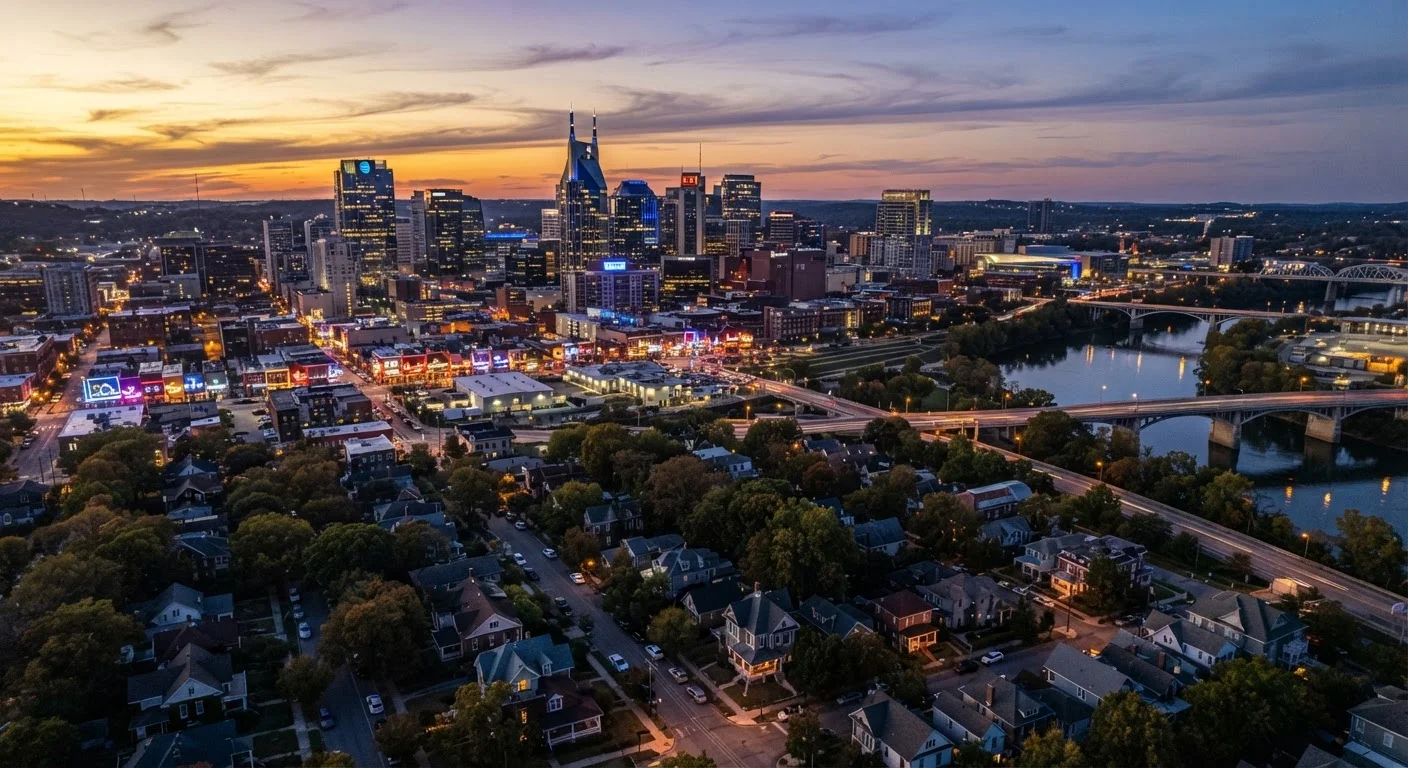
Lower Broadway: The Version Most Visitors See
If you've seen a Nashville travel photo, it almost certainly came from Lower Broadway. The neon signs, the multi-story honky-tonks, the live country music pouring out of every doorway at noon on a Tuesday - this strip delivers exactly what it promises. But it's a specific product, designed and optimized for tourism at volume.
The bars here operate on a cover-charge-free, tip-the-band model. The crowds are dense on weekends. Bachelorette parties are not occasional - they are structural. Pedal taverns and party buses cycle through regularly. None of this is a criticism; it's accurate description. Visitors who understand what Lower Broadway is tend to enjoy it. Those who arrive expecting an authentic local music scene sometimes feel misled.
One block off Broadway in either direction, the character shifts immediately. That rapid transition is one of Nashville's defining traits.
Visit Broadway Early in the Day
If you want to experience Lower Broadway without the densest crowds, late morning on a weekday is noticeably calmer. You can still catch live music - many venues run sets throughout the day - but you'll have more room to move and easier access to grab a drink and settle in. Weekend evenings are the peak volume window.
East Nashville: A Different Rhythm Entirely
Cross the Cumberland River and the temperature drops a few degrees - not literally, but atmospherically. East Nashville has attracted independent restaurants, craft cocktail bars, vintage shops, and a younger, more locally-rooted crowd. It's the part of the city where you're more likely to sit next to someone who actually lives in Nashville than someone visiting for a weekend.
Five Points is the neighborhood's informal center, with walkable blocks lined with coffee shops and small restaurants. The vibe is relaxed in a way that downtown rarely is. Prices at restaurants here tend to be more moderate, though gentrification has been reshaping costs across the area for years.
East Nashville Is Still Changing
East Nashville has been in an active gentrification cycle for over a decade, and the neighborhood continues to shift. Some longtime local businesses have closed as rents rise; new restaurants and bars open regularly. Travel information about specific spots can go out of date quickly, so it's worth checking recent local sources before visiting any particular place.
East Nashville isn't a hidden secret anymore - it's well-covered in travel media. But it still feels distinctly different from the tourist corridor, and that difference is worth experiencing firsthand.
12South, Midtown, and the Gulch: Three Takes on Urban Polished
12South is a walkable strip of boutiques, brunch spots, and a famous mural wall that generates a consistent stream of photo-seekers. It's pleasant, well-maintained, and skews toward a demographic interested in lifestyle retail and farm-to-table dining. It's also genuinely walkable in a way that much of Nashville is not.
Midtown - centered loosely around Vanderbilt University - has a more neighborhood-functional feel. You'll find dive bars alongside upscale restaurants, and the energy changes depending on whether Vanderbilt is in session. The Gulch, just south of downtown, is the city's most strikingly modern pocket: high-rise buildings, rooftop bars, and a clean, developed aesthetic that reads more like a recently built urban quarter than a neighborhood with deep roots.
All three areas offer a version of Nashville that feels less frenetic than Broadway, but each one serves a different traveler. Understanding which matches your travel style before you book accommodation can meaningfully change your experience.
Much like the way New Orleans rewards visitors who look beyond Bourbon Street, Nashville opens up considerably once you move past the most-photographed blocks.
What This Means When You're Planning Your Trip
Nashville's neighborhoods are not interchangeable. Staying in the Gulch puts you in walking distance of a different set of restaurants and bars than staying near 12South. Basing yourself in East Nashville means ridesharing to Broadway rather than walking home from it at 2 a.m. - which might be exactly what you want, or might be inconvenient depending on your plans.
A few practical considerations worth mapping before you arrive:
- Walk radius: Identify what's within 15 minutes on foot from where you're staying. Nashville's neighborhoods are internally walkable but not always well-connected to each other on foot.
- Noise and crowd tolerance: If light sleeper or early riser, proximity to Lower Broadway has real implications on weekend nights.
- Food priorities: Nashville's most locally-praised restaurants are scattered across neighborhoods. A list of places you want to eat will tell you a lot about where to base yourself.
- Development stage: Several areas are actively changing. What a blog post from two years ago describes may look different on the ground today.
Nashville is a genuinely interesting city with more texture than its party-destination reputation suggests. Getting that texture requires treating each neighborhood as its own destination within the destination.