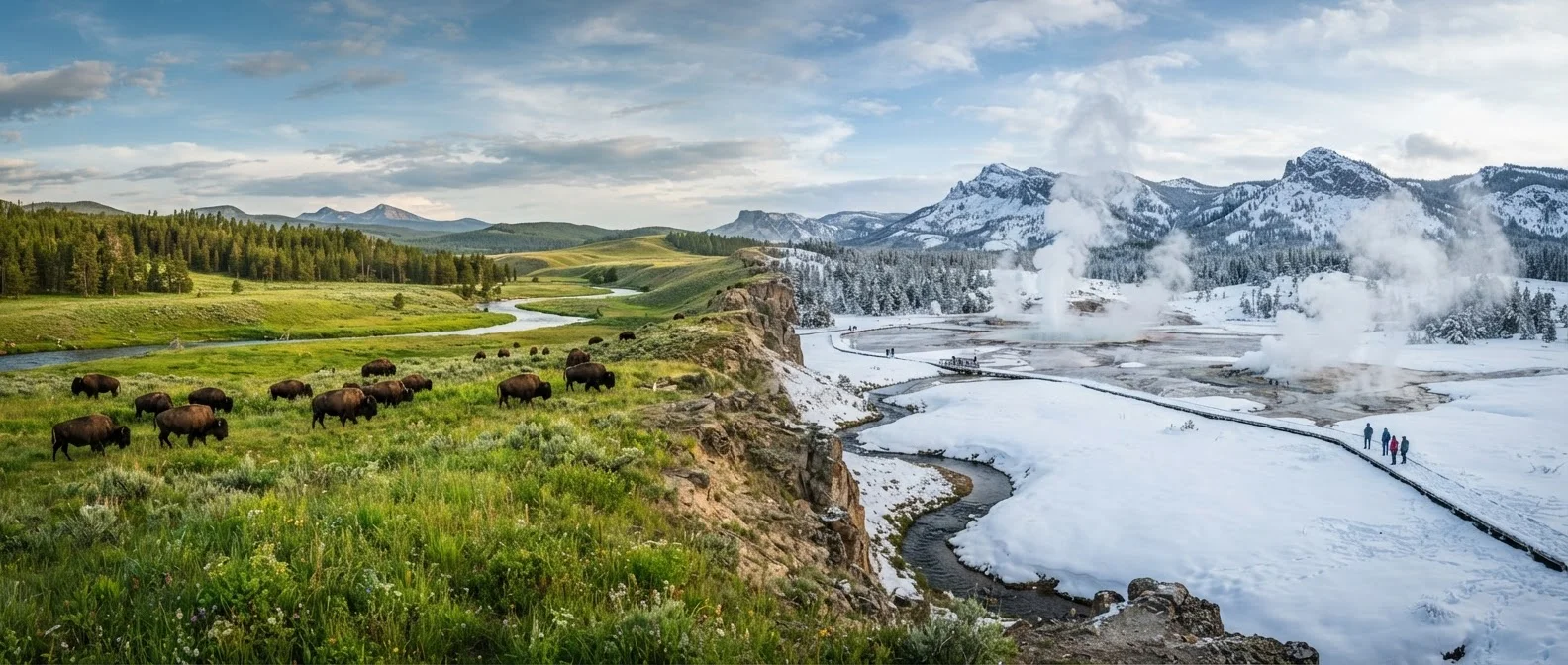
Access and Crowds: A Tale of Two Park Experiences
Yellowstone's 2.2-million-acre landscape behaves almost like two different parks depending on the season. In summer - roughly late May through early September - the Grand Loop Road and most secondary roads are fully open to private vehicles. Visitors can self-drive between geothermal basins, pull-outs, and trailheads at their own pace. The tradeoff is volume: Yellowstone routinely sees 3-4 million annual visitors, with the largest share arriving in July and August. Parking lots at Old Faithful, Grand Prismatic Spring, and Mammoth Hot Springs fill early in the morning, and traffic jams caused by wildlife sightings (known locally as "bison jams") are common.
Winter tells a starkly different story. By mid-November, most park roads close to private vehicles. The primary exceptions are the road between Gardiner and Cooke City, which stays open year-round, and the Mammoth to Tower-Roosevelt corridor. To reach the interior - including the Old Faithful area - visitors must use guided snowcoach services or rent permitted snowmobiles. This isn't an obstacle so much as a filter: it keeps crowds manageable and ensures those who do make the trip are rewarded with near-solitary access to geothermal features. If you're thinking about road conditions on the drive to the park, our guide on seasonal tire preparation is worth reviewing before any winter mountain drive.
| Criterion | Summer | Winter |
|---|---|---|
| Road Access | Nearly all roads open | Most roads closed to private vehicles |
| Visitor Crowds | High - millions visit July-August | Very low - interior accessible by tour only |
| Wildlife Visibility | Bears, bison calves, active wolves | Wolves, bison near thermals; no bears |
| Thermal Drama | Always active; less visually striking | Steam highly visible against snow and cold air |
| Hiking Availability | Hundreds of miles of maintained trails | Extremely limited; mostly snowshoe/ski |
| Lodging Options | Multiple in-park lodges and campgrounds | Limited; Old Faithful Snow Lodge primary option |
| Advance Planning Required | Months ahead for peak weeks | Snowcoach reservations needed well ahead |
| Typical Temperatures | 50-80°F daytime | 0-20°F daytime; wind chill significant |
Wildlife and Thermal Features by Season
Summer is prime time for bear activity, with grizzlies and black bears frequently spotted feeding in meadows from late spring through early fall. Wolf packs are active, bison calves appear in May and June, and the Lamar Valley earns its nickname as "America's Serengeti" during peak summer mornings. Thermal features are always active, but they don't stand out as dramatically against warm, dry air.
Winter reverses some of these dynamics. Wolves are easier to track in snow, and bison congregate near geothermal areas where ground warmth keeps grass accessible. The Lamar Valley remains one of the best places in North America to observe wolves, and cold temperatures make Old Faithful's steam column tower visibly higher than in summer. The contrast of hot springs against snow and ice produces a genuinely otherworldly visual that photographs can't fully capture. For readers wondering whether winter or shoulder timing might suit them better, our overview of shoulder season travel in the U.S. offers useful context on timing decisions generally.
3-4M
Annual Yellowstone visitors
The National Park Service reports Yellowstone typically receives between 3 and 4 million recreational visits per year, the majority concentrated in summer months.
~170K
Winter visitors annually
Winter visitation accounts for a small fraction of the annual total, according to NPS data, making it significantly less crowded than the summer peak.
500+
Active geysers in the park
Yellowstone hosts more than half the world's active geysers, according to the National Park Service, active and visible year-round regardless of season.
Planning, Lodging, and Practical Realities
Summer logistics require months of advance planning. Campground reservations through the recreation.gov system open in the spring and fill quickly for peak weeks. In-park lodges managed by the park's concessionaire book well ahead, and gateway towns like West Yellowstone and Gardiner see their own lodging shortages in July. Arriving early in the day - before 9 a.m. - is one of the most effective strategies for managing crowd frustration at major sites.
Winter travel is logistically simpler in some respects and more demanding in others. Snowcoach reservations with authorized concessionaires must be booked in advance, and only a few in-park lodges operate in winter, including the Old Faithful Snow Lodge. However, the overall visitor load is so much lower that spontaneity becomes more possible once you're inside. Cold-weather gear is non-negotiable: daytime temperatures commonly sit well below freezing, and wind chill in exposed thermal basins can be severe. Check current road and facility status directly through the National Park Service (nps.gov/yell) before finalizing any trip, as seasonal openings and closures can shift based on weather and staffing.
This article provides general travel information only. Road conditions, facility availability, and park access rules change seasonally and year to year. Always verify current details with the National Park Service and relevant transportation providers before booking or traveling.