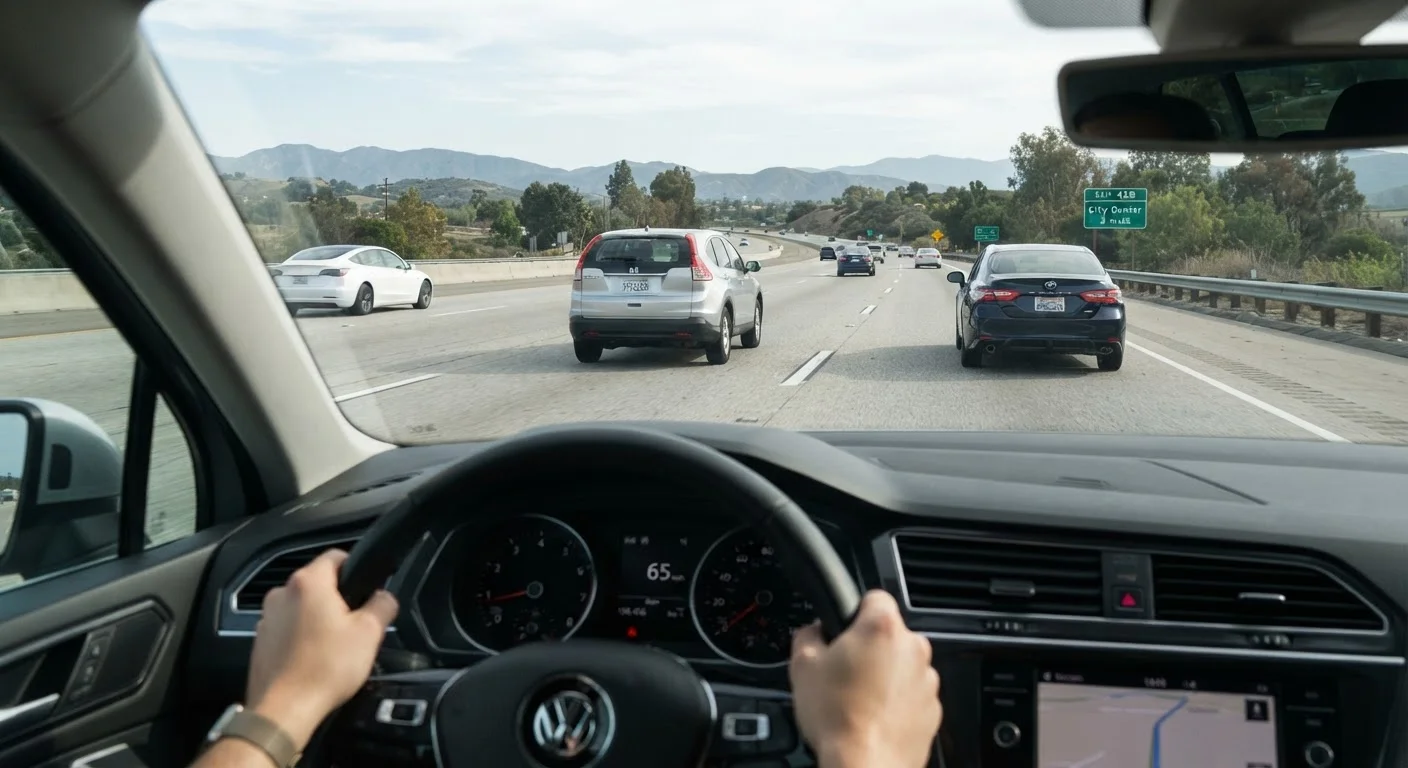
The Reaction Time Myth
Most drivers believe that sharp reflexes are their primary defense on the road. Reaction time does matter - but it's largely outside your control while you're behind the wheel. Research consistently places average perception-reaction time for an alert driver at approximately 1.5 seconds. That's the time from seeing a hazard to your foot actually applying brake pressure. You can't meaningfully improve that number in the moment.
What you can control is how much space you've left yourself before that 1.5 seconds begins to count down. Following distance is the variable that makes your reaction time either sufficient or irrelevant. A one-second gap at 60 mph leaves you roughly 88 feet. At that speed, your vehicle needs over 200 feet to stop completely - and that's under ideal conditions with full brake pressure on dry pavement.
This is the core of why following distance matters more than reflexes. Reaction time sets a floor; following distance determines whether you have any room to work with above it. Common tailgating myths often obscure this basic physics reality, convincing drivers that alertness alone is enough.
How the 3-Second Rule Actually Works
The 3-second rule is the most widely taught following distance guideline in the U.S. - and it's expressed in time rather than feet for a good reason. As your speed increases, the distance covered in 3 seconds grows automatically, so the rule scales with driving conditions without requiring mental math.
To apply it: choose a fixed roadside marker. When the vehicle ahead passes it, begin counting. If you reach that marker before you hit three seconds, close the gap by easing off the accelerator. Three seconds gives most drivers enough time to perceive a sudden stop, move their foot, apply brakes, and begin decelerating - assuming dry roads and an alert mind.
Increase Your Gap in Poor Conditions
The 3-second rule is a minimum for clear, dry conditions with an alert driver. Add at least one extra second for rain, and consider 5-6 seconds in fog, ice, or if you're feeling drowsy. These buffers aren't excessive caution - they're physics-based adjustments to conditions that genuinely extend stopping distances.
Conditions frequently demand more than 3 seconds. Rain reduces tire traction significantly, extending stopping distances. Fog and darkness shrink the window in which you can even see a hazard ahead. Fatigue slows perception-reaction time below the alert-driver baseline. In any of these situations, a 4-6 second gap is more appropriate. Drowsy driving in particular degrades reaction time in ways drivers routinely underestimate.
What Happens to Stopping Distance as Speed Increases
Here's the physics that most drivers don't fully internalize: braking distance increases with the square of your speed, not proportionally. Double your speed and you roughly quadruple the distance required to stop. At 30 mph on dry pavement, a typical passenger car might stop in about 75 feet total (including reaction distance). At 60 mph, that figure climbs to roughly 300 feet.
~29%
Share of U.S. crashes that are rear-end collisions
According to the National Highway Traffic Safety Administration, rear-end crashes consistently represent nearly one-third of all traffic crashes in the United States.
1.5 sec
Average perception-reaction time for an alert driver
Transportation safety research places typical perception-reaction time around 1.5 seconds; impairment, fatigue, or distraction can push this significantly higher.
4×
Stopping distance increase from doubling speed
Because braking distance scales with the square of speed, driving at 60 mph requires roughly four times the stopping distance of driving at 30 mph on the same road surface.
This exponential relationship is why a small increase in following distance at highway speeds pays dramatically larger dividends than the same increase at neighborhood speeds. It also explains why the posted speed limit and a genuinely safe speed aren't always the same thing - road conditions shift the stopping-distance equation even when your speedometer doesn't.
Drivers who scan further ahead get a head start on hazard awareness, but scanning only helps if the gap behind the car ahead is large enough to act on what you see.
Real-World Scenarios Where Following Distance Decides the Outcome
Following distance isn't an abstract safety concept - it's the margin that determines collision or clearance in specific, everyday situations.
The common thread across these scenarios is that alertness gets you to the brake pedal; following distance determines whether braking is enough. No amount of attention compensates for the physics deficit created by a short gap.
The information in this article is intended for general educational purposes. Always follow the traffic laws and guidelines applicable in your state, and consult your vehicle owner's manual for specific braking and handling characteristics of your car.