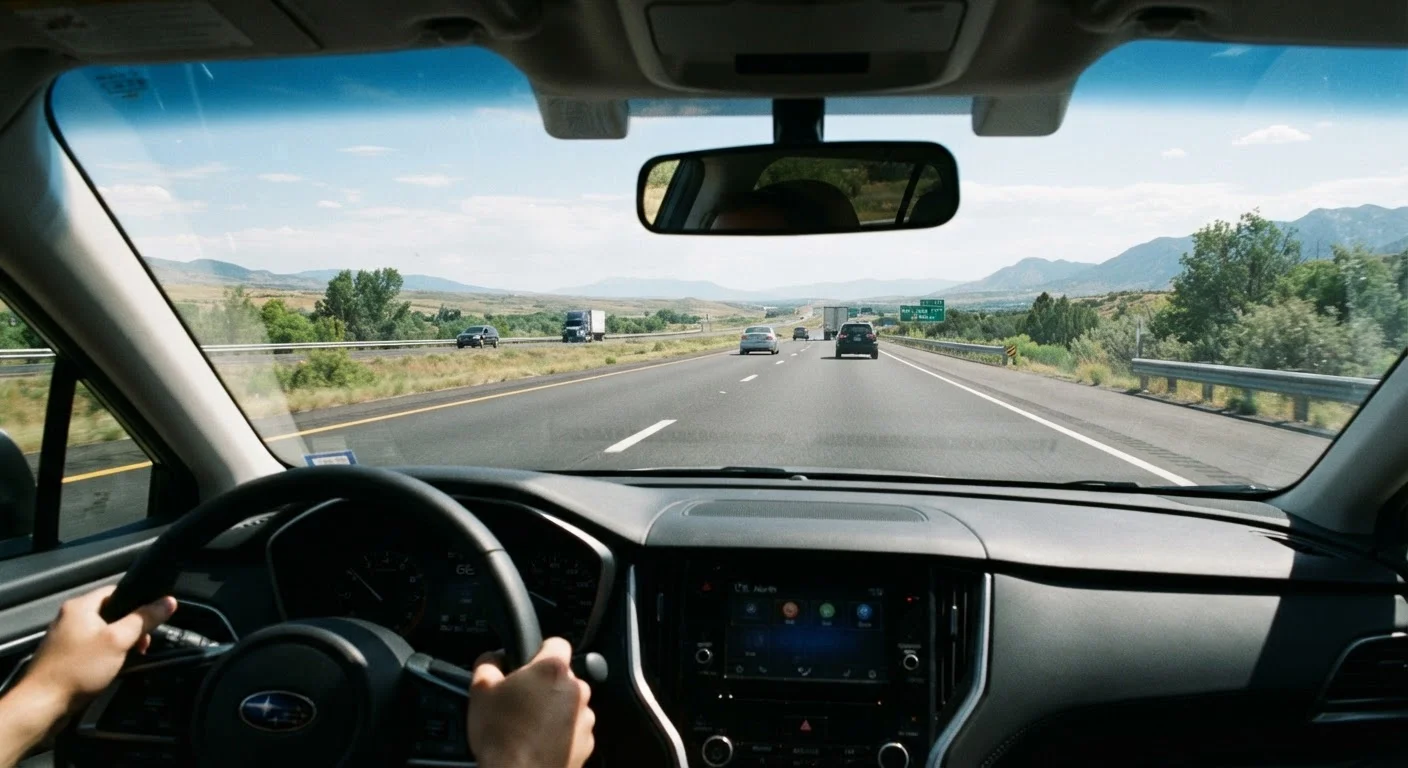
Why Where You Look Is the Most Important Variable
Most drivers think of reaction time as a fixed biological limit - something you either have or you don't. In reality, the more powerful variable is where your eyes are pointed in the first place. A driver who spots a hazard four seconds before impact has far more options than one who catches it at one second, even if both have identical reflexes.
New drivers tend to anchor their gaze close - near the front bumper or just a car-length ahead. This isn't carelessness; it's a natural response to the cognitive load of learning to drive. But it creates a dangerous gap between when a hazard appears and when the driver can respond to it.
Experienced drivers push their focal point much further down the road, processing the near zone through peripheral vision. The result is a calmer, more predictable driving style - and significantly more time to make decisions. This is the core of what driver educators call visual lead time.
The 12-Second Rule Explained
A widely used benchmark in driver training is to scan at least 12 to 15 seconds of travel distance ahead. To find your 12-second point, pick a fixed object in the distance - a sign, an intersection, an overpass - and count how long it takes to reach it. At 30 mph in a neighborhood, 12 seconds puts your eyes roughly two blocks out. At 65 mph on the interstate, you're looking about a quarter mile ahead.
That distance is not arbitrary. It represents approximately the minimum time a driver needs to perceive a hazard, decide on a response, and execute a braking or steering maneuver. Anything less and you're reacting; at 12 seconds or more, you're anticipating.
~40%
Of crashes linked to driver inattention or distraction
The National Highway Traffic Safety Administration has consistently identified inattention as a factor in a large share of reported collisions, underscoring the importance of active visual engagement.
12-15 sec
Recommended visual lead time while driving
This range is used in Smith System driver training and commercial driver education programs across the United States as the foundation of hazard-detection skills.
~1,320 ft
Distance covered in 15 seconds at 60 mph
At highway speeds, a 15-second visual lead means your eyes are processing road conditions roughly a quarter mile ahead - the equivalent of about four city blocks.
This ties directly to following distance. The gap you leave between your car and the one ahead determines whether your 12-second visual lead translates into usable stopping space - or whether another vehicle is already eating up that buffer.
What Good Scanning Actually Looks Like
Scanning is not a fixed stare. It's an active, rhythmic movement of the eyes across the full visual field. Effective scanning typically includes:
- A far focal point - your primary gaze 12-15 seconds ahead, checking for slowing traffic, merging vehicles, pedestrians, and signals.
- Periodic mirror checks - every five to eight seconds to maintain awareness of what's beside and behind you.
- Intersection sweeps - before entering any intersection, an explicit left-right-left scan to check for crossing traffic, not just the signal.
- Tracking moving hazards - pedestrians near crosswalks, cyclists in bike lanes, vehicles on side streets - logging where they are and predicting where they might go.
Merging situations demand a variation of this approach. Highway merging requires reading traffic gaps that are hundreds of feet ahead while also monitoring your own lane and acceleration - exactly the kind of multi-zone scanning experienced drivers do without thinking.
Try the Narration Drill on Your Next Drive
Pick a five-minute stretch of a familiar route and quietly name everything you notice ahead of you - signals, pedestrians, merging vehicles, brake lights. Speaking the observations aloud forces your eyes to actually hunt for them rather than passively rest on one spot. Most drivers notice within a week that their scanning range has extended noticeably without conscious effort.
Building the Habit: Practical Steps
Deliberate practice accelerates this skill faster than simply accumulating miles. A few approaches that work:
- Narrate your drive. Quietly name what you see ahead - "truck slowing," "kid near the curb," "light about to change." This forces your eyes to actually find things rather than passively staring.
- Set a scanning reminder. At the start of each drive, consciously push your gaze to the furthest visible point. The habit of resetting tends to carry through the trip.
- Practice on familiar roads. When you know the route, your cognitive load drops and you can focus on deliberately changing your eye behavior without the distraction of navigation.
Scanning also changes in adverse conditions. In heavy rain, your useful forward sight line shrinks substantially - wet roads require you to reduce speed so that your stopping distance stays within what you can actually see. The principle of visual lead time stays the same; the physical distance available to you shrinks.
Younger and older drivers face distinct versions of this challenge. Risk profiles shift across a driving lifetime, but the underlying skill of deliberate scanning remains relevant at every age. It's one of the few habits that rewards the effort to learn it at any stage.