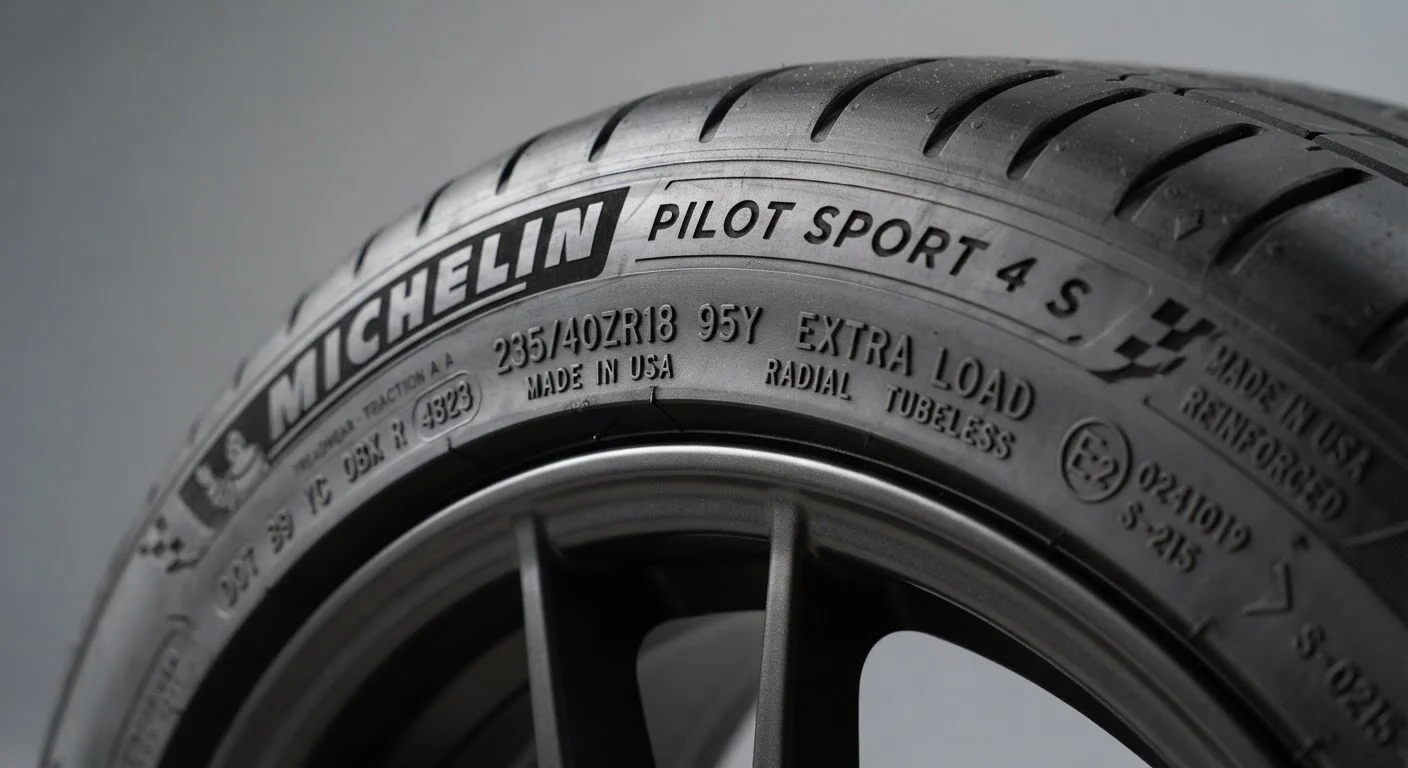
The Anatomy of a Tire Code
Look at the sidewall of any passenger tire and you'll find a string like P215/65R17 98H. It looks like a random jumble, but every character has a specific meaning defined by industry standards. Once you know the pattern, you can read any tire in about ten seconds.
| Width unit | Millimeters (e.g., 215 mm) |
| Aspect ratio | Sidewall height as % of width |
| Construction letter | R = Radial (standard on modern tires) |
| Diameter unit | Inches (must match rim exactly) |
| Load index 98 | 1,653 lbs max per tire (Industry-standard load index tables) |
| Speed rating H | Up to 130 mph |
| DOT date code | Last 4 digits = week + year of manufacture |
| 3PMSF snowflake symbol | Meets winter traction performance standard |
The code breaks down into five parts: tire type, section width, aspect ratio, construction type, wheel diameter, load index, and speed rating. Most of what you need to know for everyday decisions - including matching a replacement tire or verifying a used car's rubber - lives right in that sequence.
Decoding Each Segment
Tire Type Prefix
The letter before the numbers identifies the tire's intended use. P stands for passenger vehicle. LT means light truck. ST means special trailer. Some tires carry no prefix at all - those are Euro-metric tires built to slightly different load standards than P-metric tires, which matters if you're mixing or replacing.
Section Width
The three-digit number (215 in the example) is the tire's section width measured in millimeters from sidewall to sidewall at the widest point. A wider number means a physically broader tire.
Aspect Ratio
The two-digit number after the slash (65) is the aspect ratio - the tire's sidewall height expressed as a percentage of the section width. So a 215/65 tire has a sidewall height of about 140 mm (65% of 215). Lower aspect ratios mean shorter, stiffer sidewalls, which generally improve handling responsiveness but can make for a firmer ride.
Construction Type
R stands for radial, meaning the internal cord plies run radially from bead to bead. Radial construction is standard on virtually all modern passenger tires. The older D designation (diagonal or bias-ply) still appears on some trailer, motorcycle, and antique vehicle tires.
Wheel Diameter
The number after the R (17) is the wheel diameter in inches that the tire is designed to fit. This must match your rim exactly - a 17-inch tire will not seat correctly on a 16-inch or 18-inch wheel.
Load Index and Speed Rating
The final pairing (98H) covers how much weight the tire can support and how fast it's rated to operate. The load index is a standardized number - 98 corresponds to a maximum load of 1,653 lbs per tire, according to industry load index tables. The speed rating letter indicates the maximum sustained speed the tire is designed to handle. H-rated tires are rated to 130 mph; V covers up to 149 mph; W and Y go higher still. Always match or exceed your vehicle manufacturer's specified speed rating when replacing tires.
Aspect ratio
The ratio of a tire's sidewall height to its section width, expressed as a percentage. A lower aspect ratio means a shorter, stiffer sidewall.
Load index
A standardized numeric code that corresponds to the maximum load a single tire can support. The actual weight value is found in an industry load index table.
Speed rating
A letter code indicating the maximum sustained speed a tire is designed to handle under specified load conditions. It should always meet or exceed the vehicle manufacturer's requirement.
UTQG
Uniform Tire Quality Grading - a U.S. government-mandated system rating passenger tires on treadwear, traction, and temperature resistance using standardized grades.
Section width
The measurement in millimeters across the widest point of a tire's cross-section from one sidewall to the other, measured when mounted on a specified rim width.
Radial construction
A tire design in which internal cord plies run perpendicular (radially) to the direction of travel. Radial tires are the standard for modern passenger and light truck vehicles.
For more on how these figures intersect with tread condition and inflation, see our guide to tire pressure and tread depth.
Other Markings You May Notice
Beyond the primary size code, tires carry additional molded information worth recognizing:
- DOT code: A string beginning with "DOT" followed by up to 12 characters. The last four digits indicate the week and year of manufacture - for example, 2419 means the 24th week of 2019. Tire age matters for safety; most manufacturers suggest replacing tires six to ten years from the manufacture date regardless of tread depth.
- UTQG ratings: Uniform Tire Quality Grading includes treadwear, traction, and temperature grades. Treadwear is a relative index (higher numbers indicate longer projected wear); traction grades run AA, A, B, C; temperature grades run A, B, C from best to lowest heat resistance.
- M+S or Snowflake symbol: "M+S" (mud and snow) indicates the tread pattern meets a basic all-weather threshold. The three-peak mountain snowflake (3PMSF) symbol signals the tire passed a more rigorous winter traction test and is generally considered a dedicated winter or all-weather tire. If you're considering seasonal tire changes, this distinction matters - see our overview of seasonal tire swapping for guidance.
- Max load and max pressure: These indicate the tire's individual capacity limits - not necessarily the correct pressure for your vehicle. Your vehicle's correct inflation pressure is on the door jamb sticker, not the tire itself.