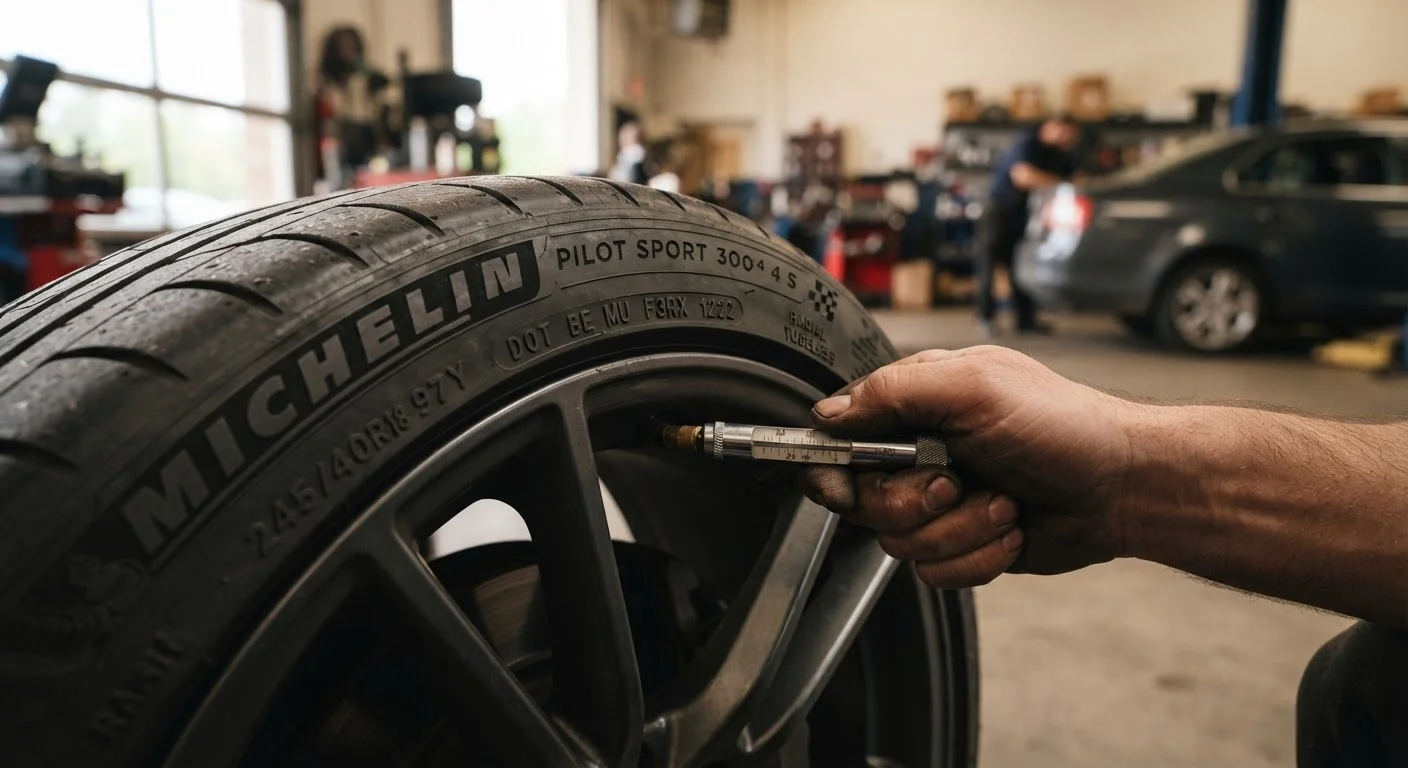
Decoding the Numbers on Your Tire Sidewall
That string of letters and numbers molded into the side of your tire isn't random. It encodes everything from the tire's physical dimensions to its load-carrying capacity and top speed rating. For a full breakdown of every character, see how to decode your tire sidewall. Here are the key figures most drivers need day-to-day.
A typical designation looks like this: P215/65R17 98H. Here's what each part means:
- P - Tire type. "P" stands for passenger vehicle. "LT" means light truck.
- 215 - Section width in millimeters, measured from sidewall to sidewall.
- 65 - Aspect ratio. The sidewall height is 65% of the section width.
- R - Radial construction, the standard for modern tires.
- 17 - Rim diameter in inches the tire is designed to fit.
- 98 - Load index. Each number corresponds to a maximum weight capacity per tire.
- H - Speed rating. "H" indicates a maximum sustained speed of 130 mph under load.
Matching replacement tires to these specifications matters. A lower load index or speed rating than your vehicle requires is a safety concern, not just a performance one.
PSI
Pounds per square inch - the unit used to measure tire inflation pressure in the United States. Your door jamb sticker lists the recommended PSI for front and rear tires separately.
Aspect Ratio
The ratio of a tire's sidewall height to its section width, expressed as a percentage. A tire labeled 215/65 has a sidewall height equal to 65% of its 215 mm width.
Load Index
A standardized number on the tire sidewall that corresponds to the maximum weight one tire can safely carry. Higher numbers indicate greater load capacity.
Speed Rating
A letter code indicating the maximum sustained speed a tire is designed to handle under full load. Common ratings range from S (112 mph) to Y (186 mph).
TPMS
Tire Pressure Monitoring System - a sensor-based system required on U.S. passenger vehicles since 2008 that triggers a dashboard warning when tire pressure drops about 25% below the recommended level.
Tread Depth
The measurement from the top of a tread block to the bottom of the groove. New tires typically start at 10/32 to 11/32 of an inch; replacement is generally recommended at 4/32 of an inch for safety.
Tire Pressure: What's Correct, How to Check It, and Why It Drifts
Correct tire inflation is one of the most impactful - and most neglected - maintenance tasks. Under-inflated tires build excess heat, wear along the outer edges, and reduce fuel efficiency. Over-inflated tires ride harder, wear in the center, and lose grip because less tread contacts the road.
| Recommended pressure source | Driver's door jamb sticker or owner's manual |
| Pressure check timing | Cold tires - parked 3+ hours or driven under 1 mile |
| Pressure change per 10°F temperature drop | ~1 PSI (General engineering guideline) |
| Legal minimum tread depth (most U.S. states) | 2/32 inch |
| Recommended replacement tread depth | 4/32 inch (Widely cited by safety organizations) |
| TPMS warning threshold | ~25% below recommended PSI (U.S. federal TPMS regulation) |
Where to find your correct pressure: Look on the sticker inside the driver's door jamb or in your owner's manual. Do not use the maximum pressure number printed on the tire sidewall - that's the tire's structural limit, not your vehicle's recommended operating pressure, and it's often significantly higher than what's safe for everyday driving.
How to check accurately: Measure when the tires are cold - meaning the vehicle has been parked for at least three hours or driven fewer than a mile. Use a quality dial or digital gauge. Tire pressure monitoring systems (TPMS) on most vehicles built after 2008 will alert you when pressure drops about 25% below recommended, but that threshold is already low enough to affect handling. Don't rely on TPMS alone for maintenance checks.
Why pressure changes: Tire pressure drops roughly 1 PSI for every 10°F drop in ambient temperature. A tire that's correct in summer can be noticeably low by midwinter without a single leak. Check pressure monthly and before any long trip. For winter-specific considerations, seasonal tire swapping guidance covers how temperature swings affect your tires more broadly.
Tread Depth: Measuring It and Knowing When to Act
Tread channels water away from the contact patch between your tire and the road. As tread wears down, that ability degrades - and stopping distances increase, especially on wet pavement.
Legal minimum vs. safe minimum: Most U.S. states set the legal tread depth limit at 2/32 of an inch. However, independent testing consistently shows that wet-weather braking performance deteriorates significantly before that threshold. Many safety organizations recommend replacing tires at 4/32 inch, and the case is strong for acting at that point rather than waiting.
How to measure: The simplest method is the penny test - insert a penny into a tread groove with Lincoln's head pointing down. If you can see the top of his head, the tread is at or below 2/32 inch: replace immediately. For a 4/32 inch check, use a quarter - if you can see the top of Washington's head, you're at or near 4/32 inch. A dedicated tread depth gauge (inexpensive at any auto parts store) gives a more precise reading and is worth having.
Uneven wear patterns: Wear that's heavier on one edge than the other usually points to an alignment or inflation problem rather than a tire defect. Center wear suggests chronic over-inflation; edge wear suggests under-inflation. If you're seeing uneven patterns, understanding wheel alignment explains what's likely happening and why it should be addressed before you install new tires. Poor tread depth also compounds the dangers described in winter road surface traction.
Check all four tires monthly, not just the ones easiest to reach. Rear tires on front-wheel-drive vehicles often wear at different rates than the fronts and can catch drivers off guard.