Fat Is Not the Enemy It Was Made Out to Be
For decades, the message was simple: fat makes you fat. Food packaging celebrated "fat-free" as a badge of health. The result was a market flooded with low-fat cookies, snack cakes, and dressings - most of them loaded with added sugar to compensate for lost flavor. Americans ate less fat and didn't get healthier. That experiment is instructive.
The core problem was treating fat as a single, monolithic thing to be avoided rather than a diverse group of molecules with very different effects on the body. Your body genuinely cannot function without dietary fat. It provides a concentrated energy source, forms the structural basis of every cell membrane, enables the production of hormones including estrogen and testosterone, and is required to absorb the fat-soluble vitamins A, D, E, and K. Fear of fat, taken to an extreme, creates real nutritional deficits.
The goal isn't to eat as little fat as possible - it's to understand which kinds of fat to prioritize, which to moderate, and which to limit as much as practically possible. As you'll see when exploring common nutrition myths, blanket avoidance of entire macronutrients rarely holds up to scrutiny.
The Four Main Types of Fat - and What They Do
Dietary fats fall into four broad categories. Their behavior in the body largely comes down to molecular structure - specifically the arrangement and number of bonds between carbon atoms in their fatty acid chains.
Monounsaturated Fats
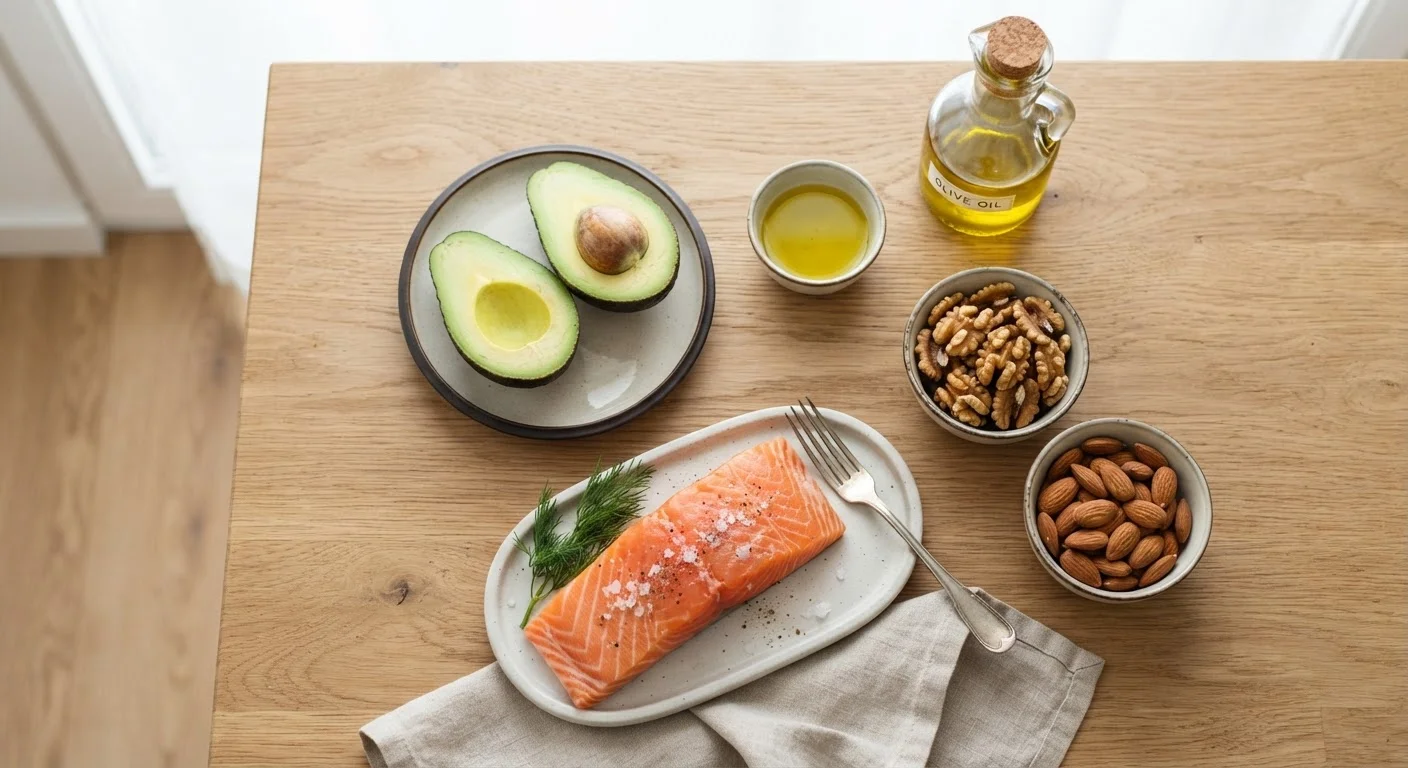
Found in olive oil, avocados, almonds, and peanuts, monounsaturated fats have one double bond in their carbon chain, making them liquid at room temperature but solid when chilled. Research consistently associates diets rich in monounsaturated fats with favorable cholesterol profiles and reduced cardiovascular risk markers.
Polyunsaturated Fats
This category includes omega-3 and omega-6 fatty acids - both considered essential because the body cannot manufacture them from scratch. Omega-3s, found in fatty fish, walnuts, and flaxseed, are particularly associated with anti-inflammatory effects and heart health. Omega-6s, found in many vegetable oils, are also necessary but are already abundant in the typical American diet.
Saturated Fats
Saturated fats - found in red meat, full-fat dairy, and tropical oils like coconut and palm - have no double bonds, making them solid at room temperature. They have historically been linked to elevated LDL ("bad") cholesterol. Current evidence suggests the picture is more nuanced and that dietary context matters, but most health authorities still recommend moderating intake rather than eliminating it entirely.
Trans Fats
Artificial trans fats, created through a process called partial hydrogenation, are the clearest category to avoid. They raise LDL cholesterol while simultaneously lowering HDL ("good") cholesterol - a doubly unfavorable effect. The FDA has largely removed partially hydrogenated oils from the food supply, but small amounts may still appear in some products. Check labels for "partially hydrogenated oil" in the ingredients list.
9 kcal/g
Energy density of dietary fat
Fat provides more than twice the calories per gram of carbohydrates or protein, making portion awareness useful - though it does not make fat inherently harmful.
4
Fat-soluble vitamins requiring dietary fat
Vitamins A, D, E, and K all require fat to be properly absorbed in the gut, underscoring why very low-fat diets carry micronutrient risks.
20-35%
Recommended share of daily calories from fat
The Dietary Guidelines for Americans suggest most adults aim for fat to comprise 20-35% of total caloric intake, with emphasis on unsaturated sources.
Reading Fat on a Nutrition Label
Nutrition labels list total fat alongside a breakdown of saturated and trans fat content. Unsaturated fats aren't always labeled separately - you may need to do a quick calculation (total fat minus saturated minus trans) to estimate how much unsaturated fat a food contains. Understanding these numbers is a foundational skill covered in depth when reading a nutrition facts label.
One critical nuance: calories from fat are denser - fat provides 9 calories per gram compared to 4 calories per gram from carbohydrates or protein. This doesn't mean fat is worse; it means portion context matters. A tablespoon of olive oil and a tablespoon of sugar provide different amounts of energy, different nutrients, and have different effects on your body - something worth considering when you think about calories versus nutrients as separate conversations.
A Simple Rule for Better Fat Choices
At room temperature, fats that are liquid tend to be unsaturated - olive oil, canola oil, most nut oils. Fats that are solid tend to be more saturated - butter, coconut oil, lard. This isn't a perfect rule, but it offers a quick, practical mental shortcut at the grocery store or when cooking.
Practical Shifts That Actually Matter
You don't need to count fat grams obsessively. A few durable principles tend to serve most people well:
- Replace, don't just remove. Swapping saturated fat sources for unsaturated ones - using olive oil instead of butter for sautéing, for example - is more meaningful than cutting fat overall.
- Prioritize whole food fat sources. Nuts, seeds, fish, and avocados come packaged with fiber, protein, and micronutrients that refined oils and processed snacks don't provide. This connects to the broader case for choosing whole foods over ultra-processed alternatives.
- Be skeptical of fat-free labels. When manufacturers remove fat, something has to carry the flavor. That something is usually sugar, starch, or salt - none of which automatically make a product healthier.
- Include fat with fat-soluble vitamins. When eating leafy greens or taking vitamin D, a small amount of fat present in the same meal helps your body actually absorb and use what you're consuming.
This article is for general informational and educational purposes only and does not constitute medical or dietary advice. For guidance tailored to your individual health needs, consult a qualified healthcare professional or registered dietitian.