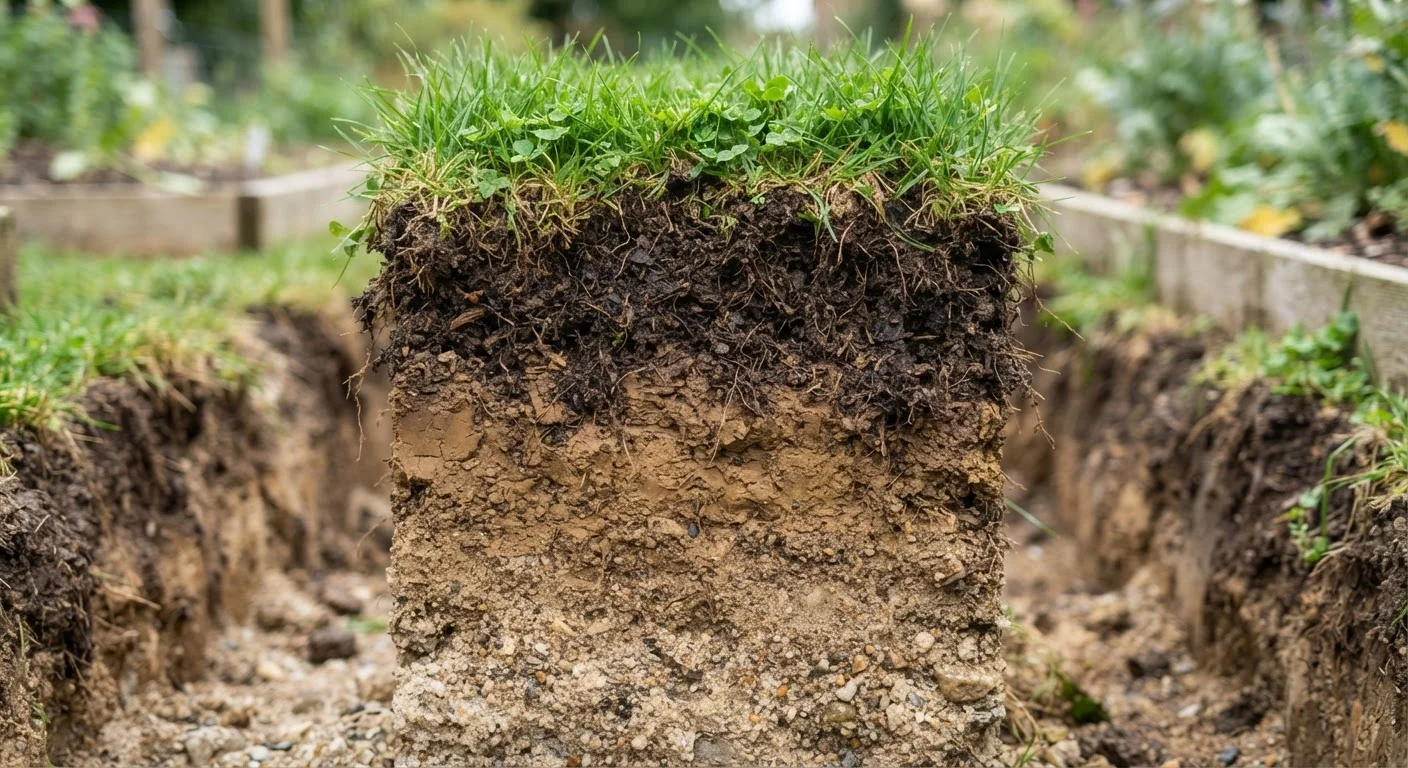
Why Soil Type Is the Foundation of Everything
Before you plant a single seed, your soil is already shaping the outcome. It controls how water moves, how nutrients are stored, whether roots can breathe, and how well your plants survive through heat or drought. Two yards side by side can have dramatically different growing conditions simply because their soil composition differs.
If you've ever had plants that mysteriously struggled despite regular watering and fertilizing, your soil type is often the overlooked culprit. Understanding what's actually under your lawn is the logical first step before any gardening project - and it pairs directly with understanding soil nutrients like NPK and pH, which govern what your plants can actually absorb.
~25%
Healthy soil volume that should be air and water
According to USDA Natural Resources Conservation Service guidelines, roughly half of healthy soil volume should be pore space - split between air and water - to support root growth and microbial life.
6-8 inches
Topsoil depth needed for most garden plants
Most vegetables and flowering plants require at least 6 to 8 inches of workable topsoil to establish healthy root systems, according to general horticultural guidance.
1 billion+
Microorganisms per teaspoon of healthy soil
Soil scientists estimate that a single teaspoon of healthy garden soil can contain more than one billion bacteria, along with fungi, protozoa, and other organisms critical to plant nutrition.
The Four Main Soil Types
Sandy Soil
Sandy soil has large, coarse particles with wide gaps between them. Water drains through it very quickly - sometimes too quickly for plant roots to absorb moisture before it disappears. It warms up fast in spring, which can be an advantage, but it holds very few nutrients. Gardens in coastal or arid regions often have sandy soil.
Clay Soil
Clay particles are extremely fine and pack tightly together. Clay holds water and nutrients well, but it drains slowly and can become compacted, making it hard for roots to penetrate. When wet, it feels slick and sticky; when dry, it can crack and harden. Clay soil is common throughout much of the American Midwest and Southeast.
Silty Soil
Silt particles are medium-sized - between sand and clay - and feel smooth or powdery when dry. Silty soil is fairly fertile and holds moisture reasonably well, but it can compact under foot traffic or heavy rain, reducing the air pockets roots need. It's often found near rivers and floodplains.
Loamy Soil
Loam is the gardener's gold standard. It's a balanced blend of sand, silt, and clay - typically around 40% sand, 40% silt, and 20% clay - plus organic matter. It drains well enough to prevent waterlogging while retaining enough moisture and nutrients for healthy plant growth. Most vegetables, flowers, and lawn grasses perform best in loamy conditions.
How to Test Your Soil Type at Home
You don't need a lab to get a useful read on your soil. Two simple methods give reliable results:
- The squeeze test: Take a handful of moist soil and squeeze it firmly. Open your hand - if it holds a ribbon shape and feels slick, you have significant clay content. If it crumbles immediately, it's sandy. If it holds briefly then breaks apart gently, it leans loamy.
- The jar test: Fill a clear jar about one-third with soil, top it up with water, shake vigorously, and let it sit undisturbed for 24 hours. Sand settles first (bottom), silt next (middle), and clay last (top). The proportions of each layer reveal your soil's texture.
For a more precise analysis - including pH and nutrient levels - consider a soil test kit or send a sample to your local cooperative extension office. Many extension services affiliated with land-grant universities offer low-cost testing and region-specific recommendations.
Send a Sample to Your Extension Office
Your local cooperative extension service - typically affiliated with a state land-grant university - often provides soil testing for a modest fee. Results usually include your soil's pH, organic matter content, and nutrient levels along with region-specific recommendations. Search for your state's extension service online to find the nearest testing program.
Improving Any Soil Type Over Time
The good news is that most soil types can be meaningfully improved, even if you can't change the underlying mineral composition. The universal solution is organic matter - primarily compost. Working a 2- to 3-inch layer of compost into the top 6 to 8 inches of soil improves drainage in clay, increases water retention in sandy soil, and adds microbial life that benefits all types.
This isn't a one-time fix. Organic matter breaks down continuously, so annual additions are what build lasting soil health. Cover crops - plants grown specifically to be turned back into the soil - are another effective long-term strategy used by gardeners to add nitrogen and improve structure.
Your soil type also directly shapes how water behaves, so it's worth reading about how water moves through different soils before setting up a watering routine. And if you're starting from scratch, the ground-up garden primer walks through soil prep as part of the full planning process.