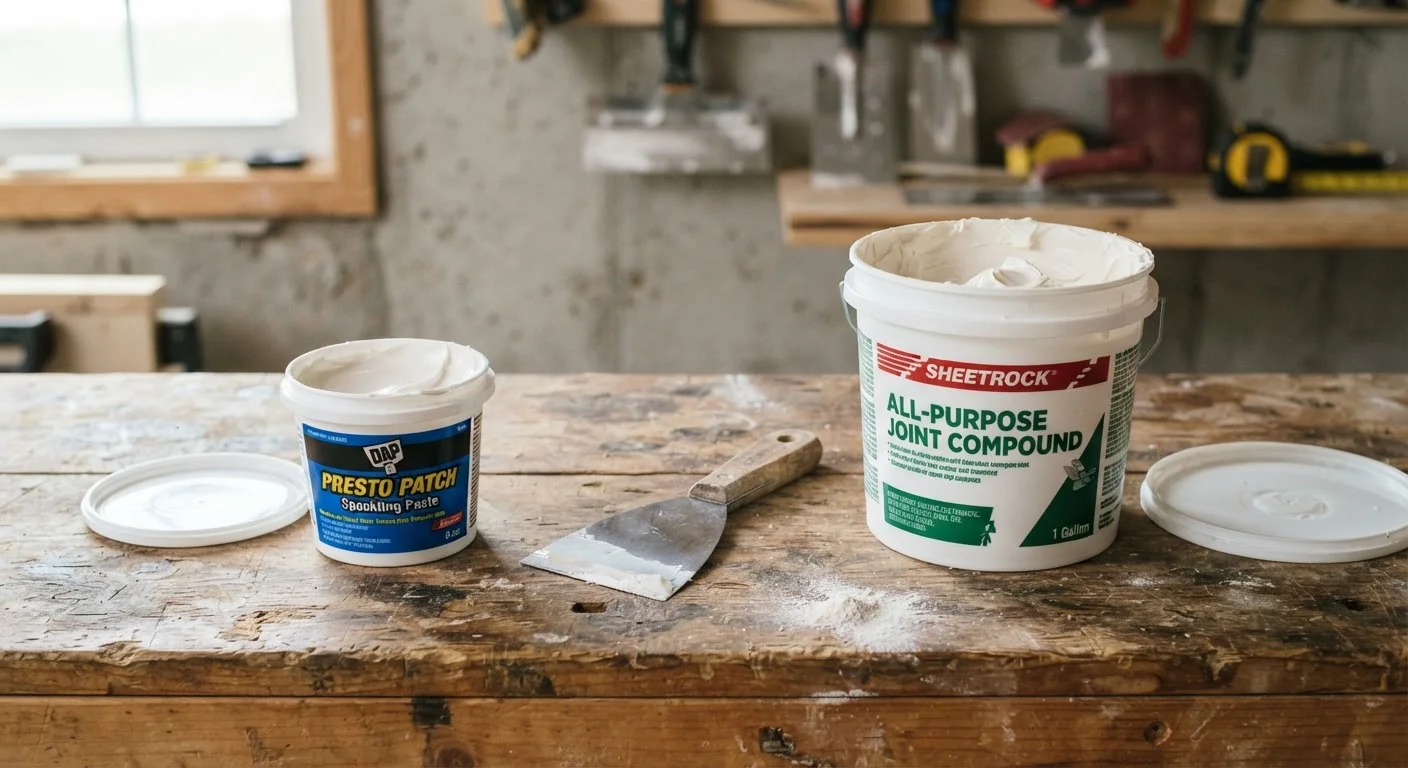
What Each Product Is Actually Made For
Walk into any hardware store and you'll find spackling and joint compound sitting near each other on the same shelf. Both are white, both fill wall imperfections, and both are paintable - so the confusion is understandable. But they're formulated for fundamentally different tasks.
Spackling compound is a paste designed for small, localized repairs. Its formula typically includes binders and lightweight fillers (often vinyl or acrylic) that allow it to dry relatively hard in a single coat with minimal shrinkage. It's engineered to go on, dry fast, and get out of the way.
Joint compound - sometimes called drywall mud - is a much more workable, spreadable material used for finishing the seams between drywall panels. It's also used to embed drywall tape, build up texture, and skim-coat large surfaces. It contains a higher water content, which means it shrinks noticeably as it dries and almost always requires two to three coats with sanding in between.
The key takeaway: spackling is a repair product; joint compound is a finishing product. Using one in place of the other doesn't always end in disaster, but it often leads to subpar results. See our drywall patching guide for a breakdown of techniques matched to different damage sizes.
Head-to-Head: How They Compare on Key Criteria
Here's a direct comparison of how spackling and joint compound stack up across the factors that matter most for a typical repair job.
| Criterion | Spackling Compound | Joint Compound |
|---|---|---|
| Best repair size | Small holes, nail pops, minor cracks | Seams, large patches, skim-coating |
| Number of coats typically needed | Usually one | Two to three |
| Dry time per coat | 30 minutes to 2 hours | 12 to 24 hours |
| Shrinkage when drying | Minimal | Noticeable; requires additional coats |
| Sandability | Moderate; can be gritty | Very smooth; feathers easily |
| Ideal container size | Small tub (pints to quarts) | Larger bucket (quarts to gallons) |
| Cost for large-area jobs | Higher per square foot | More economical at scale |
One practical point worth noting: joint compound comes in several varieties - all-purpose, topping, taping, and setting-type (which is powder-based and chemically hardens rather than air-dries). Setting-type compounds harden faster and are harder to sand, making them useful for first coats on larger repairs but less forgiving for beginners.
A Note on Lightweight vs. Standard Formulas
Both spackling and joint compound come in lightweight versions that are easier to spread and sand. Lightweight joint compound is a common choice for DIYers because it's more forgiving. However, lightweight formulas may be slightly less durable in high-traffic areas or places subject to repeated impact. Standard (or "all-purpose") joint compound offers a harder finish and is often preferred by professionals for base coats.
Choosing the Right Product for the Job
The decision usually comes down to the size of the repair and your timeline.
- Nail holes, screw pops, small cracks under 1/4 inch: Reach for spackling. Apply with a putty knife, let it dry, sand lightly, and paint. Done in an afternoon.
- Holes between 1/4 inch and fist-sized, or any repair requiring backing material: Use joint compound, applied in thin coats over a patch backer or mesh. Allow each coat to dry fully - typically 24 hours - before sanding and recoating.
- New drywall installation, seam finishing, or skim-coating: Joint compound is the only practical choice here. Spackling is not designed to be feathered thin across wide areas and will crack under those conditions.
For anyone tackling repairs beyond simple nail holes, our full patching walkthrough covers backing techniques, coat application, and how to match wall texture before painting. If your project involves gaps around window or door trim rather than open wall damage, it's also worth understanding the difference - caulk vs. sealant covers those scenarios well.
When in doubt about the scope of damage - especially if you suspect underlying moisture, mold, or structural issues - consult a licensed contractor before applying any surface repair product.