Why Filter Change Frequency Isn't One-Size-Fits-All
Furnace filter packaging often prints a suggested replacement schedule - typically every 30, 60, or 90 days. Those numbers are reasonable starting points, but they assume average conditions that rarely describe any particular home. The actual rate at which a filter clogs depends on a cluster of real-world factors: how many people live in the home, whether there are pets, local outdoor air quality, and even how often windows are opened.
A single person living in a newer, well-sealed home with no pets and no allergies might safely go three months on a basic 1-inch filter. A family of five in an older home with two dogs might need to change that same filter every three to four weeks. The filter itself doesn't know the difference - your home's conditions determine everything.
Older Homes May Need Extra Attention
Homes built before modern weatherization standards often have more air infiltration, meaning outdoor dust and particles enter more readily. If your home is older or has unsealed gaps around doors, windows, or ductwork, expect filters to clog faster than in a tightly built newer home. Duct sealing, where feasible, can reduce filter load over time.
The MERV Rating: Balancing Filtration and Airflow
Every furnace filter carries a MERV rating - a standardized scale from 1 to 16 that describes how effectively the filter captures airborne particles. Low MERV filters (1-4) catch only large debris like dust bunnies and lint. Mid-range filters (MERV 8-11) trap finer dust, mold spores, and pet dander. High MERV filters (12-16) can capture smaller particles, including some bacteria and fine allergens.
The tradeoff is airflow. Denser filter media that captures more particles also makes it harder for air to pass through. Most residential HVAC systems are engineered for filters in the MERV 8-11 range. Going higher without confirming your system can handle it may restrict airflow enough to cause overheating, short-cycling, or premature blower motor failure.
MERV 8-11
Recommended range for most residential HVAC systems
The U.S. Environmental Protection Agency notes that filters in this range offer a reasonable balance between particle capture and airflow for typical homes.
1-3 months
Typical replacement interval for standard 1-inch filters
Most HVAC manufacturers and filter producers suggest this range as a baseline, with adjustments based on pets, occupants, and air quality.
Up to 12 months
Potential lifespan of thicker 4-5 inch media filters
Deep-media filters used in whole-home systems can last significantly longer, though manufacturer guidance and regular inspection should still guide the decision.
If you or someone in your household has respiratory sensitivities, it's worth consulting your HVAC system's documentation - or a licensed HVAC technician - before selecting a high-MERV filter. For general guidance on how building materials and indoor sources also affect your air, see our article on indoor air quality and home improvement choices.
Reading the Signs Your Filter Needs Changing
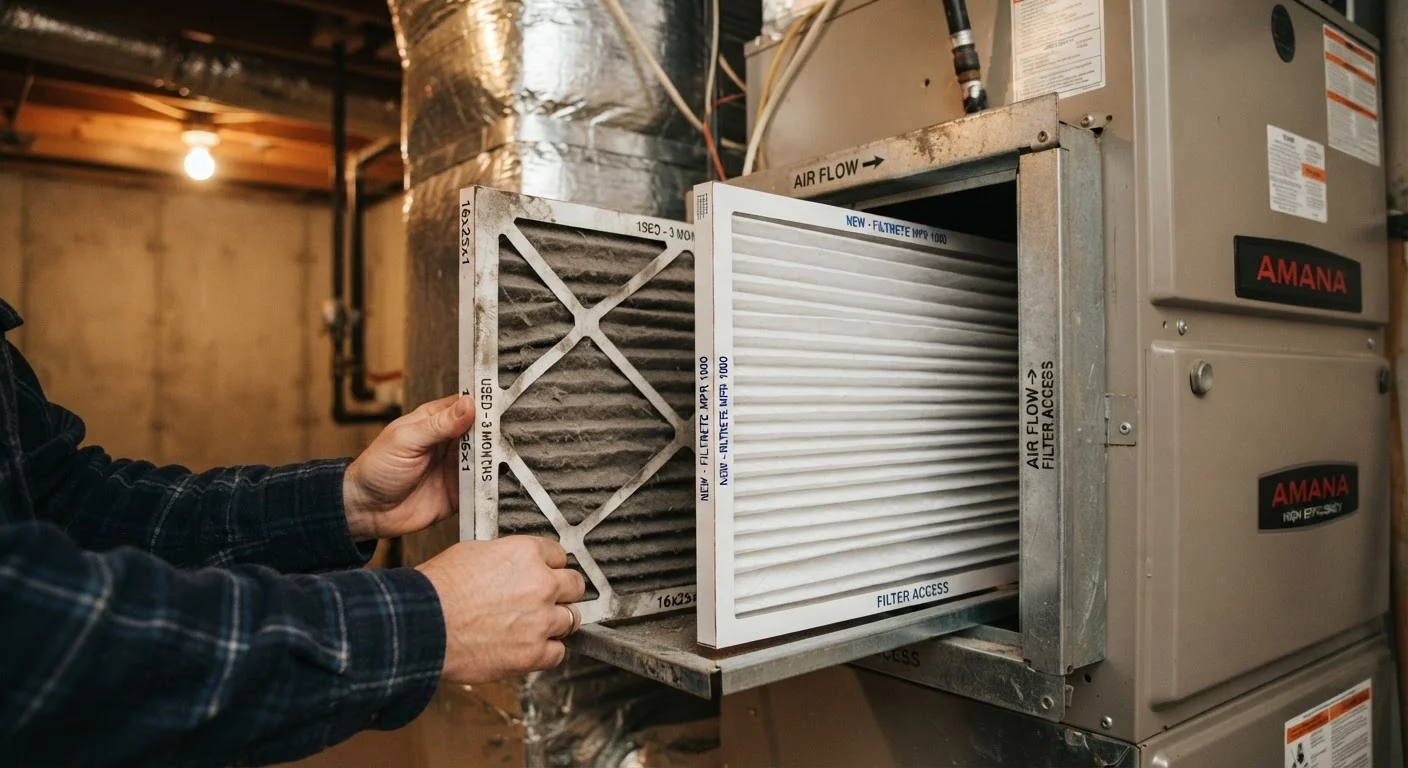
You don't always need to wait for the calendar to tell you it's time. Physical inspection is more reliable. Pull the filter out and hold it up to a light source. If little to no light passes through, it's past time for a change. A filter that started white or light gray and is now dark gray or visibly matted with debris has reached the end of its useful life.
Other signs to watch for include reduced airflow from vents, the system running longer cycles than usual to reach the set temperature, or a faint musty smell when the furnace kicks on. These don't always point exclusively to the filter - but a clogged filter is one of the first things to rule out since it's the easiest and least expensive fix.
Make Filter Checks a Monthly Habit
Pull your filter out on the same day each month - the first of the month works well as a memory anchor. Visual inspection takes under two minutes and gives you far more accurate information than any fixed schedule printed on a filter box. Replace when it looks dark and dense, not according to the calendar alone.
Building a Realistic Maintenance Habit
The most effective approach is to set a monthly visual check as a habit, regardless of your replacement schedule. A quick look takes under two minutes and gives you much better information than any fixed calendar rule. If the filter looks fine at 30 days, leave it. If it looks saturated at 45, swap it out.
Buying filters in multi-packs keeps replacements on hand so the inconvenience of having to go to the store doesn't become a reason to delay. Storing them near the furnace or in a visible spot makes the habit easier to maintain. Some homeowners set a recurring phone reminder tied to a utility bill or seasonal task - whatever anchor works best for your routine.
Furnace filters are a small, inexpensive maintenance item compared to the cost of HVAC repairs or early system replacement. Much like the often-overlooked cabin air filter in your vehicle, a home furnace filter does quiet, continuous work that's easy to forget until something goes wrong. Staying a step ahead of that curve is what preventive maintenance is all about.