The Real Job Gutters Are Doing
Most homeowners think of gutters as simple rain catchers - a convenience feature that keeps water off walkways. In reality, gutters are a critical part of your home's moisture management system, and their primary beneficiary isn't the landscaping or the siding. It's the foundation.
When rain falls on your roof, it doesn't stay there. A typical 2,000-square-foot home can shed hundreds of gallons of water during a single moderate storm. Without a gutter system, all of that water runs off the roof edges and lands in a concentrated band right next to your home's base. Over months and years, that repeated soaking erodes soil, raises the water table directly beneath the house, and increases what engineers call hydrostatic pressure - the force that water-saturated soil exerts against foundation walls.
Gutters intercept that water at the roof edge and move it somewhere safer. Downspouts are the delivery mechanism, carrying the collected water to ground level. But a downspout that discharges right at the foundation wall is almost as problematic as no gutter at all. Proper extensions - directing discharge at least 4 to 6 feet away from the house - are what complete the job.
~1,000 gal
Roof runoff per inch of rain on an average home
A commonly referenced estimate from building science education materials: a 1,000-square-foot roof sheds approximately 600 gallons per inch of rainfall, meaning a 2,000-square-foot home produces roughly 1,200 gallons per rain event.
4-6 ft
Minimum downspout discharge distance from foundation
General guidance from home inspection and building science communities recommends downspouts discharge at least 4 to 6 feet from the foundation to reduce soil saturation risk.
2x/year
Recommended minimum gutter cleaning frequency
Most home maintenance guidance, including resources from home inspection associations, recommends cleaning gutters at least twice annually, with more frequent cleaning for heavily wooded properties.
What Goes Wrong When Gutters Fail
Gutter problems tend to be quiet and gradual, which is part of what makes them dangerous. The damage doesn't appear overnight - it accumulates across seasons, and by the time symptoms are obvious, the fix is rarely cheap.
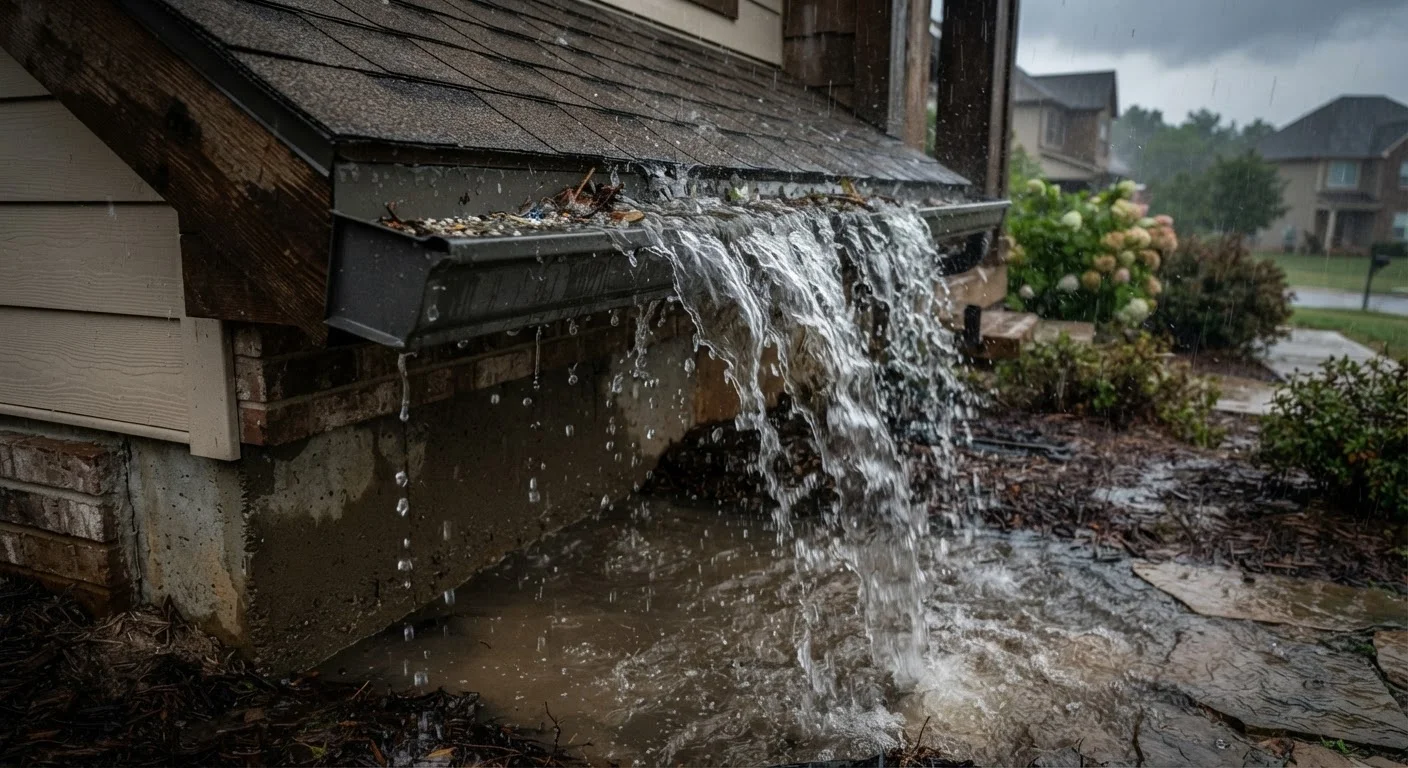
The most common failure is simple clogging. Leaves, debris, and sediment fill the channel, water backs up, and overflow spills directly down the side of the house. This is especially problematic at corners and near downspouts. But clogs aren't the only issue:
- Improper pitch: Gutters should slope slightly toward downspouts - roughly a quarter inch for every 10 feet of run. A sagging or reverse-pitched gutter holds standing water and overflows unpredictably.
- Separated joints: Where gutter sections connect, seals can fail over time. Water drips down the fascia board and quietly rots the wood behind the gutter.
- Undersized downspouts or too few of them: Even clean gutters can overflow if the drainage capacity doesn't match the roof's catchment area during heavy rain.
Each of these failures routes water toward the foundation in some form. It's worth understanding that many of the home maintenance myths that cost homeowners money involve underestimating how small, neglected systems cause large, expensive problems - gutters are a textbook example.
Easy Way to Test Gutter Pitch
After cleaning your gutters, pour a full bucket of water into the end farthest from the downspout. It should drain within a minute or two without pooling. If water sits, your gutter may have developed a sag that needs correction. This quick test takes less than five minutes and is well worth adding to your seasonal routine.
The Foundation Damage Pathway
Foundation damage from poor drainage doesn't usually look like a sudden crack or collapse. It's a slow process with several stages, each one making the next more likely.
First, soil near the foundation becomes chronically saturated. This softens the ground that supports the footing - the concrete base beneath the foundation wall. Soft, unstable soil allows the foundation to shift unevenly, a process called differential settling. You may notice doors that no longer close properly, hairline cracks in drywall, or gaps appearing at window frames before you ever see damage to the foundation itself.
Second, saturated soil pressing against a foundation wall can force water through microscopic pores in concrete, especially in older homes. Efflorescence - the white chalky residue that appears on basement walls - is a common early indicator that water is moving through concrete. Ignoring it leads to more serious intrusion.
Third, in climates with freezing winters, water-saturated soil expands when it freezes (a process called frost heave), exerting enormous lateral pressure on foundation walls. This is why foundation cracks are more common in regions with harsh freeze-thaw cycles and why drainage maintenance matters year-round.
Managing soil moisture around your home shares some logic with managing moisture in a garden: keeping water balanced and well-distributed prevents damage at the root level. The principles behind effective garden watering - avoiding chronic saturation near plant roots - apply at a structural scale to your home's foundation too.
Practical Maintenance That Prevents the Problem
Preventing foundation damage through gutter care is straightforward and inexpensive compared to the repairs it avoids. These habits form a realistic, manageable maintenance routine:
- Clean gutters twice a year. Late spring (after tree pollen and seed release) and late fall (after leaves have dropped) are the standard windows. Homes under heavy tree cover may need an additional mid-summer pass.
- Check pitch after cleaning. Pour a bucket of water into the gutter farthest from the downspout. It should flow briskly toward the outlet without pooling. Adjust hangers if needed, or call a professional for significant sags.
- Inspect downspout extensions. Make sure extensions haven't shifted, clogged, or been removed. Water should discharge onto a slope that carries it away - not toward - the house.
- Check the grade around your foundation. The soil should slope away from the house at roughly 6 inches over the first 10 feet. Flat or inward-sloping grades allow water to pool regardless of gutter performance.
- Look for signs of overflow. Staining on siding below the gutter line, eroded mulch beds directly beneath the roofline, or mud splatter on siding are all signs that water isn't being caught and redirected properly.
Just as mulch works beneath the surface to regulate moisture in garden beds, a functioning gutter system works largely out of sight - its value most visible only when it's absent or failing.