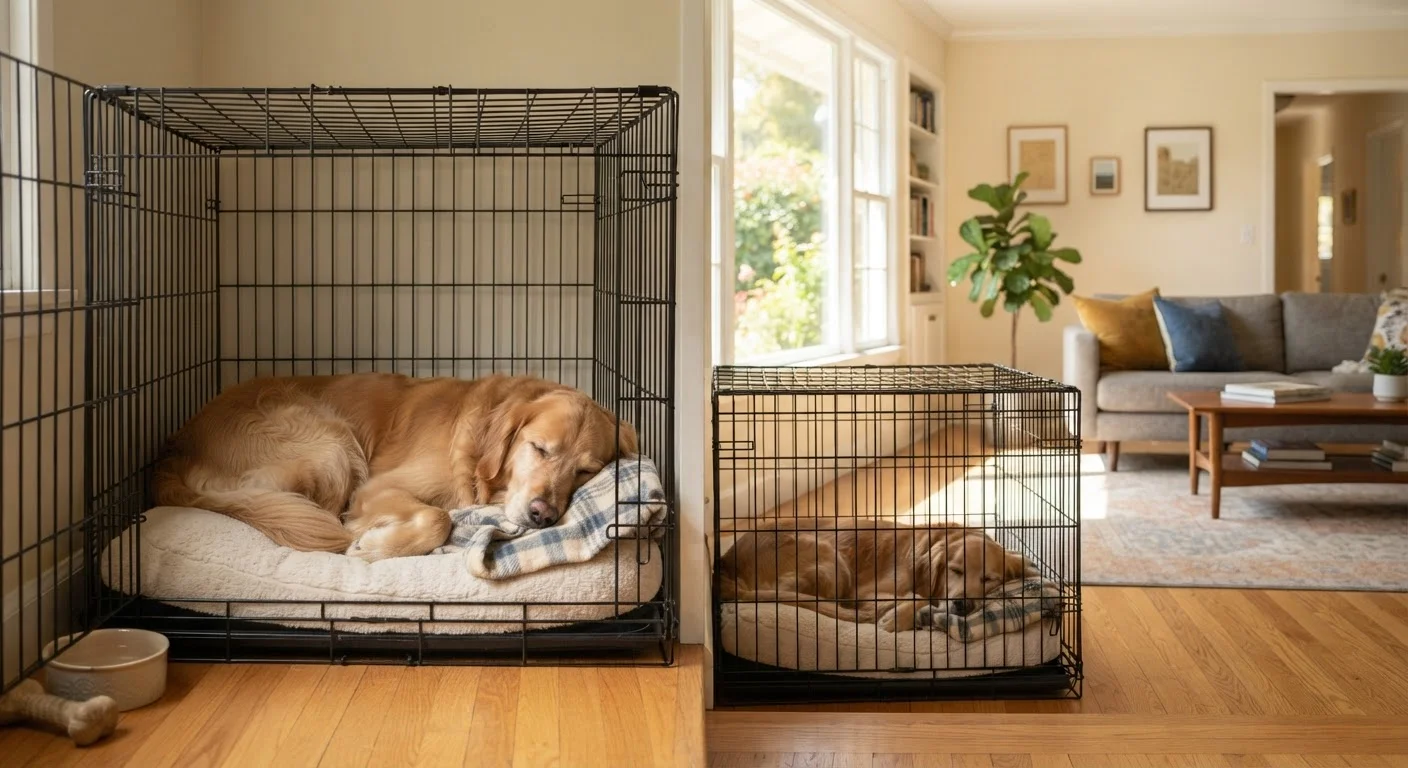
What Crate Training and Free Roaming Actually Mean
Crate training involves teaching a dog to comfortably occupy a crate - typically a wire or plastic kennel - as a resting den and safe space, especially during unsupervised periods. When done correctly, crating is not punishment; it draws on dogs' natural inclination to seek enclosed, den-like environments for security.
Free roaming means allowing a dog access to part or all of the home without confinement. This ranges from gated access to a single room to full, unsupervised run of the house. The key variable is the dog's level of training and behavioral reliability, not simply its age.
Both approaches are legitimate when applied appropriately. The distinction is that crating offers a managed environment, while free roaming requires a dog to already demonstrate the self-regulation that crating helps build. Understanding how reward-based training works is useful context for either path.
The Case for Crate Training
Crate training provides clear structural benefits - particularly for puppies and newly adopted dogs. Confinement to a crate while a dog is unsupervised prevents destructive behavior, eliminates access to household hazards (electrical cords, toxic plants, human food), and supports housetraining by encouraging bladder control.
Veterinary behaviorists note that dogs introduced to crates gradually and positively will often choose to rest there voluntarily. The crate becomes a predictable retreat rather than a stressor. This is especially valuable during transitions - moves, new babies, or changes in routine - when a familiar space offers reassurance.
| Criterion | Crate Training | Free Roaming |
|---|---|---|
| Best life stage | Puppies, newly adopted dogs | Reliable adult dogs |
| Housetraining support | Strong - limits accidents | Relies on completed training |
| Hazard protection | High - limits home access | Requires thorough dog-proofing |
| Separation anxiety | Can help if introduced properly | May worsen if dog is destructive |
| Physical freedom | Limited during confinement | Full or gated access |
| Stress risk | High if overused or punitive | Low for well-adjusted dogs |
| Owner oversight required | Lower when dog is crated | Higher during training phase |
However, crate training carries real risks when misapplied. Extended confinement - particularly exceeding four to five hours for adult dogs or two to three hours for puppies - can cause physical discomfort, anxiety, and behavior problems. A crate should never be used as a response to frustration or as the primary means of avoiding interaction with a dog.
The Case for Free Roaming
Free roaming is appropriate for dogs that have genuinely demonstrated reliable behavior at home: no destructive tendencies, solid housetraining, and comfortable tolerance of alone time. Many owners work toward this as a long-term goal, treating crating as scaffolding that's gradually removed as trust is established.
The benefits are meaningful. Dogs with free access can self-regulate more easily - choosing a cool tile floor vs. a warm bed, accessing water without owner intervention, and moving around to relieve restlessness. This autonomy can support emotional wellbeing and reduce confinement-related frustration. Pairing free roaming with adequate indoor and outdoor exercise further reduces the risk of boredom-driven destruction.
Dog-Proofing Is Non-Negotiable
Before granting free access, walk through your home from a dog's perspective. Common hazards include unsecured garbage, human medications left on counters, toxic houseplants (such as sago palm or lilies), and electrical cords. Even a well-trained dog can get into trouble if temptation is accessible. Dog-proofing is an ongoing responsibility, not a one-time checklist.
Free roaming does require that the home be genuinely dog-proofed: trash secured, toxic plants removed, cords managed, and medications stored out of reach. An honest assessment of these hazards is a prerequisite, not an afterthought.
How to Decide - and How to Transition
The decision between crating and free roaming should be based on three practical factors: your dog's current behavioral reliability, the physical safety of your home environment, and your dog's individual stress response to each option.
Start by asking whether your dog has ever been left unsupervised without incident for progressively longer periods. If the answer is yes - no destruction, no elimination accidents, no signs of distress - free roaming is likely a reasonable option. If you're unsure, structured trial runs while you're home or using a camera to monitor remotely can provide real information rather than guesswork.
Transitioning from crating to free roaming works best incrementally: start with a single room, then expand access as confidence grows. Dogs that have been socialized and acclimated to new environments typically adapt more readily to expanded home access. If your dog shows signs of anxiety - excessive vocalization, destructive behavior, or elimination in the home - consult a veterinarian or certified applied animal behaviorist before proceeding.
~80%
Dogs that develop destructive behavior when bored or under-exercised
Behavioral veterinarians consistently identify inadequate mental and physical stimulation as a primary driver of home destruction in dogs left alone.
4-5 hrs
Maximum recommended adult crate time per stint
Most veterinary and animal welfare organizations advise against confining adult dogs to a crate for more than four to five consecutive hours during the day.
This article provides general educational information about dog care practices. It is not a substitute for personalized advice from a licensed veterinarian or credentialed animal behaviorist.