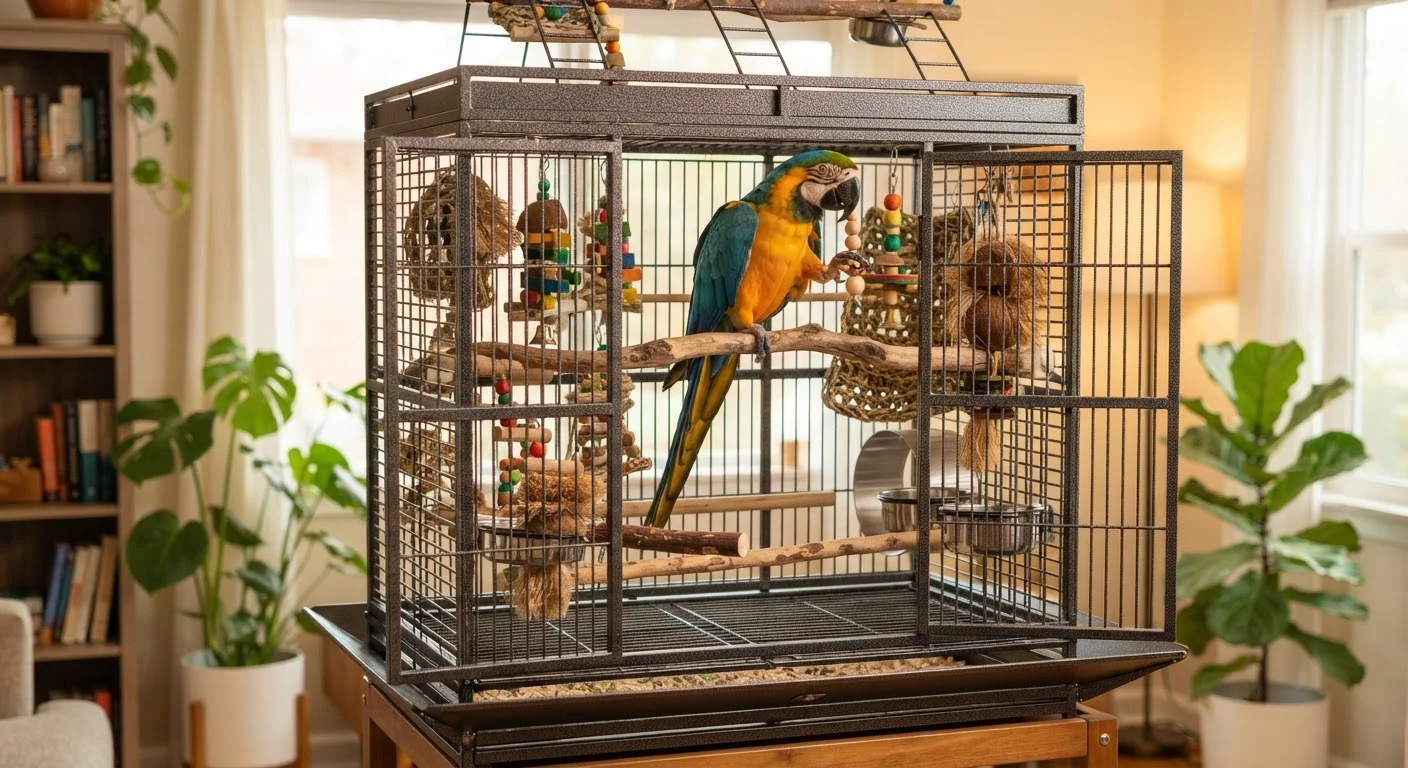
Why Cage Environment Directly Shapes Bird Behavior
Pet birds are cognitively complex animals. In the wild, parrots, finches, and canaries spend their days flying, foraging, problem-solving, and socializing - activities that engage nearly every system in their bodies. A cage that simply houses a bird without addressing those behavioral drives creates chronic frustration, which commonly manifests as feather plucking, excessive screaming, repetitive rocking, or aggression.
Understanding enrichment as a welfare necessity - not a luxury - is the foundation of responsible bird ownership. If you're still setting up your home for a new arrival, the readiness checklist for small pets covers what to prepare before your bird arrives.
Getting Cage Size and Placement Right
A bird must be able to fully extend and flap both wings without touching the cage walls or bars. For most small to medium parrots - budgies, cockatiels, conures - this means a cage far larger than many sold as "starter" options. Wider is generally more valuable than taller, since birds fly horizontally in nature.
Bar spacing matters just as much as overall dimensions. Bars spaced too widely can trap feet or heads; too narrowly, and climbing becomes impossible. Follow species-specific guidance from an avian veterinarian when selecting an appropriate enclosure.
Cage placement should feel socially connected but not overwhelmingly stimulating. A corner position against a wall gives the bird a sense of security on two sides. Avoid placing the cage directly in front of windows with unfiltered direct sun, near drafts, or in kitchens where cooking fumes - particularly from non-stick cookware - can be rapidly fatal to birds.
~70%
Captive parrots showing stress-related behaviors
Avian welfare researchers have estimated that a substantial majority of captive parrots display one or more stereotypic or stress-related behaviors, often linked to inadequate environmental enrichment.
4-6 hrs
Time wild parrots spend foraging daily
Field studies of wild parrot populations indicate most species devote between four and six hours each day to active foraging - a behavioral budget rarely addressed in captive settings.
Perches: Variety Is a Health Requirement
A single dowel perch of uniform diameter - the kind often included with starter cages - is one of the most common contributors to foot problems in pet birds. Gripping the same diameter repeatedly puts constant pressure on the same points, leading to pressure sores (bumblefoot) over time.
An enriching cage includes at least three to four perches of different diameters, textures, and materials:
- Natural wood branches (manzanita, java wood, or untreated hardwoods) provide irregular gripping surfaces that naturally exercise foot muscles.
- Rope perches offer softness and flexibility, useful for resting.
- Cement or sandy perches placed near food dishes help maintain nail length, though these should not be the primary perch.
Position perches at different cage heights, keeping the highest ones for resting and sleeping since birds instinctively prefer elevation when at rest.
Foraging Toys and Rotating Enrichment
Foraging - searching for and working to obtain food - is one of the most time-consuming activities wild birds engage in. Replicating this in a cage setting is one of the highest-impact enrichment strategies available to owners.
Incorporate foraging toys that require the bird to work for treats or food
Birds that forage for food are mentally occupied and physically active, which reduces idle time linked to destructive behaviors. Foraging closely mirrors natural feeding patterns and satisfies the bird's problem-solving instincts.
Rotate enrichment items on a weekly schedule rather than leaving the same toys in place
Novelty drives investigation and play. Items that remain constant lose their stimulating value within days, particularly for intelligent species like conures and cockatiels.
Provide species-appropriate food presentation that encourages natural behaviors
Offering food in multiple formats - scattered on a foraging tray, tucked inside hanging skewers, or hidden within shredded paper - prevents passive eating and lengthens feeding activity across the day.
Include at least one item in the cage designed for destruction
Chewing and shredding are natural and necessary behaviors for many bird species. Redirecting these behaviors toward appropriate items protects perches and the cage while satisfying the bird's drive.
Rotation is as important as variety. Leaving the same toys in place indefinitely reduces their novelty value. Introduce new or previously stored items weekly to maintain curiosity and engagement.
Birds benefit from enrichment that engages multiple senses: items to shred (palm fronds, cork bark, paper), items to manipulate (foot toys, puzzle feeders), and items that produce sound (bells, crinkle materials). Mirror the kind of environmental complexity a wild bird would encounter.
Social Time and Out-of-Cage Activity
No amount of in-cage enrichment replaces direct interaction and out-of-cage time. Most companion parrots and many other caged birds require a minimum of one to two hours of supervised time outside the cage each day. This time allows flight or wing-stretching, social bonding, and mental stimulation that simply cannot be replicated within cage walls.
If you're weighing whether your bird needs a companion, the real trade-offs of keeping a single bird vs. a pair are worth understanding before making that decision.
Social species like parrots that are left alone for long work days without environmental enrichment are at high risk for behavioral and psychological decline. If extended alone time is unavoidable, a radio or television providing background noise and ambient speech can provide modest stimulation - though it does not substitute for genuine interaction.
This article provides general educational information about bird care and is not a substitute for guidance from a qualified avian veterinarian. If your bird shows signs of distress, illness, or behavioral changes, consult a licensed avian vet promptly.