Why This Decision Is More Complex Than It Looks
The question of one bird versus two sounds simple, but it touches on avian psychology, husbandry demands, and the honest limits of a pet owner's time. Birds are not interchangeable: a budgerigar, a cockatiel, and an African grey parrot have very different social structures in the wild, and those instincts don't disappear in captivity.
Many owners assume a second bird will automatically solve behavioral problems like feather-plucking or screaming. Sometimes it does. But these behaviors often have environmental or health roots that a cage companion won't address - and may even worsen if introductions go poorly.
Understanding the real trade-offs requires looking at what birds need socially, how pairing changes the human-bird relationship, and what the practical demands of two birds actually look like day to day.
The Case for Keeping a Single Bird
A solo bird places the full burden of social engagement on the owner - and for many species, that's a legitimate arrangement when met seriously.
Stronger human-bird bond with undivided attention
A solo bird directs all its social energy toward its owner, often resulting in exceptional tameness, vocabulary development in talking species, and responsiveness to training.
Easier to monitor health and behavior changes
With one bird, subtle shifts in droppings, appetite, feather condition, or activity level are immediately apparent, enabling faster veterinary response.
Lower overall cost and space requirements
A single bird requires a smaller cage footprint, one set of annual wellness exams, and roughly half the food, toy, and supply budget of a pair.
Simpler disease management with no inter-bird transmission risk
Multi-bird households face the added challenge of infectious disease spread; a solo bird eliminates this vector entirely.
Large parrots such as African greys, Amazon parrots, and many cockatoos often form their deepest bonds with a single human and can become distressed rather than comforted by the presence of another bird. For these species, a solo living situation supported by daily out-of-cage time, foraging toys, and genuine interaction may align better with the animal's temperament.
A well-enriched cage environment - varied perch heights, rotating foraging activities, and background audio stimulation - can go a long way toward meeting a single bird's cognitive needs. Owners who underinvest in this are more likely to see stress behaviors regardless of whether a companion is present.
The Case for Keeping a Pair
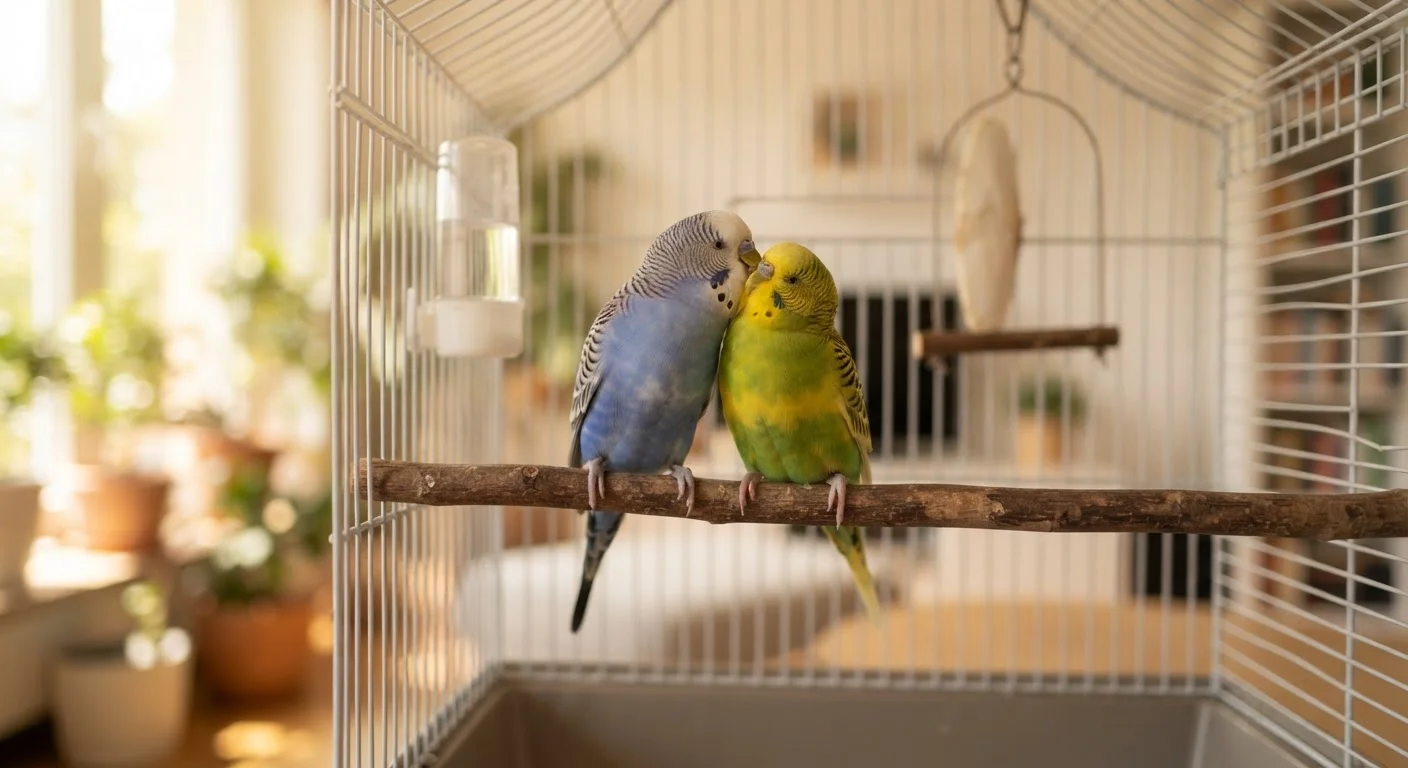
For species that live in large flocks in the wild - budgerigars, cockatiels, lovebirds, and parrotlets among them - solitary housing can be a genuine welfare concern rather than a simple preference.
Bonded pair reduces hands-on tameness over time
Birds that form strong same-species bonds typically become less interested in human interaction, which can disappoint owners who prioritized a close, trainable relationship.
Introductions carry real disease and injury risk
Quarantine lapses or size-mismatched pairings frequently result in illness transmission or physical injury - outcomes that require expensive veterinary intervention.
Costs and space requirements roughly double
Beyond food, two birds require a significantly larger cage (typically at minimum 50% bigger than for one), duplicate enrichment items, and individual veterinary records.
Pair dynamics can introduce new behavioral problems
Hormonal aggression, resource guarding, and incompatibility between individual birds are common in hastily formed pairs, sometimes resulting in one bird being bullied or injured.
Not all species benefit equally from companionship
Some large parrot species and birds that have been solitary for years may find a new companion more stressful than comforting, particularly if introduced in adulthood.
Flock-oriented species engage in continuous social behaviors: mutual preening, contact calling, and coordinated movement. These interactions regulate stress hormones and reinforce security. No amount of human interaction fully replicates the constant, low-level social presence of a conspecific (another bird of the same or closely related species).
A bonded pair also tends to be more behaviorally stable during the owner's working hours. Separation anxiety, excessive vocalization, and feather-destructive behaviors are documented more frequently in solitary flock-species birds than in paired ones, though individual variation is significant.
Species Compatibility Is Not Optional
Even birds that appear to coexist peacefully in separate cages should not be assumed to be compatible cage-mates. Lovebirds and budgies, for example, should not share enclosures despite similar size, as lovebirds can injure smaller birds. Always research species-specific compatibility before housing birds together, and consult an avian veterinarian if uncertain. Incompatible pairings cause chronic stress even without visible aggression.
What Changes When You Add a Second Bird
Adding a companion bird is not simply doubling what you already have. Several dynamics shift in ways owners don't always anticipate.
30-45 days
Recommended quarantine before introducing a new bird
Avian veterinary guidelines consistently recommend a minimum 30-day quarantine period, with many specialists advising 45 days to reduce disease transmission risk.
~2 hrs/day
Minimum daily interaction for solitary flock-species birds
Avian behavior specialists generally suggest that flock-oriented species kept alone need at least two hours of active owner interaction daily to maintain psychological wellbeing.
Tameness often decreases. When two birds bond to each other, the human becomes less central to their social world. Birds that were previously step-up trained and hand-tame frequently become less reliable over time once a same-species companion is present. This isn't a failure - it's natural avian behavior - but it matters if you value a close, interactive relationship with your pet.
Introductions require patience and quarantine. Any new bird should be quarantined for a minimum of 30 days before being housed near your existing bird, and avian vets typically recommend a full 45 days. This protects against transmissible diseases including psittacosis and avian polyomavirus. Rushing introductions is one of the most common mistakes in multi-bird households.
Costs increase non-linearly. A larger cage, doubled food quantities, additional perches, and - critically - two separate veterinary relationships all add up. Avian veterinary care is already a specialized expense; two birds represent two sets of annual wellness exams and two potential illness costs.
For owners already navigating the nuances of bird behavior, the common myths around small pet care are worth revisiting before making the leap to a second animal.
Making the Right Call for Your Situation
No single answer applies across all species and households. A few questions can clarify the decision:
- How many hours per day can you realistically provide direct interaction? Fewer than two hours daily for a flock-oriented species like a cockatiel is a meaningful indicator that a companion bird would improve welfare.
- Is your current bird showing stress behaviors? Consult an avian veterinarian before attributing these to loneliness - underlying health or environmental causes are common.
- What species are you considering pairing? Different species should generally not share a cage, even when they appear to tolerate each other. Size mismatches can lead to serious injury.
- Are you prepared for a potentially less tame bird? If hands-on interaction is central to why you keep a bird, a companion may genuinely change the dynamic you value.
Just as the indoor vs. outdoor debate for cats ultimately comes down to the specific animal's needs and the owner's circumstances, the single-vs.-pair question resists universal answers. Working with an avian-certified veterinarian before making this decision is always the most reliable path forward.
This article is for general informational purposes only and does not constitute veterinary advice. Always consult a qualified avian veterinarian regarding your bird's specific health and behavioral needs.