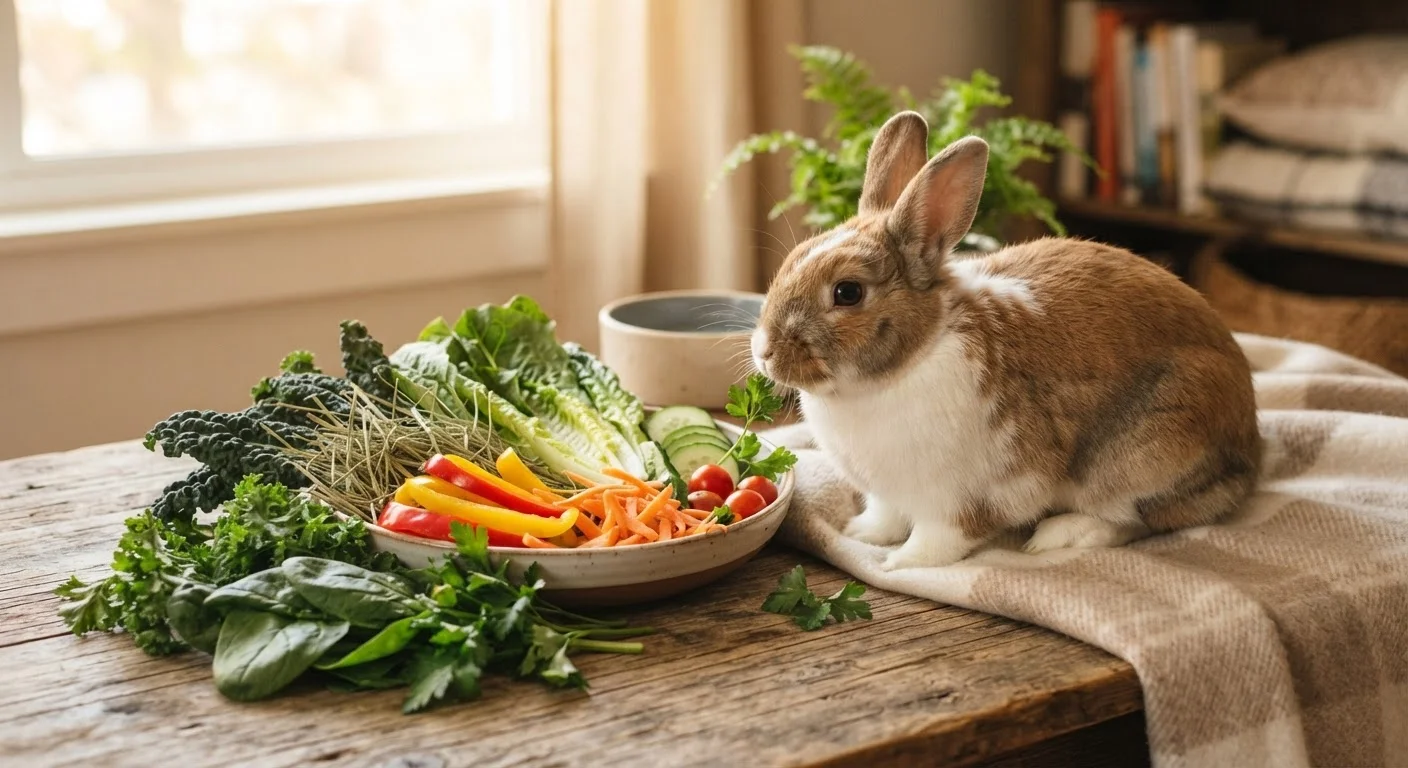
The Foundation: What Rabbits Need at Any Age
Regardless of life stage, a rabbit's diet is built on one non-negotiable foundation: unlimited grass hay. Timothy, orchard grass, and meadow hay should make up roughly 80-85% of a rabbit's daily intake. Hay keeps the digestive tract moving, grinds down continuously growing teeth, and prevents the gut stasis - a potentially life-threatening slowdown of digestion - that veterinarians cite as one of the most common rabbit emergencies.
Fresh water must be available at all times, either in a heavy ceramic bowl or a sipper bottle. Dehydration accelerates GI problems and kidney stress, particularly in older animals.
For a broader picture of what rabbit ownership involves day to day, see our complete rabbit care guide.
| Primary food (all life stages) | Unlimited grass hay (timothy, orchard grass, meadow) |
| Hay proportion of daily diet | 80-85% |
| Alfalfa hay appropriate for | Kits (under 6 months), pregnant or nursing does, underweight seniors (vet-supervised) |
| Fresh greens daily (adults) | 1-2 packed cups per 4-5 lbs body weight |
| Pellets for adult rabbits | ~¼ cup per 5 lbs body weight; timothy-based only |
| Senior rabbit threshold | Approximately 5-6 years old |
| Fruits (treats only) | ~1 tsp per 2 lbs body weight, occasional only |
| Foods to avoid entirely | Iceberg lettuce, onions, avocado, chocolate, corn, potatoes, rhubarb |
Kits to Juveniles: Birth Through Six Months
Young rabbits (kits) nurse from their mother until approximately 6-8 weeks of age. After weaning, alfalfa hay - higher in protein and calcium than grass hay - is appropriate for kits because growing bodies require those nutrients for bone and muscle development. Introduce small amounts of age-appropriate pellets made from alfalfa during this phase.
Fresh leafy greens can be introduced gradually starting around 12 weeks, adding one new item at a time and watching for loose stools, which signal that a food doesn't agree with the rabbit. Portions should be small - start with just a tablespoon per day. Avoid fruit, starchy vegetables, and anything high in sugar entirely during this stage.
Many rabbit myths persist around what young animals can eat safely. Common small-pet care myths - including ideas about what's "natural" for rabbits - are worth reviewing before establishing feeding habits.
Adults: Six Months to Five Years
Once a rabbit reaches sexual maturity - typically around 6 months for smaller breeds, up to 12 months for larger ones - the diet shifts decisively toward timothy or orchard grass hay. Alfalfa becomes too rich in calcium and calories for adult rabbits not undergoing special circumstances like pregnancy or illness.
Adult rabbits benefit from a daily serving of fresh leafy greens: roughly 1-2 packed cups per 4-5 lbs of body weight. Reliable choices include romaine lettuce, green leaf lettuce, cilantro, parsley, and arugula. Rotate varieties to provide a range of nutrients. Fruit can be offered as an occasional treat - approximately a teaspoon per 2 lbs of body weight - but should never become a dietary staple due to high sugar content.
Pellets serve as a supplement, not the centerpiece. For healthy adult rabbits, about ¼ cup of plain, timothy-based pellets per 5 lbs of body weight per day is a common guideline, though individual needs vary. Consult a rabbit-savvy veterinarian for portion guidance specific to your animal.
Gut stasis
A dangerous condition in which a rabbit's gastrointestinal tract slows or stops moving. It can be life-threatening within hours and is often linked to insufficient hay intake, stress, or illness.
Kit
A baby rabbit from birth through the weaning period, typically up to 6-8 weeks of age.
Alfalfa hay
A legume-based hay that is higher in protein, calories, and calcium than grass hays. Appropriate for young, growing, pregnant, or underweight rabbits but too rich for healthy adults.
Cecotropes
Soft, nutrient-dense droppings that rabbits produce and re-ingest directly from their hindquarters. This is a normal, essential part of rabbit digestion and not a sign of illness.
Timothy hay
A grass hay and the most widely recommended staple for adult rabbits. It provides the fiber needed to support healthy digestion and natural tooth wear.
Senior Rabbits: Five Years and Beyond
Rabbits are generally considered seniors around age 5-6, though some larger breeds age faster. Older rabbits often lose body condition - muscle mass decreases and weight can drop - so monitoring weight monthly becomes important. Some seniors benefit from reintroducing alfalfa hay in limited amounts or slightly increasing pellet portions to maintain condition, but only under veterinary guidance since kidney function may also be declining.
Leafy greens remain essential and may be easier on the digestive system than dry pellets for rabbits with dental changes. Tooth problems are common in aging rabbits and can affect willingness to eat hay; a veterinarian should check teeth at least annually.
Hydration becomes even more critical. If a senior rabbit is reluctant to drink, lightly misting leafy greens can help increase moisture intake. Watch for any sudden change in eating habits - it is often the first sign that something is medically wrong. Understanding rabbit behavior can help you spot early signs of discomfort or illness.
This article provides general nutritional information for educational purposes and is not a substitute for veterinary advice. Always consult a qualified rabbit-savvy veterinarian for guidance specific to your pet's health and life stage.