Why the Southwest Rewards Wandering Past the Famous Rim
The Grand Canyon receives roughly five million visitors a year. That volume concentrates most of them along a short stretch of the South Rim between March and October, producing traffic, crowded overlooks, and permit lotteries that can feel more like logistics than adventure. Meanwhile, within a day's drive in almost any direction, the Colorado Plateau, the Sonoran Desert, and the Basin and Range province hold landscapes that are - by almost any measure - equally extraordinary.
This isn't a case of hidden gems being oversold. These are established, well-documented places managed by the National Park Service, the Bureau of Land Management, or state agencies. What they share is that most American travelers simply don't plan far enough past the Canyon to reach them. If you're building a Southwest itinerary, a structured road trip framework will help you connect these sites logically rather than backtracking across hundreds of miles of desert.
Canyonlands National Park, Utah
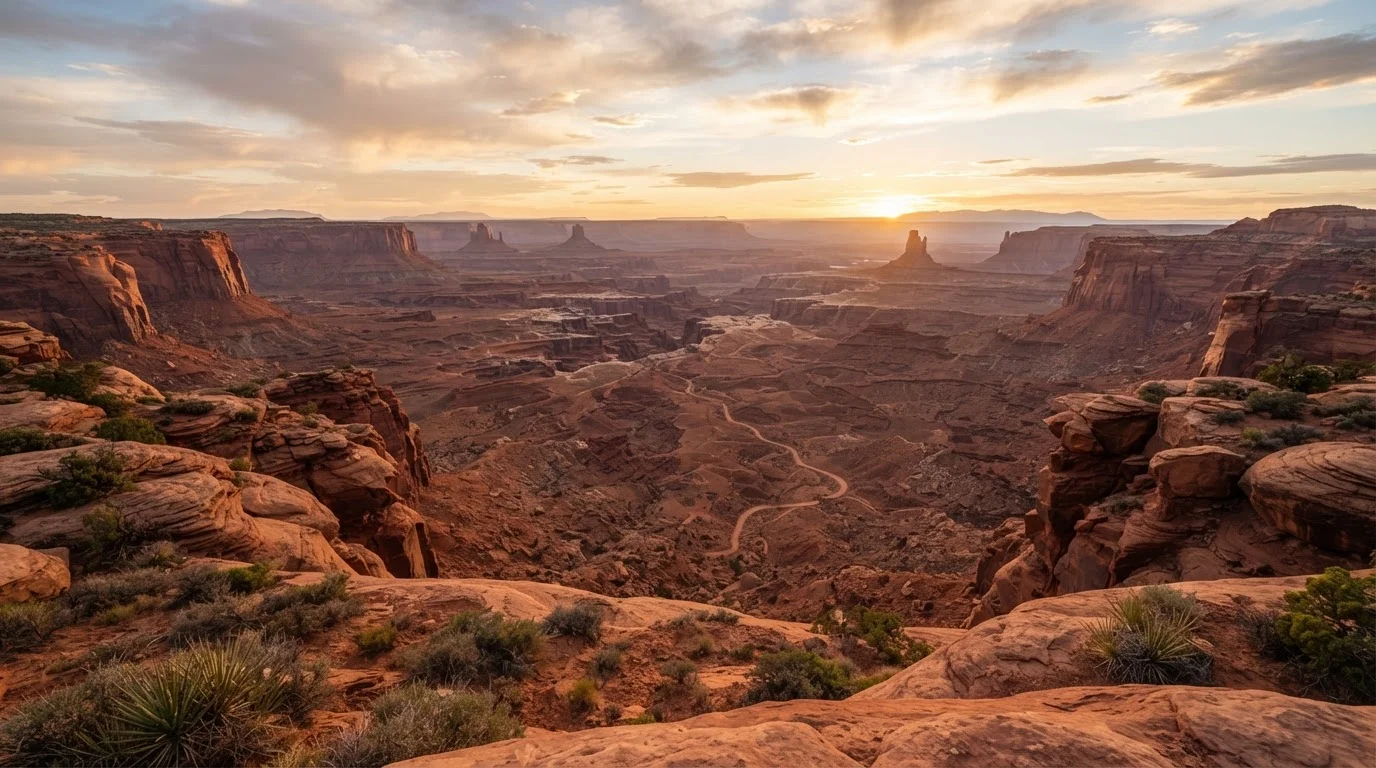
Canyonlands sits roughly 30 miles from Arches National Park in southeastern Utah, yet it draws a fraction of the visitors. The park divides into four distinct districts - Island in the Sky, the Needles, the Maze, and the rivers themselves - each with a completely different character. Island in the Sky offers panoramic mesa-top views over eroded canyons that stretch well over 1,000 feet deep. The Needles district rewards hikers willing to spend two or more days threading through red-and-white banded spires. The Maze is one of the most remote, technically demanding areas in the lower 48 and is not appropriate for casual day visitors.
Permit requirements vary by district and activity. Check the National Park Service website for current reservation windows before building your dates around this stop.
Canyonlands' four districts offer landscapes ranging from easy mesa-top drives to genuinely remote wilderness - few national parks span that range.
Chaco Culture National Historical Park, New Mexico
Chaco is one of the most significant archaeological sites in North America. Between roughly 850 and 1150 CE, it served as a major center of Ancestral Puebloan culture, and the scale of its great houses - Pueblo Bonito contains over 650 rooms - remains impressive even in ruin. The site sits in a remote canyon in northwestern New Mexico, reached by miles of unpaved road that requires a high-clearance vehicle and is impassable when wet.
That remoteness is also what makes Chaco exceptional for stargazing. The park holds International Dark Sky Park designation, and ranger-led astronomy programs are offered on selected evenings. Visitors should plan for no cell service, limited water, and basic facilities only. Permits are required for overnight stays in the campground.
Chaco's combination of monumental archaeology and designated dark skies makes it unlike almost any other site in the country.
Chiricahua National Monument, Arizona
In the far southeastern corner of Arizona, the Chiricahua Mountains rise abruptly from the desert floor, hiding a landscape of towering volcanic rock columns, balanced boulders, and cool forested canyons that feel nothing like the surrounding Sonoran Desert. The monument's trail system is genuinely well-designed - the Echo Canyon Loop gives most reasonably fit hikers access to the most dramatic formations in a half-day outing.
Chiricahua sits along a recognized birding corridor, and the species diversity here draws serious birders from across the country. The area also has layered historical significance connected to the Apache Wars of the late nineteenth century, which interpretive materials on-site address in documented detail. The nearest substantial services are in the town of Willcox, roughly 35 miles away.
The volcanic rock columns of Chiricahua are geologically distinct from anything else in the Arizona desert - and the birding is exceptional.
Great Basin National Park, Nevada
Most travelers associate Nevada with Las Vegas, but the state's only national park sits in the Basin and Range province near the Utah border - and it receives fewer than 150,000 visitors annually, making it one of the least-visited parks in the lower 48. Great Basin contains Lehman Caves, a remarkably intact limestone cavern system with guided tours available year-round. Above ground, Wheeler Peak rises to nearly 13,000 feet and supports one of the world's few remaining groves of ancient bristlecone pines, some of which are over 4,000 years old.
The park's high elevation means temperatures are dramatically cooler than the surrounding desert basin, and snow is possible in any month at the summit. The campgrounds fill on holiday weekends but are typically accessible without advance reservations at other times - verify current conditions with the park before arrival.
Great Basin shelters 4,000-year-old bristlecone pines and a pristine cave system - all with visitor numbers that make the experience feel genuinely uncrowded.
Vermilion Cliffs National Monument, Arizona/Utah
The Vermilion Cliffs stretch along the Arizona-Utah border and include some of the most visually dramatic geology on the Colorado Plateau. The monument contains The Wave - a sandstone formation with intense, undulating color bands that has become one of the most sought-after photography locations in the Southwest. Access to The Wave requires a permit obtained through a lottery managed by the Bureau of Land Management, and competition for permits is high year-round.
The broader monument contains far more than a single formation. Coyote Buttes South, Paria Canyon, and the Buckskin Gulch slot canyon system are all within the monument boundary and require their own separate permits. Buckskin Gulch is the longest slot canyon in the American Southwest and is accessible to hikers comfortable with technical terrain. Flash flood risk is serious and real - check weather upstream, not just at your location.
Vermilion Cliffs contains multiple slot canyon systems and permit-access formations that collectively define Southwest canyon country at its most intense.
Planning Honestly for the Desert
Every destination in the list above shares one reality: the desert is unforgiving to underprepared travelers. Water access is genuinely limited at many sites, cell service disappears for long stretches, and summer temperatures across the Colorado Plateau and Sonoran Desert routinely exceed 100°F. Even experienced hikers misjudge desert conditions - always carry more water than you think you need, tell someone your itinerary, and check road conditions with the relevant land management agency before departure.
Check Permit Requirements Well in Advance
Several of the destinations in this list - including Coyote Buttes North (The Wave), Canyonlands' Maze district, and Chaco overnight camping - require advance permits that book out weeks or months ahead. The National Park Service and Bureau of Land Management each manage separate reservation systems, so check each site's official page as soon as your travel window is confirmed. Don't assume walk-up availability for popular sites during peak season.
If you're weighing a base city for a multi-day exploration, it's worth thinking through what each desert hub actually offers on a practical level. Our comparison of Las Vegas, Tucson, and Santa Fe as week-long bases covers climate, services, and what each city does well for visiting travelers. For a contrast in regional character, the US Gulf Coast offers a dramatically different American landscape - equally underestimated, entirely different logistical demands.
The Southwest beyond the Grand Canyon isn't a consolation prize. It's a region that rewards travelers who arrive curious, prepared, and willing to slow down.