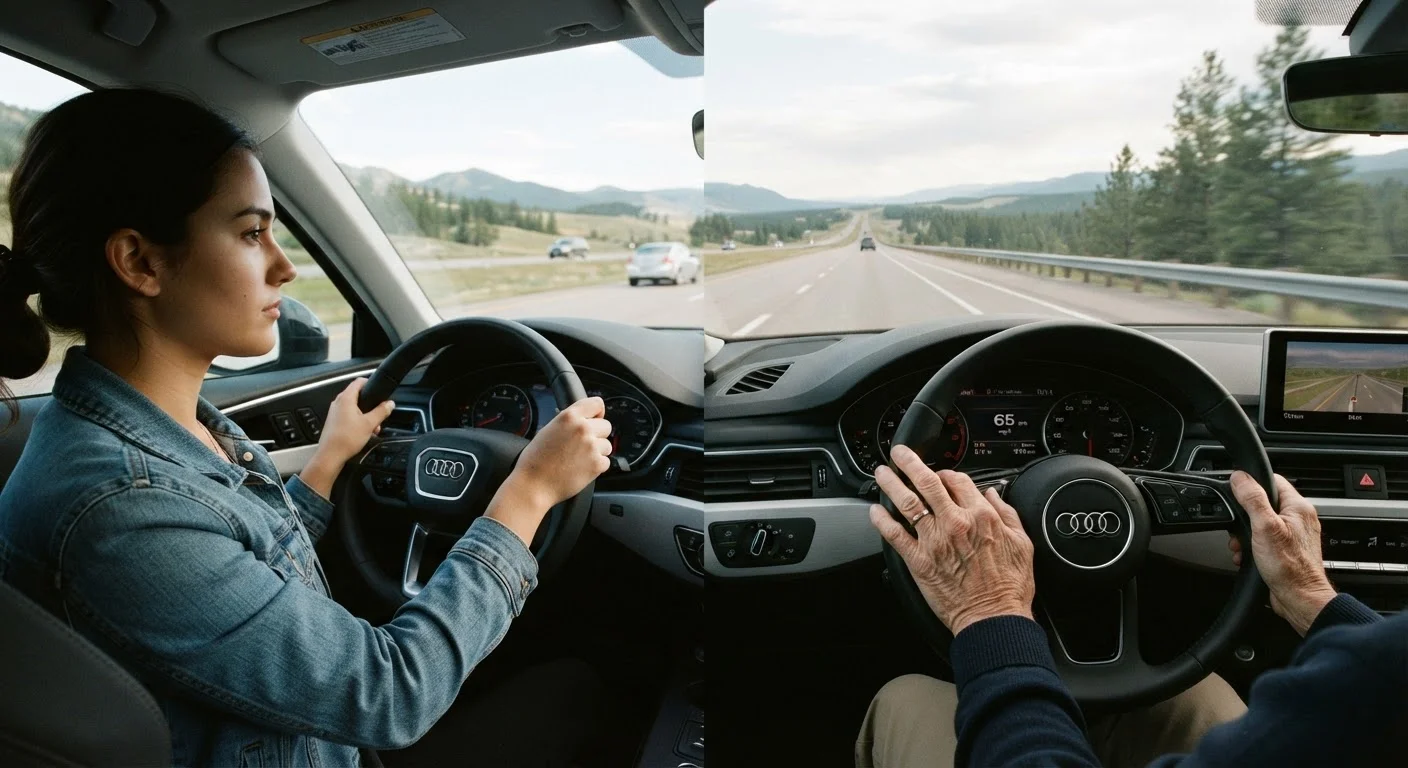
Why Age Changes Driving Risk
Driving risk isn't fixed. It rises, falls, and shifts character across a lifetime - shaped by brain development, accumulated experience, physical aging, lifestyle, and the types of situations each age group regularly faces on the road. Understanding how and why risk changes is more useful than any single safety tip, because it lets drivers and their families make smarter, stage-appropriate decisions.
The patterns aren't random. Research from the National Highway Traffic Safety Administration (NHTSA) consistently shows distinct crash profiles at different age bands. Teen drivers are overrepresented in crashes relative to miles driven. Fatal crash rates dip through middle age, then begin rising again past 70. But the causes at each end are almost entirely different - which means the countermeasures have to be different too.
~4x
Higher crash risk for 16-year-olds vs. adults
NHTSA data consistently shows teen drivers are involved in crashes at rates far exceeding more experienced age groups per mile driven.
21-34
Peak age range for alcohol-impaired fatal crashes
According to NHTSA, drivers in this bracket account for a disproportionate share of alcohol-related traffic fatalities.
75+
Age at which fatal crash rates begin rising again
Older adults show increasing crash rates per mile, largely linked to physical vulnerability rather than elevated exposure or risk-taking.
Teen Drivers: High Risk, Specific Reasons
Teenagers are not simply inexperienced adults. Adolescent brain development - particularly in the prefrontal cortex, which governs impulse control and hazard assessment - continues into the mid-twenties. That neurological reality compounds the learning curve every new driver faces.
The crash risk for 16-year-olds is significantly higher per mile than for any other age group. Three factors dominate: inexperience (difficulty reading complex traffic situations), peer pressure, and distraction. Research shows that carrying passengers measurably increases crash risk for teen drivers - a dynamic explained further in how passengers change risk behind the wheel.
Graduated Driver Licensing (GDL) laws exist specifically because exposure under controlled conditions builds the pattern recognition that experience provides. Key early skills like scanning well ahead of the vehicle are habits that separate beginners from competent drivers - see how experienced drivers train their eyes.
For new teen drivers, prioritize varied-condition practice over total hours. Supervised driving in rain, at night, and on unfamiliar roads builds the pattern recognition that purely good-weather hours don't.
Crash data shows teen incidents spike in conditions - darkness, wet roads, highway merges - that require experience the standard 50-hour logbook rarely covers systematically.
If you're reviewing your own driving fitness as you age, start with an eye exam and a frank conversation with your doctor about any medications you're taking. These two steps catch the most common physical contributors to late-life driving risk.
Vision and medication effects are among the most addressable factors in older driver safety - and among the most frequently overlooked until after an incident occurs.
Young Adults: Overconfidence and Lifestyle Pressures
Drivers in their 20s often perceive themselves as skilled - and compared to new teens, they are. But this age group carries its own distinct risks. Overconfidence can suppress caution in genuinely dangerous scenarios, and lifestyle factors introduce impairment risks that are less common in teenagers.
Alcohol-impaired driving peaks in the 21-34 age bracket according to NHTSA data. Fatigued driving is also highly prevalent: irregular sleep schedules, shift work, and social late nights create a population of drivers who underestimate how impaired they actually are. Recognizing drowsy driving warning signs in yourself is a skill that pays dividends throughout this phase of life.
Speeding is another statistical marker for this group. The ability to control a vehicle at speed and the judgment to choose appropriate speed in variable conditions are not the same thing - and young adults tend to be more confident in the former than they should be in the latter.
Middle-Age Drivers: The Quiet Risk Window
Statistically, drivers in their 30s through early 60s have the lowest crash rates per mile traveled. Experience is high, risk-taking tendencies have generally moderated, and physical capabilities remain largely intact. This can easily read as a reason to stop paying attention - which is exactly where complacency becomes the primary hazard.
Two risks deserve specific attention in this group. First, prescription medication use rises sharply through middle age. Many common medications - antihistamines, sleep aids, anxiety medications, certain blood pressure drugs - carry warnings about drowsiness or impaired reaction time that drivers may overlook. Always review medication inserts for driving-related warnings and discuss concerns with a pharmacist or physician.
Second, driving routines can become so automatic that attentiveness drifts. Familiar routes in particular generate a kind of highway hypnosis where drivers arrive at destinations with limited memory of the journey. High-familiarity routes are where distraction and complacency produce incidents that feel shocking in hindsight.
Older Drivers: Physical Changes That Affect Safety
Physical aging affects driving in well-documented ways. Vision changes - reduced contrast sensitivity, slower adaptation between light and dark, and narrowing peripheral field - are among the most significant. Night driving becomes meaningfully harder, and conditions like wet roads compound the challenge. For practical guidance on that specific situation, night driving habits that reduce risk and driving in heavy rain are worth reviewing.
Reaction time also increases with age, though the degree varies widely between individuals. Neck and shoulder flexibility affects the ability to check blind spots effectively. Certain medications - more common among older adults - can further slow response time or affect alertness.
The important distinction is that older drivers tend to self-regulate well: many voluntarily avoid highways, night driving, or poor weather once they recognize limits. This self-awareness is protective. The danger point is when physical decline outpaces honest self-assessment, making periodic evaluation - by a physician, occupational therapist, or through a formal driving assessment - a reasonable precaution rather than a threat.
When to Seek a Formal Driving Assessment
If family members or friends have raised concerns about an older driver's safety, or if the driver themselves notices increasing close calls, a formal driving evaluation by a certified driver rehabilitation specialist is a practical and constructive step. These professionals assess functional ability - not just license status - and can recommend vehicle adaptations or training that extend safe driving. A physician referral is often the clearest starting point.
Strategies That Apply at Every Age
Some risk-reduction principles hold across every life stage. Eliminate distraction actively - not just passively. Putting a phone out of reach before starting the engine is more reliable than willpower in the moment. Build in margins: follow distance, speed cushion, and time buffer all create space to recover from the unexpected. Match conditions to capability: if visibility is poor, weather is severe, or fatigue is present, adjusting plans is a decision, not a failure.
Driver education and refresher courses are underutilized at every age past 16. For older drivers especially, programs designed for mature drivers can both improve skills and potentially qualify participants for insurance discounts - worth checking with your provider directly.
Finally, honest conversation within families about driving changes - whether a teenager's first months behind the wheel or a parent's gradual decline - matters more than most people give it credit for. The goal at every stage isn't to remove keys; it's to match exposure to realistic capability while building the habits that reduce preventable harm.