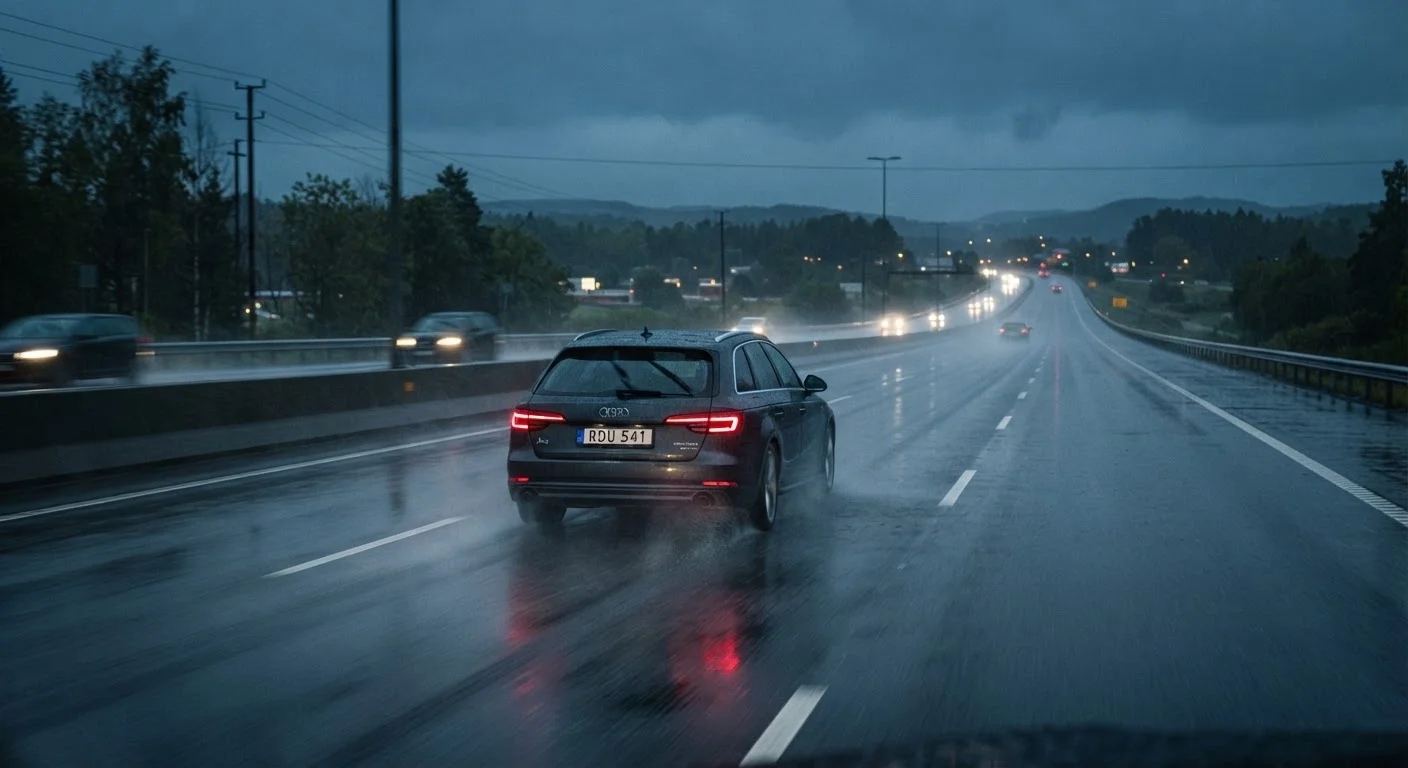
Why Rain Demands More Than Just Slowing Down
Most drivers know to ease off the gas when it rains. Fewer understand why, or how dramatically the physics of driving shift the moment the road gets wet. Water doesn't just make the surface slippery - it disrupts the friction your tires depend on for every function: accelerating, turning, and stopping. Once that grip is reduced, your margin for error shrinks fast.
Rain also compounds visibility problems that go beyond rain streaks on glass. Spray from other vehicles, reduced contrast at lane markings, and glare from wet surfaces all demand more visual attention. See our guide to scanning the road ahead for techniques that give you more reaction time in exactly these conditions.
The good news: most of what changes in rain is predictable and manageable with the right habits. What stays the same is just as important - the fundamentals of smooth, deliberate vehicle control don't change, they just demand more precision.
What you will need
What Actually Changes When Roads Are Wet
Stopping Distance
On a dry road, a vehicle traveling at 60 mph typically needs around 180 feet to stop in an emergency. On wet pavement, that figure can climb significantly - by some estimates, braking distance increases by 50 to 100 percent depending on tire condition, vehicle weight, and road surface. Increasing your following distance to at least four seconds (up from the dry-road standard of two to three seconds) gives your brakes room to work.
Hydroplaning Risk
Hydroplaning happens when a tire encounters more water than it can channel away, causing it to ride on a film of water rather than the road itself. Steering and braking become almost ineffective in that moment. It can happen at speeds as low as 35 mph, particularly in standing water or on roads with poor drainage. Tires with worn tread are far more vulnerable because the grooves that channel water away are shallower. Your car maintenance routine should include regular tread-depth checks - a quarter inserted headfirst into the tread groove, with Lincoln's head disappearing, is the commonly cited minimum threshold.
Visibility - for You and Other Drivers
Turn your headlights on, even in daytime rain. Many states legally require headlights whenever windshield wipers are in use, and the practical reason is clear: headlights make your vehicle visible to others, not just help you see. High beams actually reduce visibility in rain by reflecting glare off water droplets - use low beams.
Cruise Control Behavior
Turn it off. Cruise control works against you in wet conditions because it tries to maintain a fixed speed even when you hit a puddle, which can accelerate a wheel that's lost traction. Manual throttle control lets you respond naturally to what the road is doing beneath you.
What Stays the Same: Core Driving Principles
Rain changes conditions, not the fundamentals. Smooth inputs - gradual acceleration, gentle braking, deliberate steering - matter on dry roads and matter even more when traction is reduced. Abrupt steering or hard braking on a wet surface is where drivers lose control.
Space management remains the same principle, just scaled up. The goal in any conditions is always to give yourself enough room to react. In rain, that room needs to be larger. This is the same logic that applies to night driving: low-visibility conditions require more buffer, not different rules.
Your Tires Are Your First Line of Defense
No driving technique fully compensates for worn or underinflated tires in wet conditions. Tire grooves exist specifically to channel water away from the contact patch - when they're worn down, that function is compromised. Check your tires regularly as part of your overall vehicle upkeep, and consult a qualified mechanic if you're unsure about their condition.
Vehicle inspection matters year-round, but the stakes are more visible in wet weather. Bald or underinflated tires, worn wiper blades, and foggy rear windows are all hazards that heavy rain exposes immediately. A habit of checking these before you leave is worth building - the pre-drive safety walkthrough covers exactly this kind of preparation.
Step-by-Step: Adjusting Your Driving for Heavy Rain
Check your vehicle before you leave
Run through the basics: wiper blade condition, tire pressure and tread depth, and that all exterior lights are working. In heavy rain, worn wipers smear more than they clear, and underinflated tires lose water-channeling efficiency faster. If tread is visibly low, the risk of hydroplaning rises sharply.
Turn on headlights and set to low beam
Switch on your headlights as soon as rain begins - not just at dusk. Low beams improve your visibility to other drivers without creating glare. Check that taillights are on as well; rear visibility is often overlooked and critically important in heavy spray conditions.
Reduce speed and increase following distance
Drop your speed to match road conditions - this may mean driving well under the posted limit. Increase your following distance to a minimum of four seconds. To measure this: watch a fixed point (an overpass, a sign) and count seconds from when the car ahead passes it to when you do. In heavy rain, consider adding a second or two more.
Turn off cruise control
Disengage cruise control before entering rain or as soon as precipitation becomes significant. On a wet road, cruise control can apply throttle at exactly the wrong moment - such as when a wheel loses contact during a hydroplane event - making recovery harder.
Steer and brake with deliberate smoothness
Avoid sharp turns or sudden braking. On wet surfaces, abrupt inputs can break traction before your vehicle has time to compensate. Ease into braking earlier than you normally would, and make steering adjustments gradually. If your vehicle has anti-lock brakes (ABS), apply steady, firm pressure rather than pumping the pedal - the system manages brake modulation automatically.
Avoid flooded roads and deep puddles
Never attempt to cross flooded roadways. Moving water as shallow as six inches can knock a person off their feet, and just twelve inches can float many passenger vehicles. The depth of standing water is almost impossible to judge from inside a car. If a road ahead is flooded, turn around and find an alternate route.