The Three Core Jobs of Your Suspension
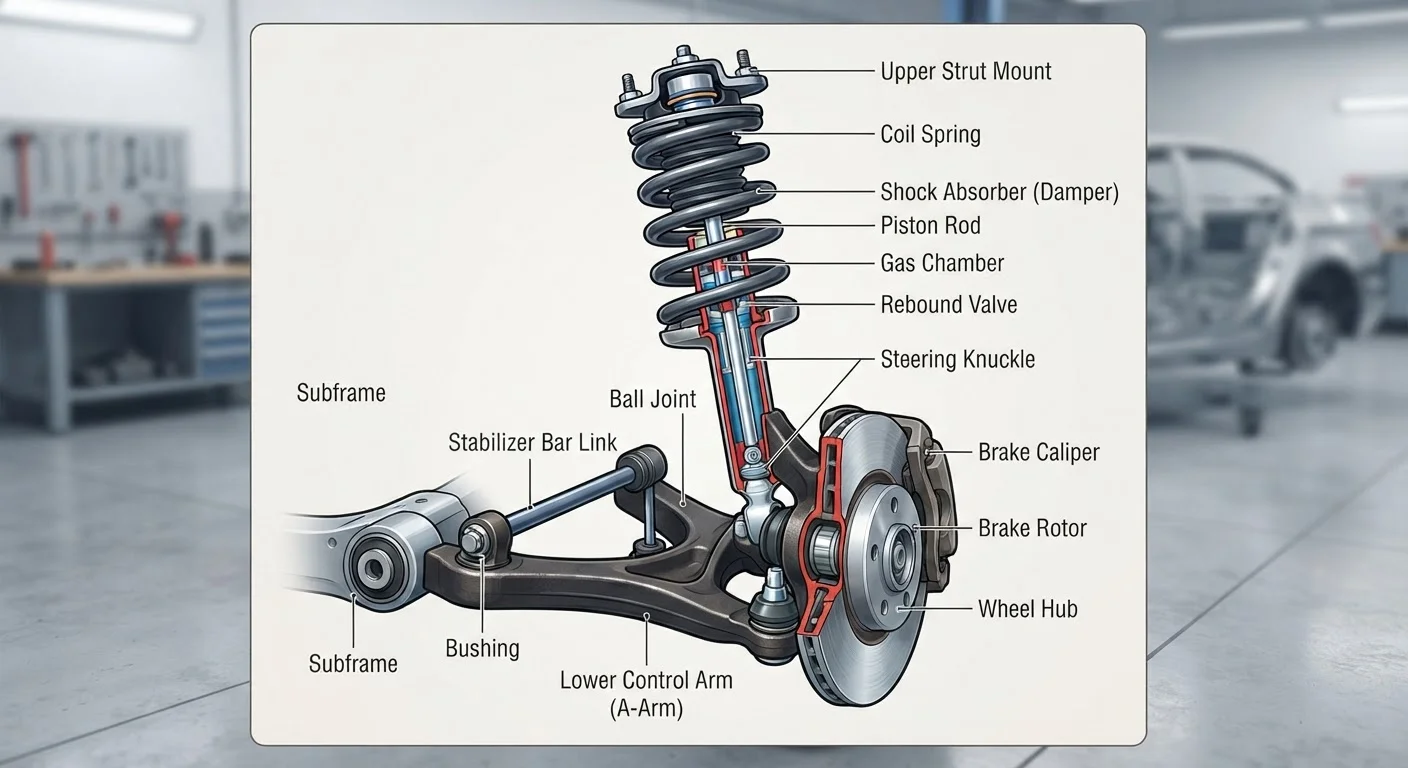
Your suspension has to do three things simultaneously: absorb road impacts, keep the tires in firm contact with the pavement, and prevent those impacts from being transmitted directly into the cabin. Every component in the system exists to serve one or more of these goals.
When a wheel rolls over a pothole, the energy from that impact has to go somewhere. The suspension's job is to absorb and manage it - rather than letting it travel straight through the chassis to your spine. How well the system handles that energy determines both ride comfort and vehicle control.
Good suspension design also keeps the tire's contact patch - the small footprint actually touching the road - as flat and stable as possible. This matters especially during cornering and braking, where traction depends entirely on that contact. Wet roads make this even more critical, since reduced friction leaves little margin for poor tire contact.
Springs, Shocks, and How They Work Together
Springs are the primary energy absorbers. When a wheel hits a bump, the spring compresses to absorb the impact, then expands again as the wheel drops back down. Coil springs (the most common type) are compact and effective. Leaf springs - flat, layered strips of steel - are still used on many trucks and SUVs for their load-carrying capacity.
Springs alone, however, would leave you bouncing long after the bump. That's where shock absorbers (or dampers) come in. A shock absorber controls how quickly the spring compresses and returns. Inside, hydraulic fluid passes through small valves, converting that movement into heat and dissipating the energy. The result is a single, controlled motion rather than repeated oscillation.
~50,000 mi
Typical shock absorber service interval
Industry guidance from automotive engineers generally places functional shock absorber life in the 40,000-60,000 mile range, though road conditions vary this significantly.
Up to 20%
Potential increase in stopping distance with worn shocks
Research conducted by automotive safety organizations has indicated that heavily worn shock absorbers can extend braking distances by a meaningful margin compared to new units.
4 points
Tire contact patches keeping the car on the road
Each tire's contact patch is roughly the size of a hand - the suspension's entire job is to keep all four of those small areas pressed firmly against the pavement.
A strut integrates the shock absorber into a structural housing that also carries part of the vehicle's weight, making it a load-bearing component - not just a damper. Many front suspensions on passenger cars use struts because they're compact and effective.
Control Arms, Ball Joints, and Suspension Geometry
Springs and shocks handle the vertical motion, but the wheels also need to be precisely guided through their up-and-down travel. That's the role of control arms - rigid metal links that connect the wheel hub to the vehicle's subframe. They define the arc through which the wheel moves.
At the outer end of each control arm is a ball joint, a pivot point that allows the wheel to turn for steering while still moving up and down with the suspension. Ball joints wear over time; a worn ball joint introduces play into the steering and can become a safety risk if it fails completely.
Check Tire Wear as a Suspension Clue
Uneven tire wear is one of the earliest visible signs of a suspension or alignment issue. Run your hand across the tread - if one edge is wearing faster than the other, or you feel cupping (scalloped dips across the tread), have your suspension and alignment inspected. Catching these issues early prevents more expensive repairs later.
Suspension geometry - terms like camber (wheel tilt from vertical), caster (steering axis angle), and toe (wheel direction relative to center) - describes how these components are positioned. When alignment is correct, tires wear evenly and the car tracks straight. A hard impact with a curb or pothole can shift these angles, which is why alignment should be checked after significant road impacts. This also connects to how drivetrain layout influences handling - suspension geometry must be tuned to work with the power delivery system.
Independent vs. Solid Axle Suspension
Suspension systems fall into two broad categories. With an independent suspension, each wheel moves on its own - a bump on the left side doesn't directly affect the right. This allows each tire to maintain better road contact over uneven surfaces and generally produces smoother, more controlled handling. Most modern passenger cars use independent suspension at all four corners.
A solid axle (also called a live axle or beam axle) connects both wheels on an axle with a rigid bar. When one wheel hits a bump, the axle tilts and the opposite wheel is affected. Solid axles are simpler, stronger, and more capable of handling heavy loads, which is why many trucks and off-road vehicles still use them at the rear.
Understanding which setup your vehicle uses helps explain how it behaves. A truck with a solid rear axle may feel less composed on winding roads than a sedan with fully independent suspension - that's by design, not a defect. The same geometry that limits on-road agility gives it the durability to haul heavy loads over rough terrain.
When Suspension Problems Affect Safety
Suspension wear is gradual, which makes it easy to overlook until the problem is significant. A key warning: worn shock absorbers have been shown in studies to meaningfully increase braking distances, because the tire loses consistent road contact under hard stops. On roads affected by winter conditions, the consequences can be severe.
Watch for these indicators that your suspension may need professional evaluation:
- Excessive bouncing or wallowing after bumps
- The nose of the car dipping sharply under braking
- Uneven or rapid tire wear on one side
- Pulling or drifting while driving straight
- Clunking or knocking sounds over bumps
A qualified mechanic can perform a visual inspection and a bounce test to assess damper condition. Suspension repair is not typically a DIY job - components are under significant mechanical stress, and incorrect installation can create serious safety hazards. Have any suspected issues evaluated by a professional before dismissing them.