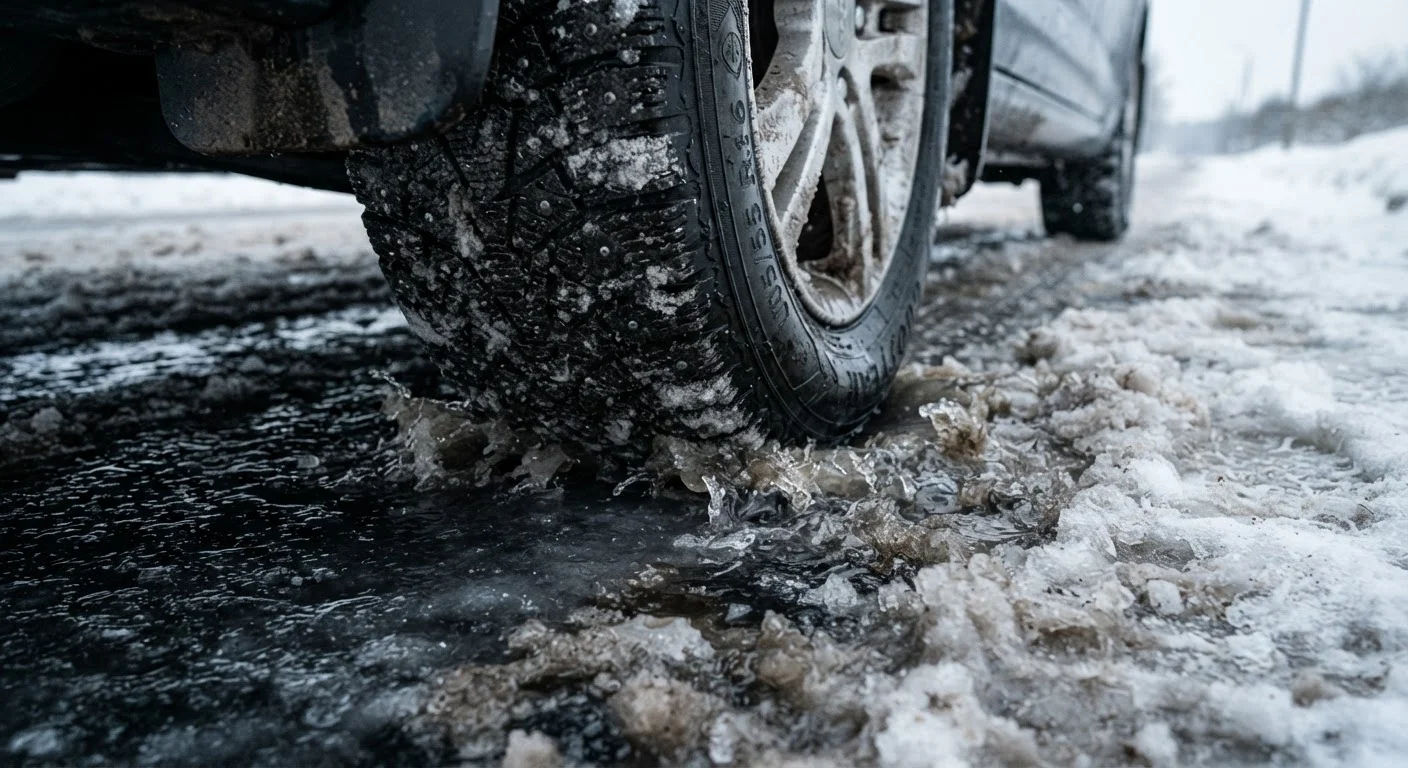
Why Winter Road Surfaces Aren't All the Same
Most drivers treat winter roads as a single hazard - cold and slippery. In reality, black ice, slush, and packed snow are three distinct surfaces that behave very differently under your tires. Each one changes how your car accelerates, steers, and stops. Knowing what to expect before you encounter each condition can make the difference between a controlled response and a skid.
Your tires' ability to grip the road depends on friction. Winter surfaces reduce that friction in different ways and to different degrees. Tread depth and tire pressure matter on every winter surface - see our guide to tread depth and tire pressure for a full breakdown of what those numbers actually mean.
Black Ice: The Most Dangerous Surface
Black ice forms when a thin layer of water freezes directly on the pavement, creating a nearly transparent glaze. It looks like a wet road - sometimes it's invisible entirely. That deception is what makes it so dangerous.
What happens under your tires: Black ice has a friction coefficient close to zero. Your tires have almost nothing to grip. Braking distances can increase by ten times or more compared to dry pavement, and steering inputs may produce little to no directional change. Anti-lock brakes (ABS) will still pulse and try to maintain control, but physics limits what any system can do.
Where it forms: Bridges and overpasses (air cools them from below), shaded stretches of road, and low-lying areas where cold air pools. Morning and late-night driving carry the highest risk.
How to respond: If you feel the car floating or your steering go light, resist braking hard. Ease off the accelerator, keep the wheel straight, and let the vehicle slow naturally. If your rear starts to slide, steer gently in the direction of the slide - opposite inputs will worsen a spin.
Your Electronics Help, But Have Limits
Traction control and stability control systems can reduce the severity of a black ice skid, but they cannot override the laws of physics. On near-zero-friction surfaces, these systems simply have too little grip to work with. The most effective tool is reduced speed before you reach an icy patch - not electronics after the fact.
Slush: Unpredictable and Uneven
Slush is a mix of partially melted snow and water. It's typically found during temperature transitions - when roads warm slightly above freezing or just after a plow passes. It looks manageable, but it creates its own set of problems.
What happens under your tires: Slush acts like a fluid layer between your tire and the pavement. At speed, your tires can hydroplane on slush the same way they do on standing water - this is sometimes called slush-planing. The effect is sudden and lateral forces become unpredictable. Deep slush also creates a drag that can pull the wheel toward the thickest accumulation, especially in tire ruts.
Steering and braking behavior: Slush reduces grip unevenly. One side of the vehicle may encounter more resistance than the other, causing the car to pull. Braking in slush is better than on black ice but significantly worse than on dry or even packed snow. Stopping distances typically double or more compared to dry pavement.
How to respond: Slow down before entering slush, not while in it. Sudden braking in slush can trigger a skid. Keep a firm, centered grip on the wheel - don't fight strong pull forces, just steer gently to compensate. For a broader look at how water-based surfaces affect vehicle control, our wet-road driving guide covers related habits.
Packed Snow: More Grip, but Still Treacherous
Packed snow forms when traffic compresses loose snow into a firm, white layer. It's the most common winter surface on well-traveled roads after a snowstorm. It feels more stable than the other two conditions - and in many ways it is - but it still dramatically reduces stopping distances and requires adjusted driving habits.
What happens under your tires: A good winter tire (or all-season tire with adequate tread) can bite into packed snow and create meaningful grip. Friction is far higher than on black ice. However, grip is still roughly half of what you'd have on dry pavement, and it degrades quickly if temperatures drop further and packed snow begins to re-freeze near black ice conditions.
Where drivers get overconfident: Four-wheel drive and all-wheel drive help you accelerate on packed snow, but they do not improve your ability to stop. Braking performance depends on your tires, not your drivetrain. Drivers in AWD and 4WD vehicles often travel faster than conditions allow, assuming they can stop just as fast - they cannot. Your vehicle's transmission type doesn't change your stopping physics on snow.
How to respond: Increase following distance to at least three to four times your normal gap. Brake early and gently. Watch for shaded patches where packed snow may have re-frozen into ice.
Key Principles Across All Three Surfaces
Regardless of which winter surface you're driving on, a few principles apply universally:
- Speed is your biggest variable. Every winter surface condition worsens dramatically at higher speeds. Slowing down multiplies your available response time and shortens stopping distances.
- Smooth inputs matter. Abrupt steering, braking, or acceleration upsets vehicle balance on any low-traction surface. Move the wheel and pedals gradually.
- Space creates options. Following distance isn't just about reaction time - it's about giving yourself room to steer around a problem if braking alone won't stop you in time.
- Your suspension affects stability. Worn shocks or struts reduce tire contact with the road surface, which matters even more in winter. Understanding how your suspension works helps you recognize when a vehicle may be less stable than it should be.
Winter driving confidence doesn't come from assuming your car can handle anything - it comes from knowing what each surface will actually do and adjusting before the situation demands it.