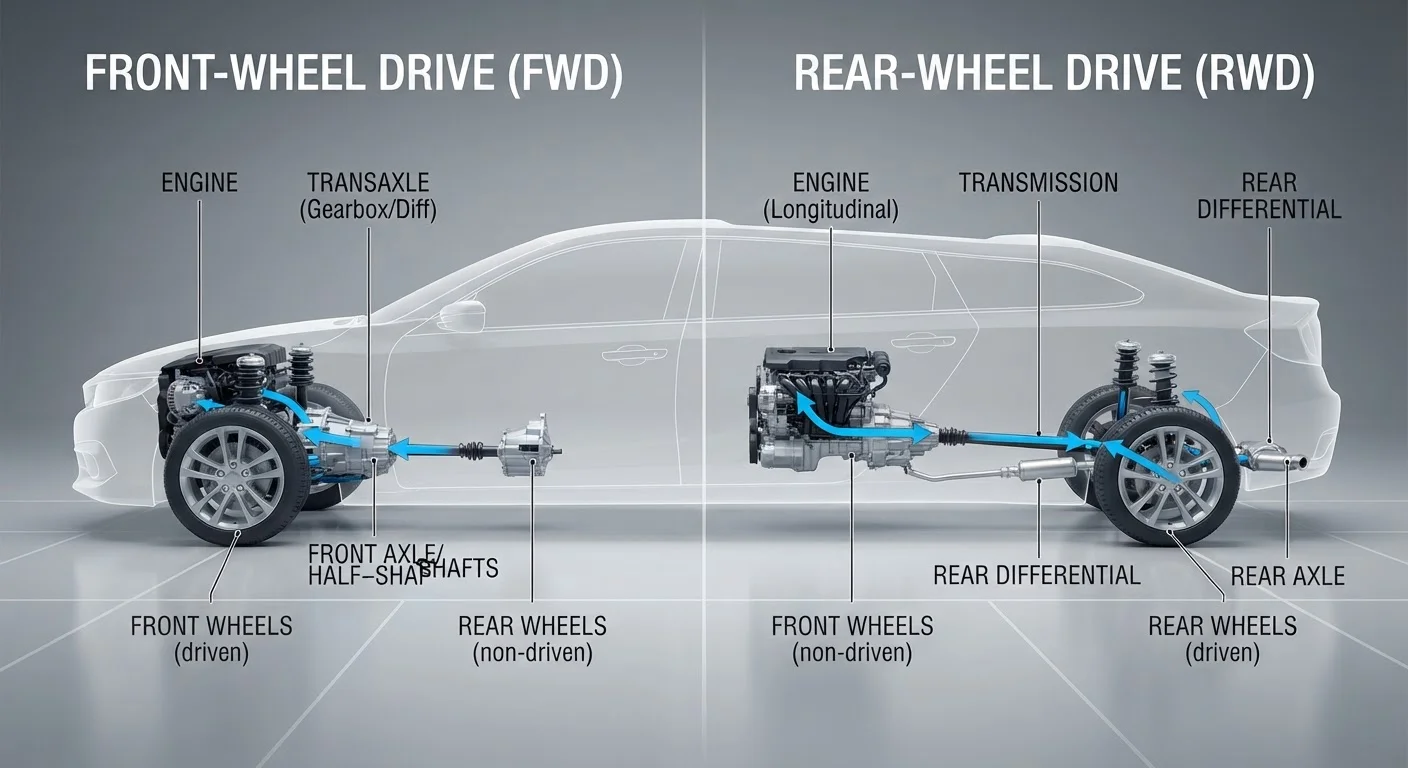
How Each System Moves Power to the Pavement
Every vehicle needs a way to transfer engine power to the wheels. Where that power goes - and how it gets there - defines whether a car is front-wheel drive or rear-wheel drive.
In a front-wheel drive (FWD) vehicle, the engine's power travels to the front wheels through a transaxle - a unit that combines the transmission and differential into a single compact package. Those same front wheels both propel the car and control its direction. This setup is mechanically efficient: fewer separate components, less weight, and no need for a long driveshaft running the length of the car.
In a rear-wheel drive (RWD) vehicle, power flows from the engine through a transmission, then down a driveshaft that runs beneath the cabin floor to a rear differential, which splits power between the two rear wheels. The front wheels focus entirely on steering. This separation of duties is the fundamental reason RWD vehicles often feel different to drive. For more on how transmissions fit into this picture, see how different transmission types affect driving feel.
| Criterion | Front-Wheel Drive (FWD) | Rear-Wheel Drive (RWD) |
|---|---|---|
| Power delivery | Engine power to front wheels | Engine power to rear wheels |
| Steering wheels | Front (also driven) | Front only (not driven) |
| Weight distribution | Front-heavy | More balanced, often near 50/50 |
| Handling tendency at limit | Understeer (predictable) | Oversteer (requires skill) |
| Snow/wet traction | Better for everyday winter use | Requires more care on slippery roads |
| Interior space | Flatter floor, more cabin room | Driveshaft tunnel reduces floor space |
| Mechanical complexity | Simpler, fewer components | More components (driveshaft, rear diff) |
| Towing capability | Limited - load reduces front traction | Better - load improves rear traction |
| Common vehicle types | Sedans, minivans, crossovers | Sports cars, trucks, luxury sedans |
How Drive Layout Affects Real-World Handling
The mechanical difference between FWD and RWD becomes most apparent when you're asking the car to do something demanding - accelerating hard, cornering quickly, or navigating slippery pavement.
Understeer vs. oversteer: FWD vehicles tend toward understeer - when pushed past the limit of grip, the front end washes wide rather than following the intended line. Most drivers find understeer predictable and easy to manage. RWD vehicles are more prone to oversteer - the rear steps out when grip is exceeded. This is controllable with experience, but requires more driver input in critical moments.
Weight distribution: Packing the engine, transmission, and driven wheels all at the front means FWD cars are often nose-heavy. RWD vehicles - especially those with the engine positioned further back - can achieve closer to a 50/50 front-to-rear weight split, which engineers consider ideal for balanced cornering. The vehicle's suspension geometry interacts closely with this weight distribution to shape ride and handling.
Traction in winter weather: FWD has a natural advantage on snow and ice - engine weight sits directly over the driven wheels, helping them grip. That said, any two-wheel-drive system has limits in serious winter conditions. For a deeper look at how your tires behave on different winter surfaces, see how black ice, slush, and packed snow each behave under tires.
Drive Layout Is Only Part of the Traction Story
Tire quality, tread depth, and tire type (all-season vs. winter) have a significant impact on how any vehicle handles in poor conditions - often more so than whether it's FWD or RWD. A well-equipped FWD vehicle on worn tires will underperform a RWD vehicle on quality winter tires. Don't overlook tires when evaluating how your car will behave in challenging weather.
Practical Trade-offs: Space, Cost, and Everyday Use
Beyond handling dynamics, drivetrain choice carries real consequences for interior packaging, ownership costs, and how the vehicle serves daily life.
Interior space: Without a driveshaft tunnel running down the center of the car, FWD vehicles offer a flatter floor and more usable cabin space. This is one reason that front-wheel drive became dominant in family sedans, minivans, and most crossovers - it simply delivers more room for passengers and cargo from a given vehicle footprint.
Mechanical simplicity and cost: FWD drivetrains have fewer separate components - no driveshaft, no rear differential. This generally means lower manufacturing cost (often reflected in vehicle pricing), reduced weight, and fewer parts that can need attention over time. RWD adds components, and rear differentials do require periodic fluid changes.
Towing and load carrying: When a RWD vehicle is loaded or pulling a trailer, weight shifts rearward - directly onto the driven wheels. This improves traction under load in a way FWD cannot match, which is one reason trucks and larger performance vehicles continue to use rear-wheel drive. Wet-road driving in any two-wheel-drive layout demands adjusted habits; how rain changes stopping distance and vehicle control is worth understanding regardless of which layout your vehicle uses.
If neither FWD nor RWD fully meets your needs, all-wheel drive adds another layer of capability - see how AWD and 4WD differ from each other and from two-wheel-drive layouts.
~65%
Share of U.S. passenger cars using FWD
Front-wheel drive became dominant in mainstream passenger vehicles during the 1980s and 1990s as automakers prioritized interior space and fuel efficiency.
50/50
Ideal front-to-rear weight balance for handling
Engineers widely regard an even weight distribution as the benchmark for balanced cornering - a target more achievable in RWD layouts with rear- or mid-engine placement.
~10%
Typical weight penalty of adding a RWD drivetrain
The additional driveshaft, rear differential, and related components in a RWD system generally add meaningful weight compared to an equivalent FWD setup, which can affect fuel economy.