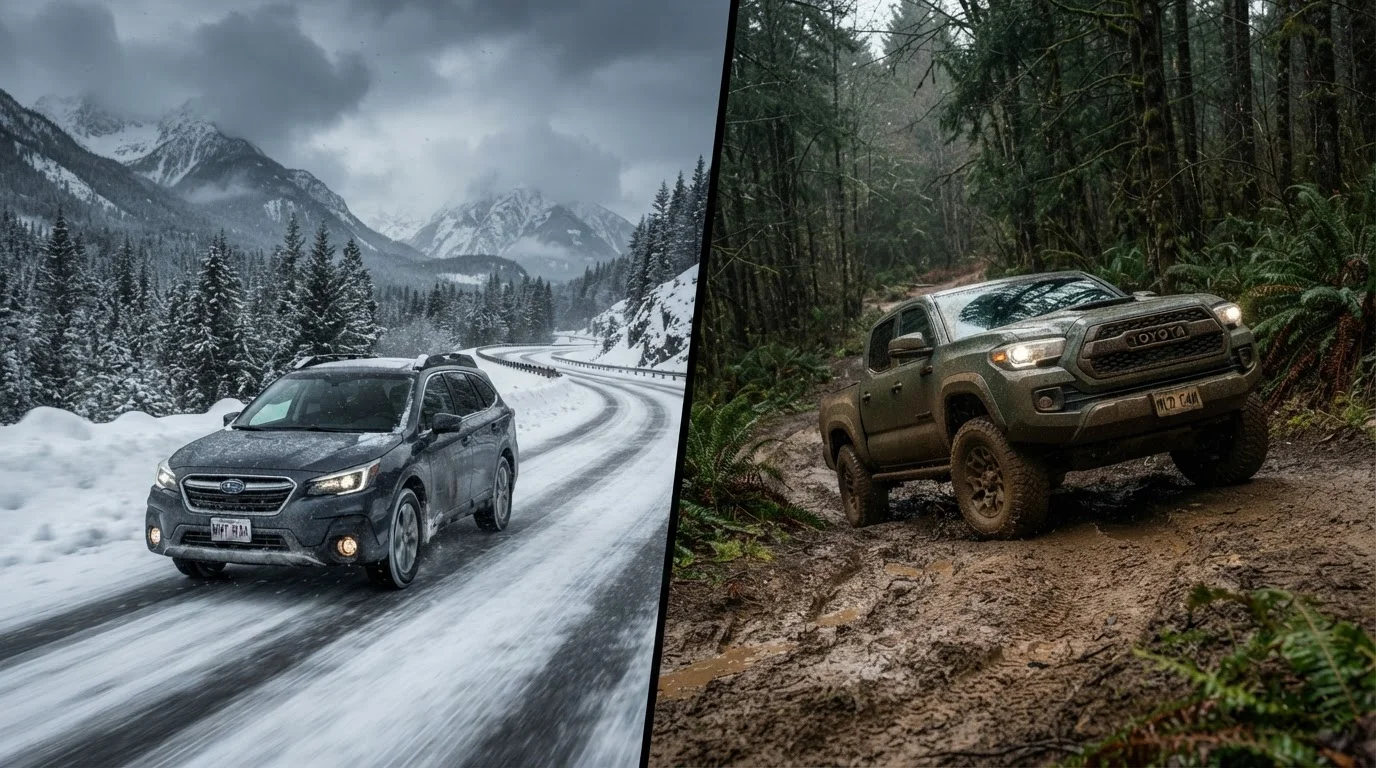
How Each System Actually Works
The confusion between AWD and 4WD is understandable - both send power to all four wheels. But how they do it, and under what conditions, is where they diverge significantly.
All-Wheel Drive uses a center differential (or an electronically controlled coupling) to continuously monitor wheel slip and distribute torque between the front and rear axles - and sometimes side to side - in real time. No driver input is needed. The system simply responds to conditions. Most AWD setups found in crossovers and cars operate in front-wheel-drive mode under normal conditions and only send power rearward when slip is detected, which improves fuel efficiency.
Four-Wheel Drive traditionally locks the front and rear axles together so they spin at the same speed. This is engaged manually - via a lever, button, or rotary dial - and typically offers multiple modes: 2H (two-wheel drive, rear), 4H (four-wheel high, for moderate terrain), and 4L (four-wheel low, for severe off-road conditions). The low-range setting multiplies torque dramatically, making 4WD uniquely capable on steep grades, deep mud, and rock crawling.
| Criterion | All-Wheel Drive (AWD) | Four-Wheel Drive (4WD) |
|---|---|---|
| Engagement | Automatic, always active | Driver-selected modes |
| Primary terrain | Paved roads, rain, light snow | Off-road, deep snow, mud, rock |
| Low-range gearing | Not available | Available (4L mode) |
| Typical vehicle types | Cars, crossovers, some SUVs | Trucks, body-on-frame SUVs |
| Fuel efficiency impact | Minimal with modern systems | Higher in active 4WD modes |
| Driver input required | None | Yes - mode selection matters |
| Braking improvement | None | None |
For drivers who want to understand how drivetrain layout connects to vehicle behavior, see our article on front-wheel drive vs. rear-wheel drive for the broader picture.
Where Each System Performs Best
AWD shines in the kind of conditions most American drivers encounter: a wet interstate, a slushy suburban street, or a gravel driveway. It provides meaningful traction improvement over two-wheel-drive systems on these surfaces without asking anything of the driver. Paired with good all-season or winter tires, AWD handles the majority of adverse weather situations effectively.
4WD is built for scenarios that go beyond pavement. Deep snow, unpaved forest roads, creek crossings, and loose rock are exactly the situations where 4WD's locked axles and low-range gearing provide an advantage that AWD cannot replicate. The low range (4L) reduces wheel speed while multiplying torque - useful for controlled crawling where momentum alone won't get you through.
AWD and 4WD Don't Improve Braking
A common misconception is that all-wheel drive or four-wheel drive shortens stopping distances. Neither system has any effect on braking - that's determined by tire compound, road surface, and ABS performance. Drivers with AWD or 4WD should maintain the same following distances and speed adjustments as any other vehicle in wet or icy conditions. Overconfidence in drivetrain capability is a real safety risk.
One important caveat: neither AWD nor 4WD improves braking. Both systems help a vehicle accelerate and maintain traction, but stopping distance on ice or snow depends primarily on tire quality and driver behavior. This is worth keeping in mind when conditions are severe - see how black ice and packed snow behave under your tires for a closer look at winter surface dynamics.
Tire choice also matters enormously regardless of which drivetrain you have. Our guide on seasonal tire swapping explains when dedicated winter tires make sense - even on an AWD vehicle.
Practical Trade-Offs to Consider
Neither system is universally better - each comes with trade-offs worth weighing before assuming one is right for your situation.
~50%
Share of new US vehicles sold with AWD or 4WD
Industry data has consistently shown that roughly half of new light vehicles sold in the United States include some form of all-wheel or four-wheel drive.
2-4 MPG
Typical fuel economy reduction with AWD vs. FWD
The U.S. Department of Energy notes that AWD and 4WD systems generally reduce fuel economy by roughly 1-2 MPG compared to equivalent two-wheel-drive models, varying by system design.
- Complexity and cost: 4WD systems - especially those with true low-range transfer cases - add mechanical complexity and weight. Maintenance costs can be higher over time compared to simpler AWD setups.
- Fuel economy: Traditional part-time 4WD used in 2H mode is efficient, but engaging 4H or 4L on dry pavement causes drivetrain binding and should be avoided. AWD systems are generally better suited to mixed-use driving without a fuel penalty.
- Vehicle type: AWD is standard or optional on most cars, crossovers, and luxury SUVs. 4WD is the norm on full-size trucks and body-on-frame SUVs. Your vehicle type often determines which system is available to you.
- Driver engagement: AWD is essentially invisible - it works without you thinking about it. 4WD requires some understanding of when and how to engage each mode correctly to avoid damage or unsafe handling.
Understanding how your drivetrain interacts with your transmission is also useful context. Our article on transmission types and how they affect driving covers how these systems work together.